Vincent Kompany’s Bayern München Tactical Analysis 25-26
In this article, the tactics of Bayern München under Vincent Kompany in 25-26 is going to be analysed. When this article is being written, they have already secured the league title, are the finalists in DFB Pokal and will play against Paris Saint-Germain in the semi-final of the UEFA Champions League (Just lost to PSG on aggregate tonight when I’m finalising the article…). Therefore, the main topic of this article will be what their successful season looks like from a tactical perspective.
Vincent Kompany is one of the most promising managers in the next generation who has worked with, or actually played under Pep Guardiola, alongside Mikel Arteta, Enzo Maresca or Xabi Alonso. Unlike his great teacher, however, the biggest strength of Bayern lies in the transitions. In both attacking and defensive transitions, they outplay the opponents by quick reaction, which doesn’t give them time to take a breath and makes themselves unstoppable.
Their extreme attacking approach can be explained by the fact that they have broken the Bundesliga record of the number of the goals scored by a single team in a season (101 goals), which was set by themselves in 1971-72 season. Kompany’s side has already scored 113 goals with three more games to play and it is technically more than the highest record in history held by Real Madrid who scored 121 goals in 38 games, which is equivalent to 108.3 goals in 34 games, which is the Bundesliga’s number of games.
Needless to mention these stats though, the German champions dominate the game in and out of possession by aggressive style of football, so let’s explore the tactics of Vincent Kompany’s Bayern München.
In Possession
In modern football, almost every team presses man-to-man and it is difficult to play out from the back safely. Even the first pass to a centre back will immediately trigger the opposition pressing.
Komapny’s answer is so simple.
Whenever the ball goes out of the pitch, they restart quickly before the opposition organises their shape to apply pressure. If they match up and are ready to press man-to-man, it becomes almost impossible to play out from the back. However, it usually takes some time to get back in shape to press, so Bayern restart the game quicker than that to avoid the opposition organised pressing.
Additionally, by quickly restarting the game, they often play to the wingers without any pressure and they can carry the ball all the way into the final third. Therefore, it is quite reasonable to emphasise quick restarts because they can skip the phase of build up. It sounds like the build up is nothing important, but it is actually true, because no matter how well you play out, eventually only goals matter.
However, not every time they can restart the game quickly, for example when the game is stopped by the referee. In this case, they try to manipulate the opposition man-to-man pressing with dynamic movements and exploit the space in behind.
Dropping Forwards
When playing out from the back under the opposition high pressing, it is important to have more options around the ball no matter if they press man-to-man or not. Securing multiple options around the ball will help the team keep playing short passes to build the game. To achieve this, Bayern’s forwards often drop deep to provide passing lanes and especially Harry Kane can play like a central midfielder.
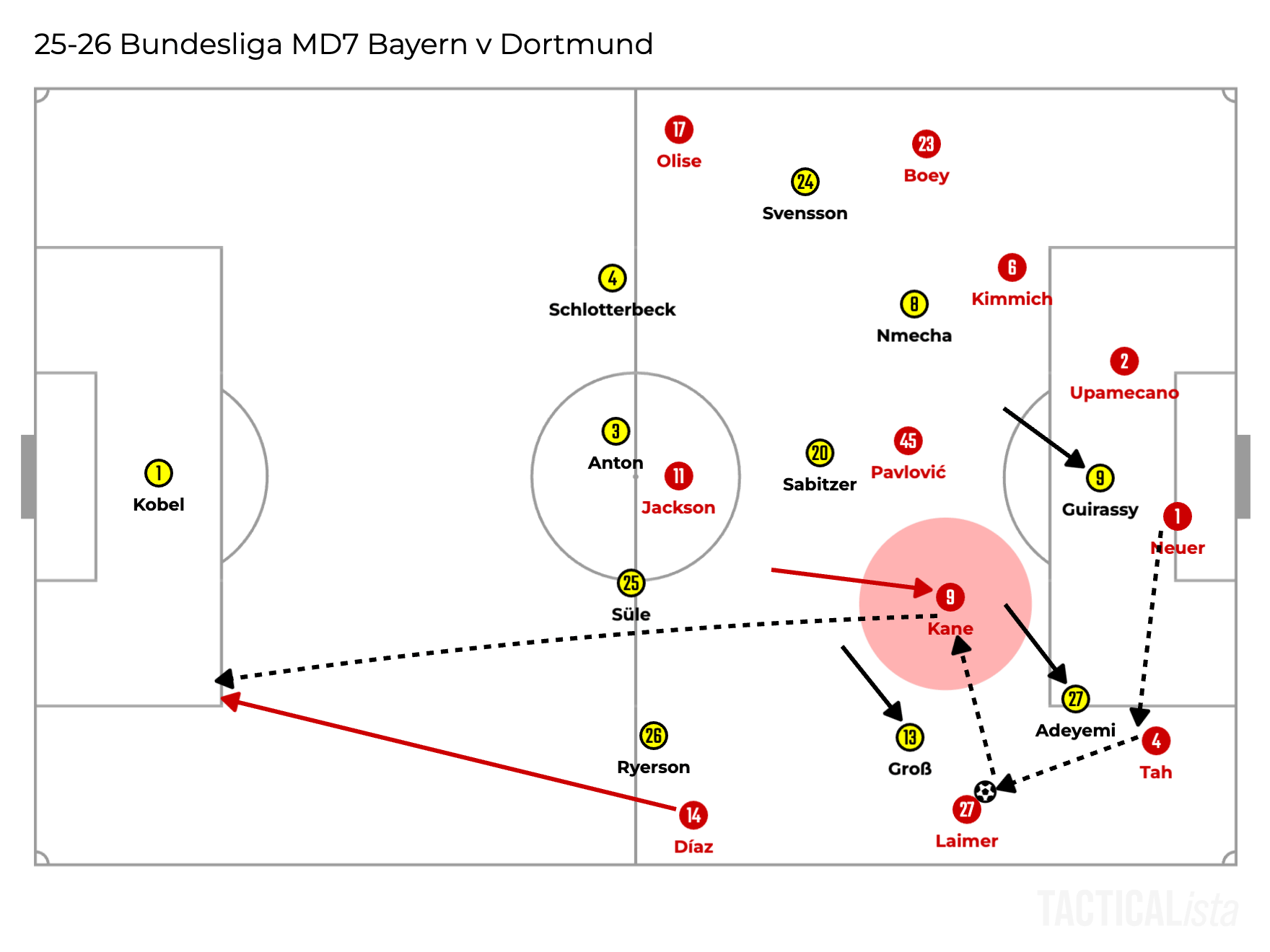
In the illustration above, Kane dropped deep to create an overload around the ball and received it from Konrad Laimer in between the opposition forward and midfield lines. In this scenario, one of the defensive midfielders was on the opposite side and the other was marked tightly. Therefore, without his support, they would’ve not kept playing short to securely beat the opposition pressing. Then, he played in behind the last line and this shows his ability to play and distribute like a midfielder.
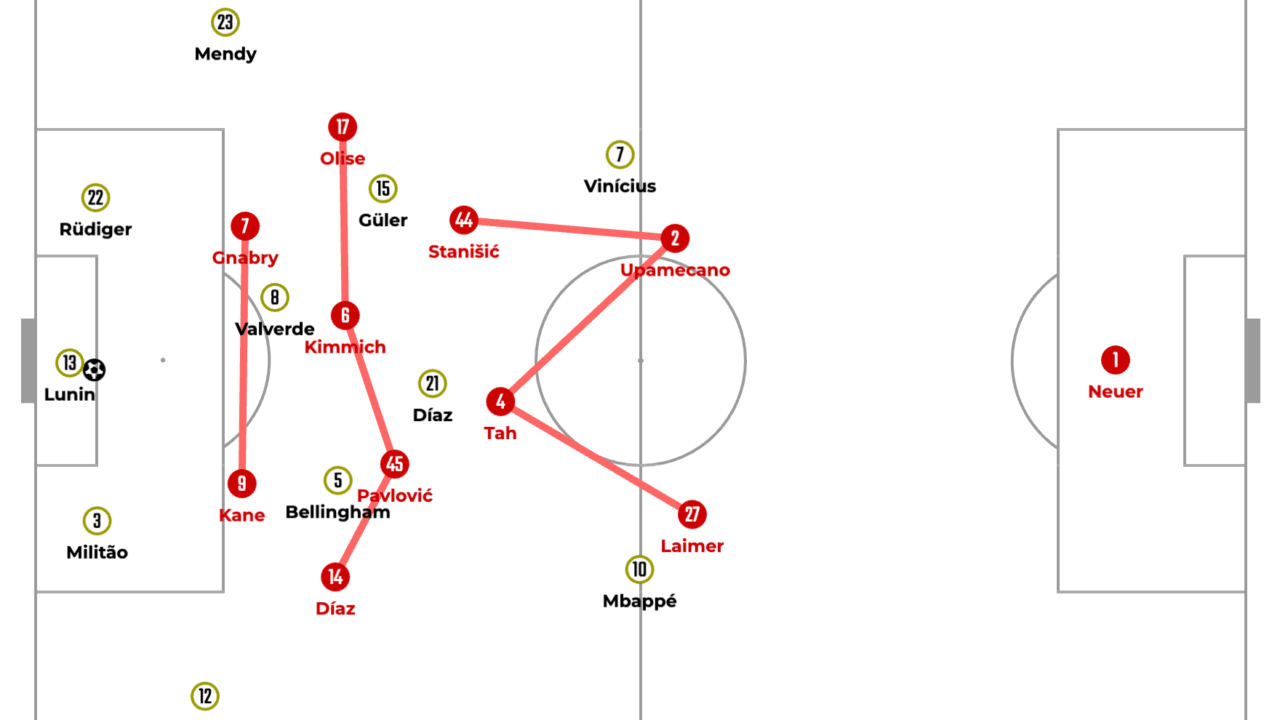
And it is not only Kane but also his partner Serge Gnabry or Lennart Karl who can drop deep to provide extra options to beat the opposition high pressing. The illustration below shows how Gnabry offered a passing lane for Manuel Neuer and linked up with Joshua Kimmich to play through the middle against Real Madrid.
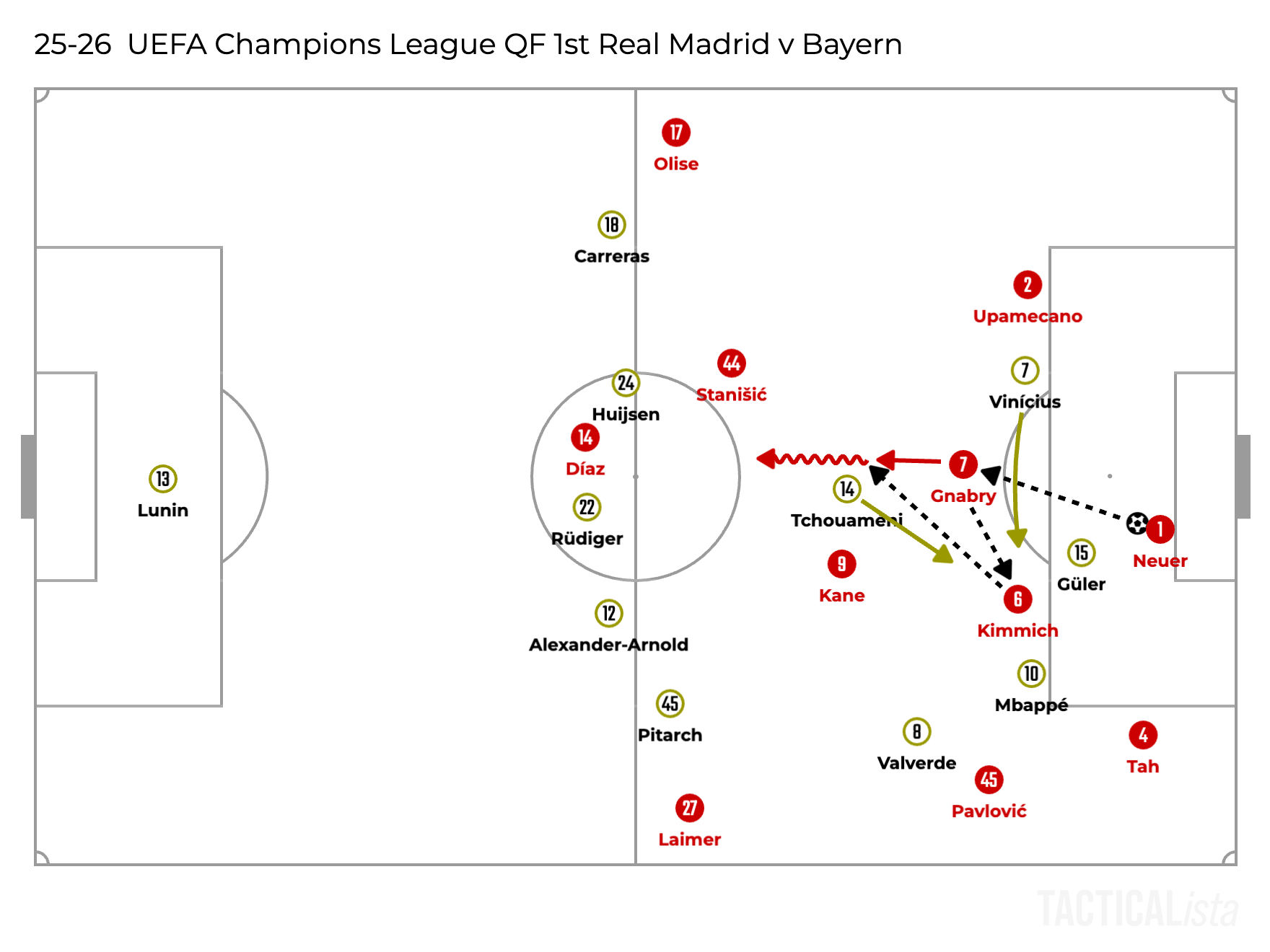
In both examples, the opposition centre backs didn’t follow the forwards dropping off, so they could become spare players in between the lines and create overloads to beat the opposition high pressing. However, more and more teams press man-to-man nowadays, so they are usually marked tightly by the opposition centre backs.
When this happens, they regard it as a trigger to rotate and manipulate the opposition man-to-man pressing. The fullbacks often step higher and diagonally into the pocket, and if the opposition centre backs followed Bayern’s forward dropping deep, they exploit the space behind the last line.
This is the example of the rotation on the right side against PSG when Willian Pacho committed to Kane and Laimer made the diagonal run in behind.
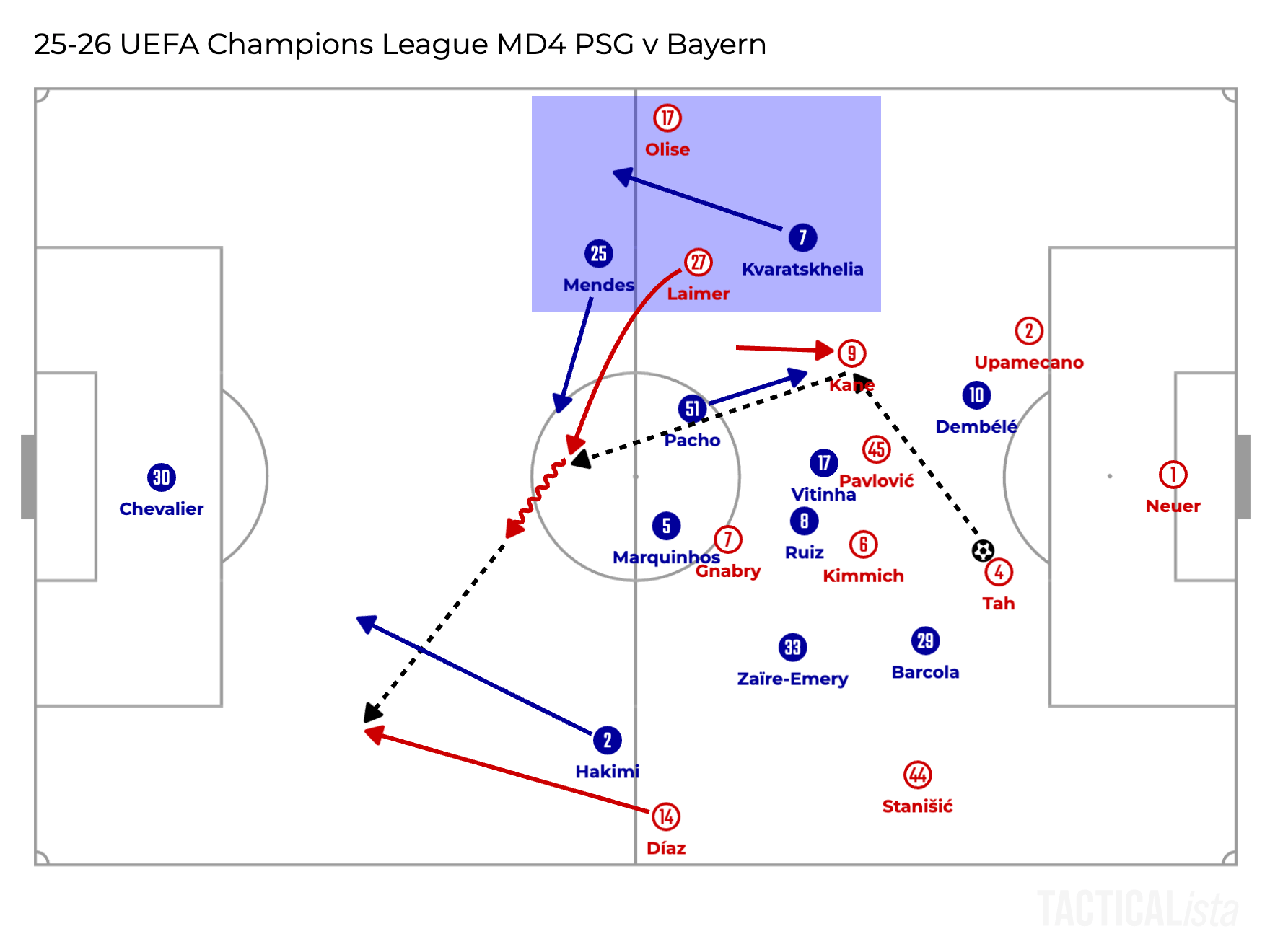
In the end, as we have already seen before, Kane provided the passing option in between the lines instead of the defensive midfielders who were marked tightly, then played in behind the space vacated by Pacho.
Another example was seen against Arsenal in the Champions League. This time, both Kane and Karl dropped off and Arsenal got William Saliba to follow Kane all the way, so Laimer moved higher up the pitch and Bukayo Saka kept marking him.
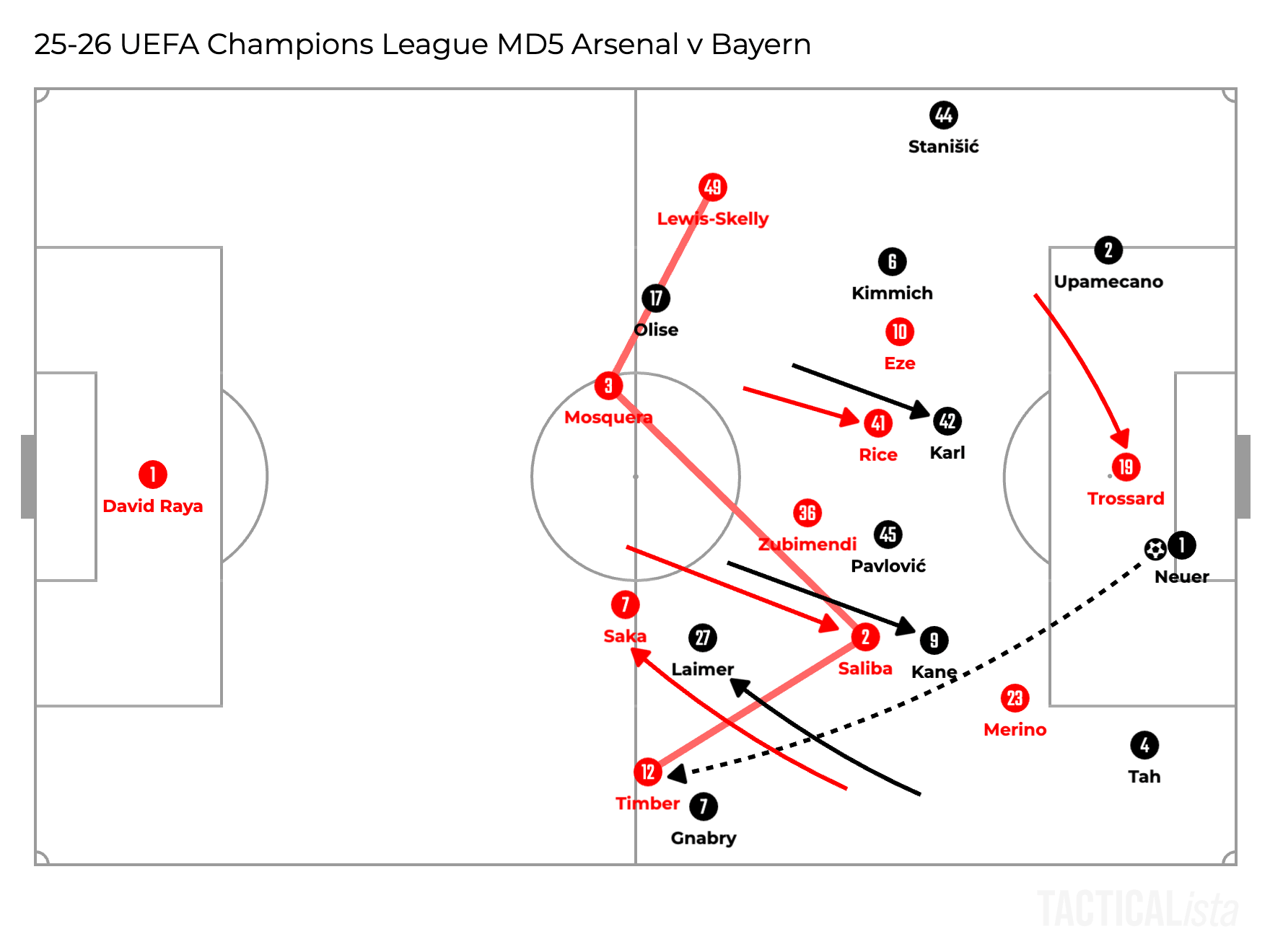
These rotations can manipulate the opposition man-to-man pressing and cause problems for them. The opponents can choose to follow them all the way, but if they leave their positions, the structure will be disorganised. What makes it even more difficult for the opponents is that it is especially Bayern’s forwards who drop deep, so the centre backs need to leave their positions if they want to keep pressing man-to-man like Arsenal here. However, if they move away from the last line, Bayern’s wingers or fullbacks are ready to exploit the space behind them, so it is a tough decision for them.
This is a very effective idea, but their strong intent to play in behind makes it actually work.
Exploiting the Space in Behind
We’ve already seen a few examples when Bayern exploited the space in behind though, they always seek to play in behind and this is the key to build up better. Even with these rotations, if only playing to feet, the defenders can easily deal with it because they can read it well. Like Kompany’s Bayern, however, if the attacking team can play both to feet and in behind, the centre backs cannot fully commit.
And needless to say, exploiting the space in behind is the ultimate objective in possession to score goals. In the illustration below, the third goal against Atalanta is replicated.
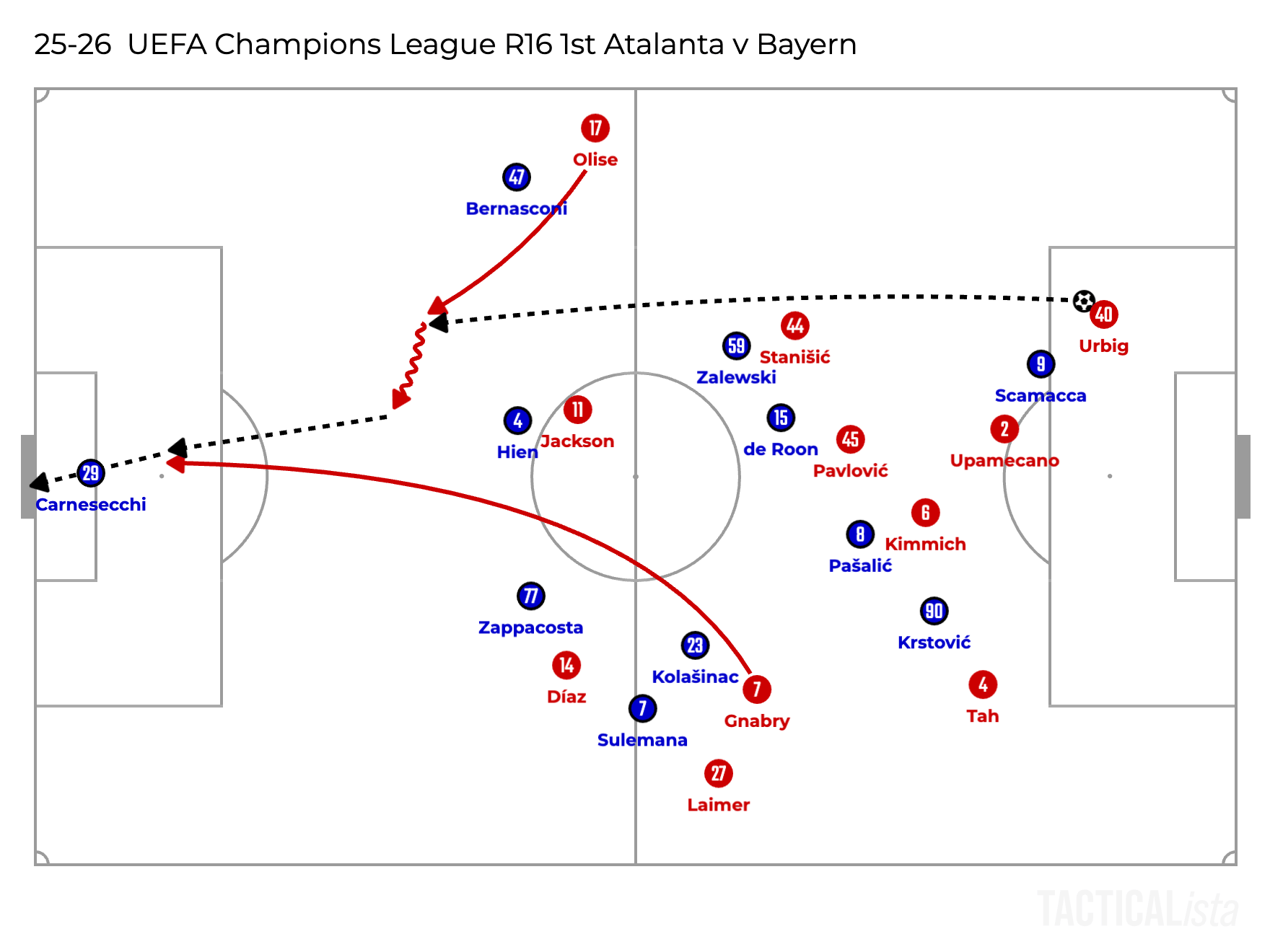
From the goalkeeper Jonas Urbig, Michael Olise received the long ball in behind the defenders and Gnabry beat the opposition goalkeeper after making a long run into the box. This was a very simple attack, but one of the most effective possessions.
Another goal came from the run made by the fullback. Against Stuttgart, the right fullback Laimer ran diagonally through the defenders and got into the box, resulting in the first goal for Bayern.
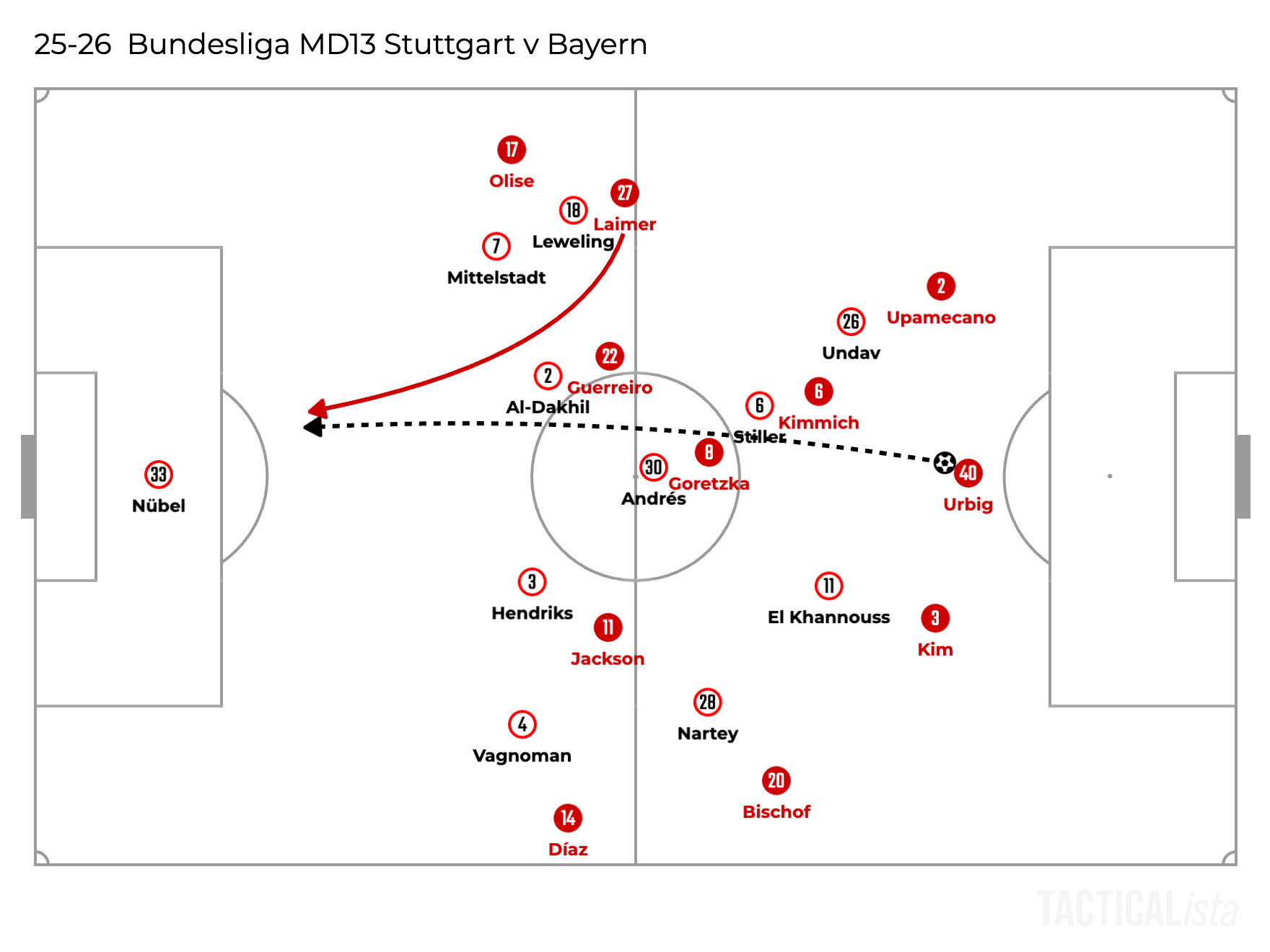
Not only against high pressing, but also they have a strong intent to play in behind when the opposition sets the defensive block. As it is the ultimate goal in attack, the wingers or fullbacks are keen to run in behind and especially Kimmich delivers the lofted ball in behind.
The illustration below shows their goal against Arsenal at Emirates.
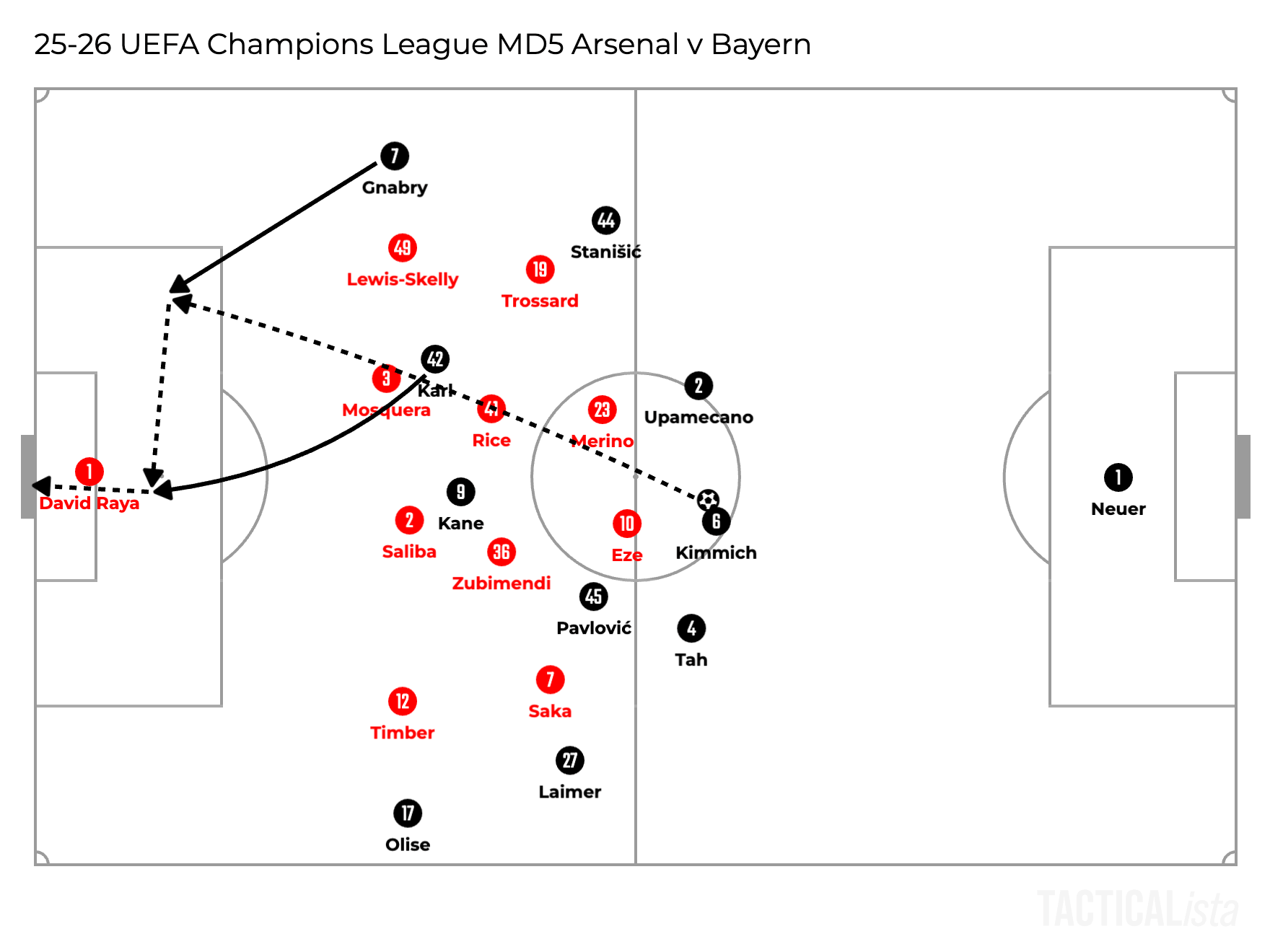
Arsenal defended with a compact block and a high line, which was difficult to play through because there was no space in between the lines. However, Gnabry made the diagonal run in behind and Kimmich found him, then Karl scored the goal at the end.
Their strong intent to play in behind is directly reflected in their attacking mindset. They don’t hesitate to play these difficult balls, as they just think they can win it back immediately. This mentality makes it so hard to defend.
Positional Structure & Final Third Attacking
The last part of the analysis about their attacking tactics is discussing their positional structure especially against the opposition defensive block in the final third. Unlike when the opposition applies tight pressure with accepting to leave space, they need to create gaps by moving the ball with the positional structure.
The basic structure is shown below.
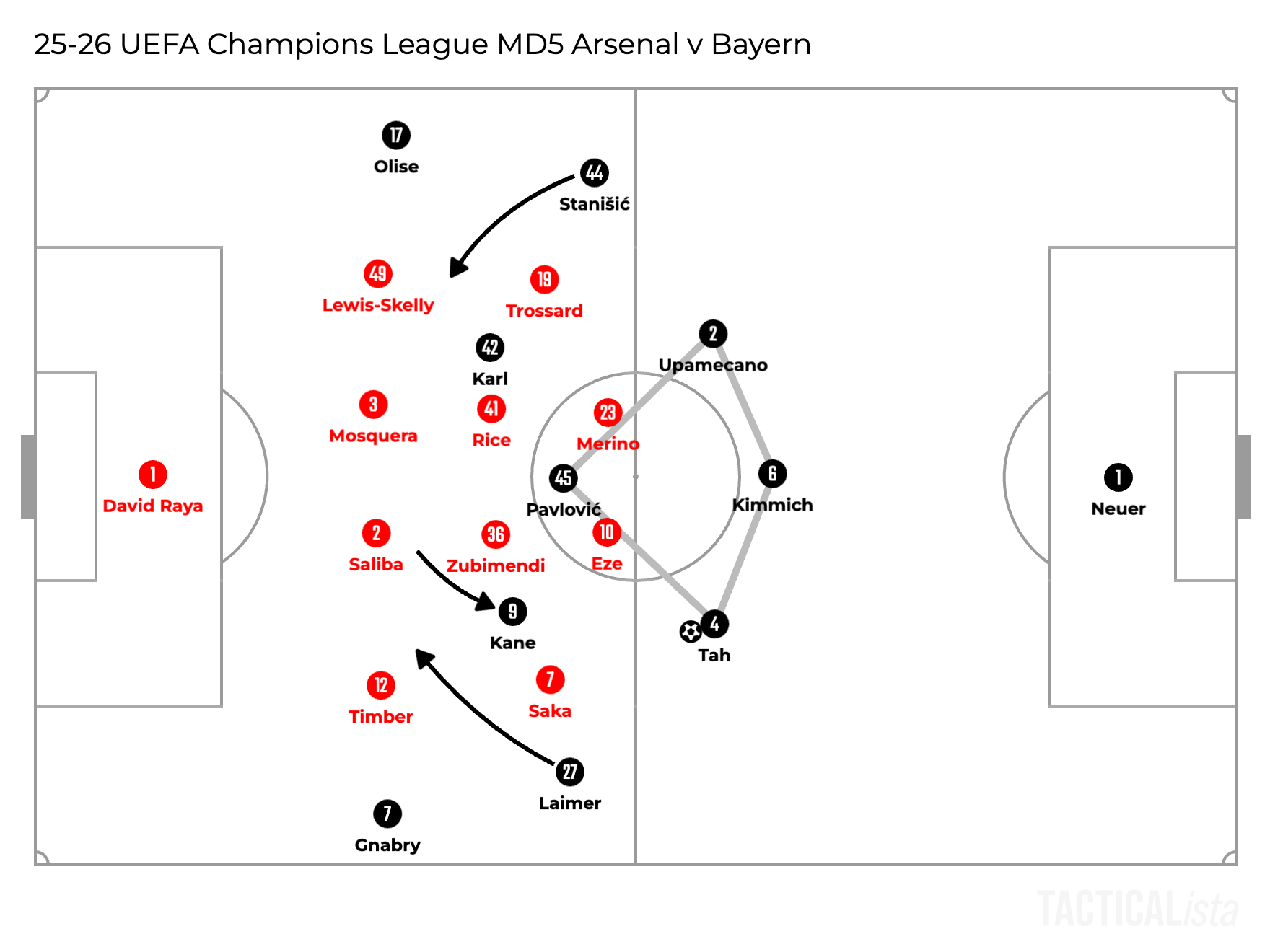
At the back, they maintain the possession with two centre backs and two defensive midfielders, but either of the defensive midfielders often drops into the back line. This provides an extra passing option thanks to their ability to read the press and find the space against the opposition first pressing line.
Another characteristic is that the wingers tend to keep the width and the fullbacks drift inside and occupy the half spaces, as it is already discussed in the analysis of build up play. This is quite a typical idea of positional play, which is letting the wingers stay wide to pin the opposition back line and giving them 1v1 occasions to take on the opposition fullback.
Olise and Luis Díaz are, needless to say, two of the best wingers this season. Olise has kept unlocking the defence individually and creating something out of nothing again and again, and Díaz has provided more forward momentum especially in transitions. In addition to their ability by the touchline, they can also link up with the strikers inside the opposition defensive structure.
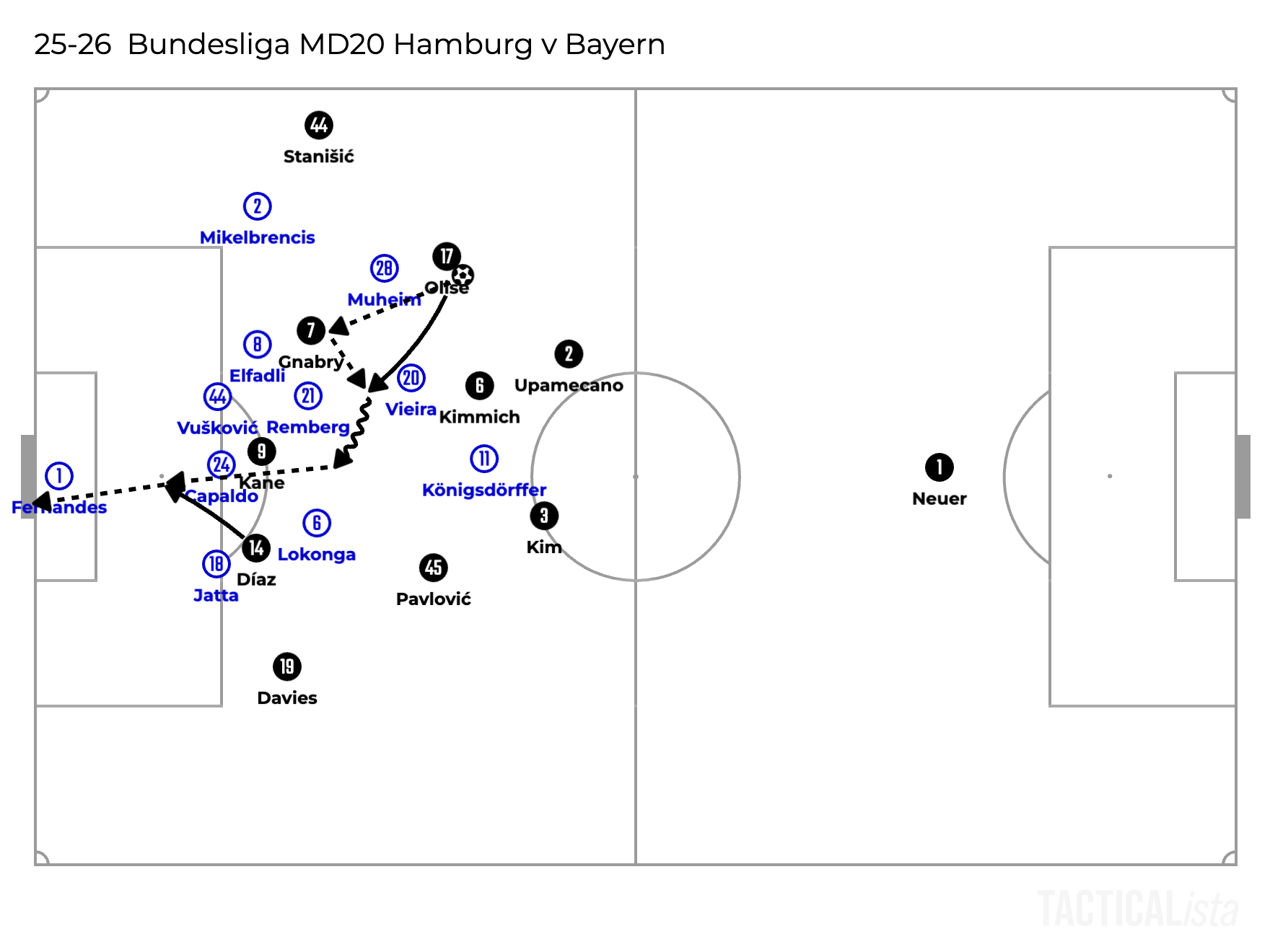
This is a great example of showing how they break through the middle with the combination. Olise had the ball on the right and played a one-two with Gnabry, then played through the defence to find Díaz inside the box.
The secured structure at the back with two centre backs and two defensive midfielders provides more opportunities to attack as they also contribute to win the ball back quickly, and the individual brilliance of the wingers and the combination in the middle lane will break down whatever deep defensive block in the end.
Out of Possession
Overall, out of possession, they aggressively press man-to-man and try to apply pressure on the ball all the time. This doesn’t just make it difficult for the opposition to build the game but also generates opportunities to play quick counterattacks to score more goals.
And their strong focus on man-to-man or duels can be inferred from their work on the training ground. Of course, it is impossible to know everything Kompany does, but they post a lot of YouTube videos of 2v2 or 4v4 games. No matter what their objective is, probably just for fun, not many teams do them as much as they do. It is common to add neutral players to provide a numerical superiority in rondos or small sided games, so they don’t experience more duels than Kompany’s men do. This shows his strong focus on duels in football and the reason why FC Bayern is fit.
https://youtu.be/rsYiceEPmzY?si=d9qIgfUZqwmwVLUj
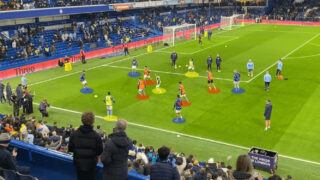
High Pressing Structure
When they press high, they are willing to disorganise the back line by themselves and match up their shape. The fullbacks can advance to mark the opposition midfielders or fullbacks and the centre backs follow their strikers all the way.
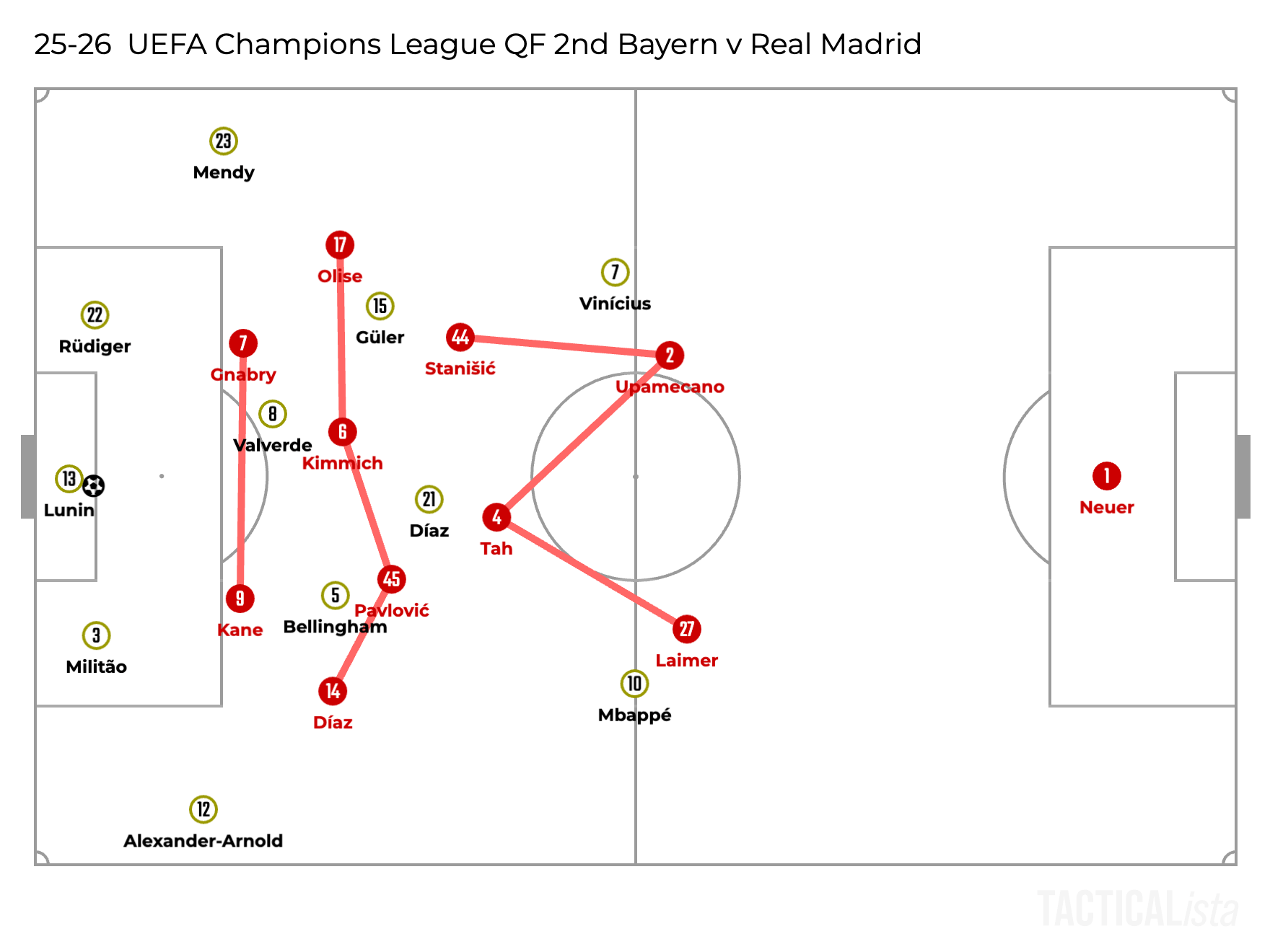
And when they press high, they never give time for the opponents. Even when the opposition plays back to the goalkeeper, they don’t stop pressing and even apply intense pressure on him.
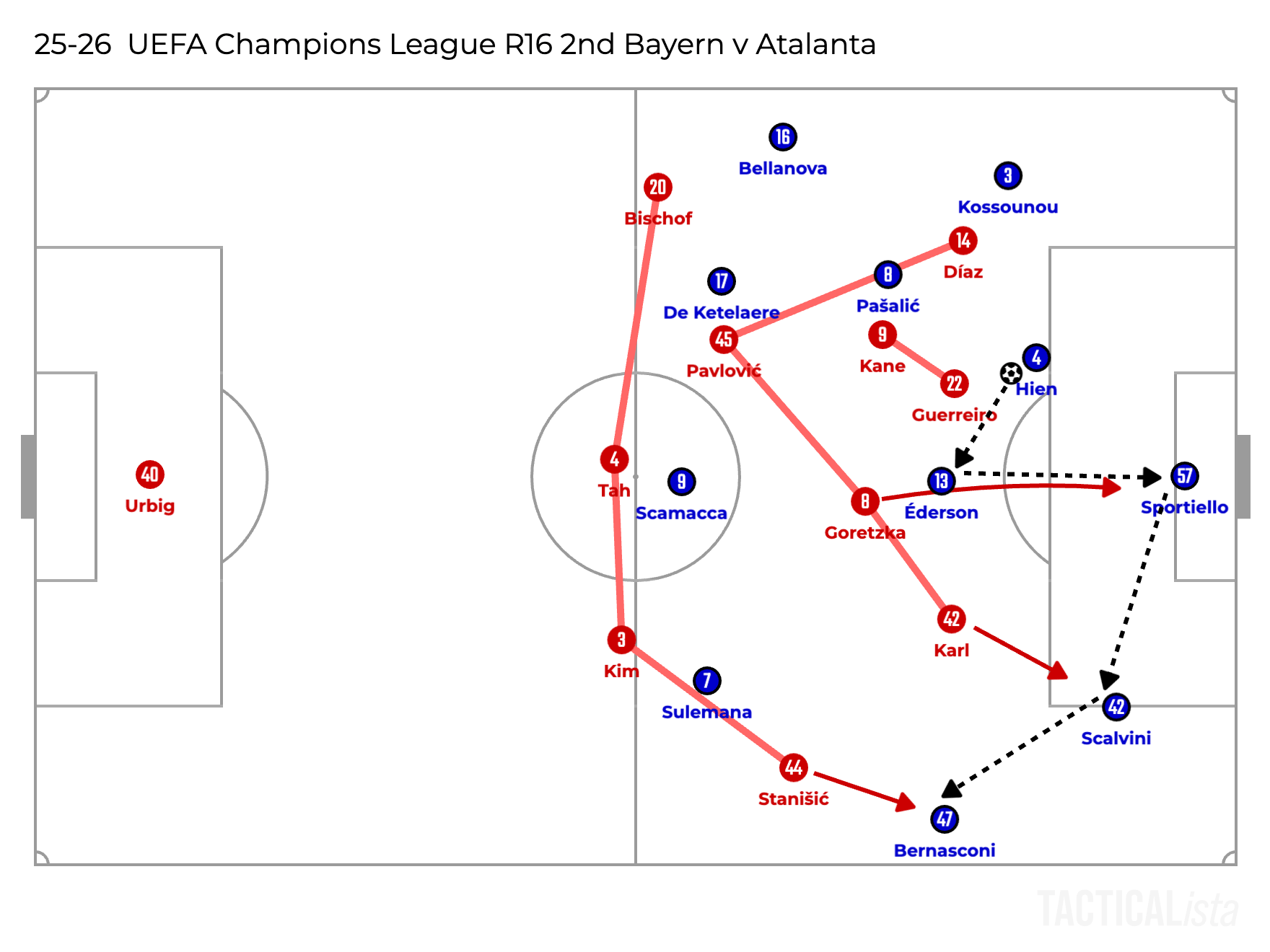
In the illustration above, the defensive midfielder Leon Goretzka pressed on Éderson who played back to the goalkeeper, then he kept chasing the ball, which led the team to trigger the press. The defensive midfielder’s pressing on the goalkeeper forces him to play either side, which dictates which side to lock them in. Therefore, from goal kicks, the defensive midfielder often becomes the first player to press.
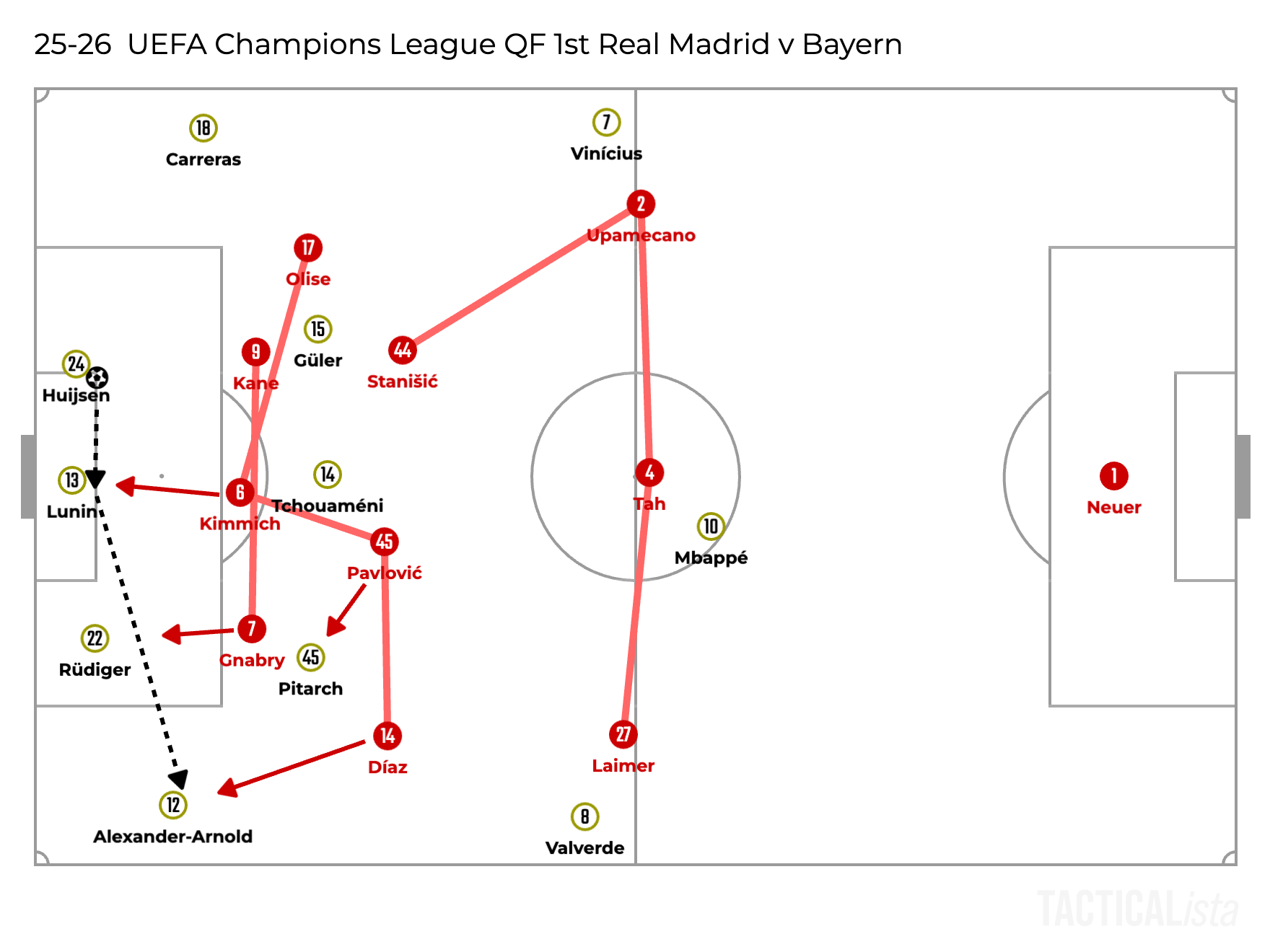
This is the example against Real Madrid. Kimich was positioned like a centre forward and applied pressure on Andriy Lunin to play outside. Then, as a team, they shuffled across towards the ball side and locked them in.
This is the basic structure of high pressing, and the main goal is not just winning the ball back but also playing a counterattack to threaten the goal. The image below shows their one of the biggest chances against PSG in the 1st leg of the semi final of the Champions League.
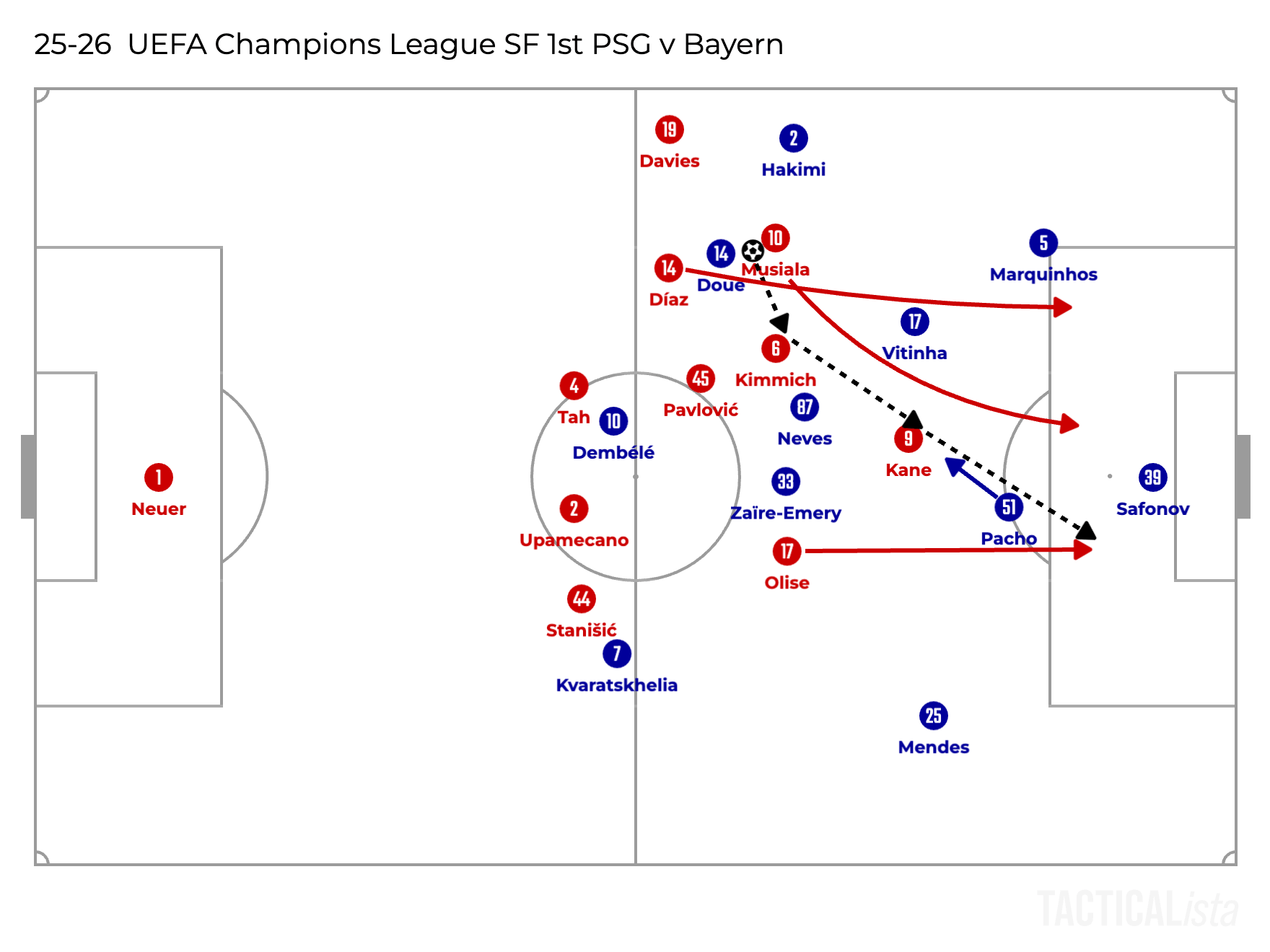
Jamal Musiala pressed back and won the ball in the midfield to give it to Kimmich, then he quickly played forward to Kane. At the same time, Díaz, Musiala and Olise bursted into the box and Olise should’ve scored here.
Another one is illustrated below and this time it ended up with a goal.
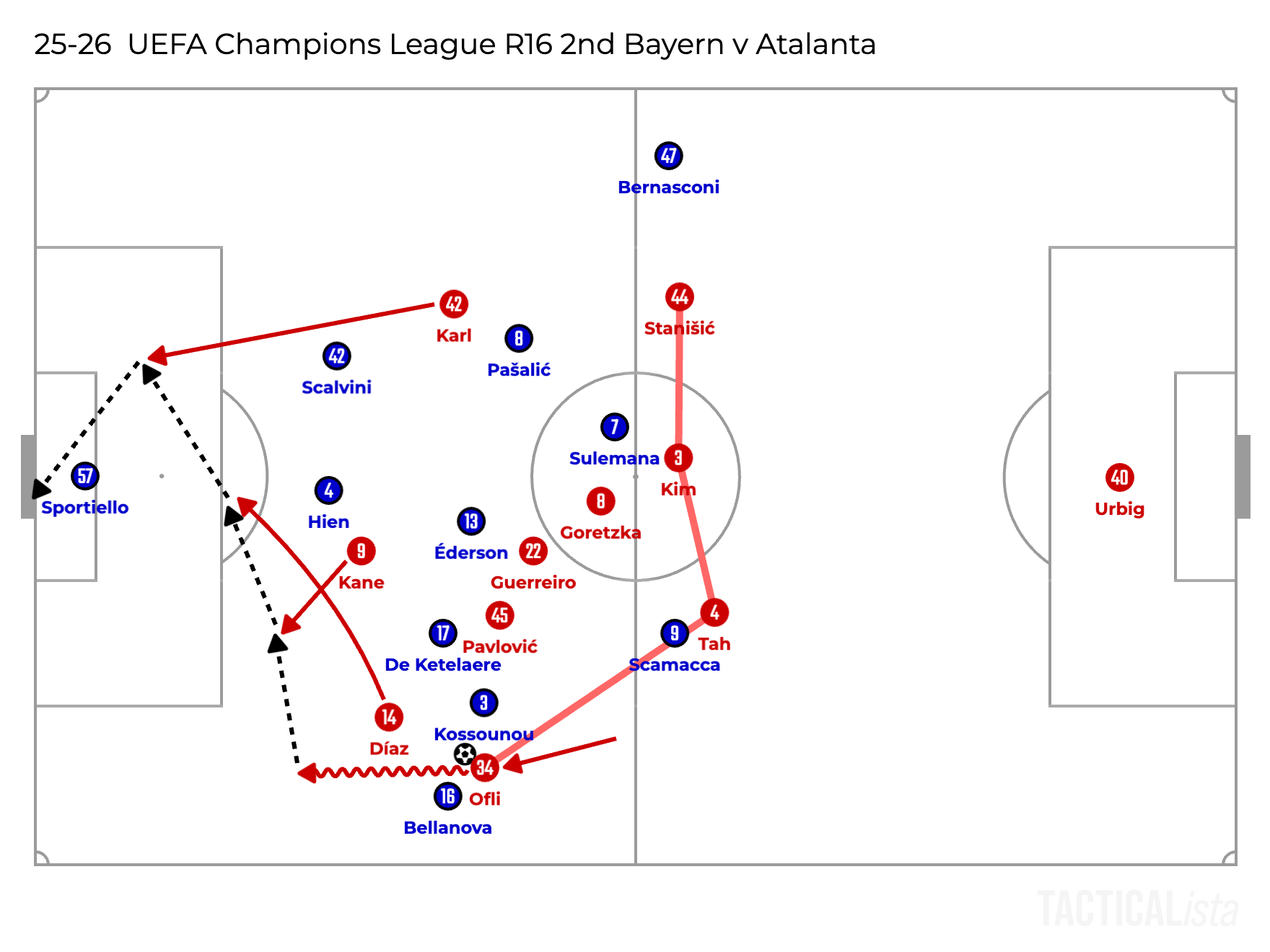
After winning the ball on the left side, like the previous instance, Kane linked up in the middle and both wingers, Díaz and Karl sprinted into the box to immediately threaten the goal.
In short, Bayern’s intense man-to-man pressing is to score goals. The intensity in each duel and quick reactions in transitions help them keep scoring numerous goals.
DMF’s Intelligence
The key players who make the man-to-man pressing actually work are the defensive midfielders. Of course, in man-to-man pressing, whether each player can win each duel is the most important, but this is not enough to make every pressing successful.
For example, when the opposition tries to play into the striker, intercepting it before the duel occurs is better than relying on the centre back to win the duel. Additionally, if the ball is launched and it dropped in the midfield, securing this second ball is extremely important, otherwise it gives the opportunities to the opposition to accelerate their attack.
The illustration below shows a certain scenario when Bayern regain the ball by their high pressing against Real Madrid.
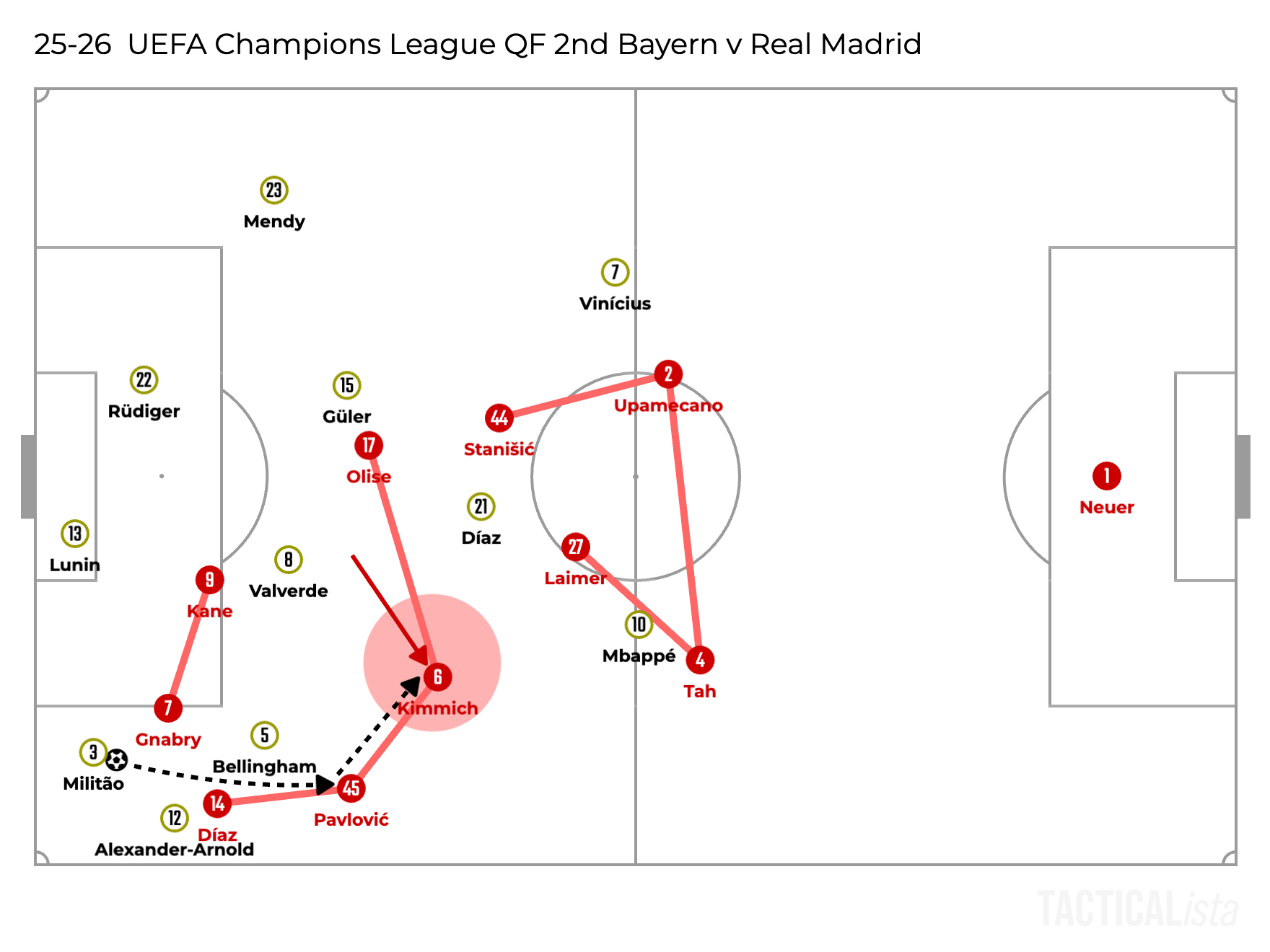
They were locking them in the corner of the pitch, and the only option for Éder Militão was to roughly play forward. It was disrupted by Aleksandar Pavlović on the way and the ball was dropped in the middle of the pitch. Then, it was Kimmich to secure this second ball thanks to his clever positioning.
He used to mark Federico Valverde, but as Bayern successfully trapped them in the corner, he read what would happen next and decided to occupy the area where the ball was likely to be played soon.
Another example is also showing the intelligence of Pavlović to read the game.
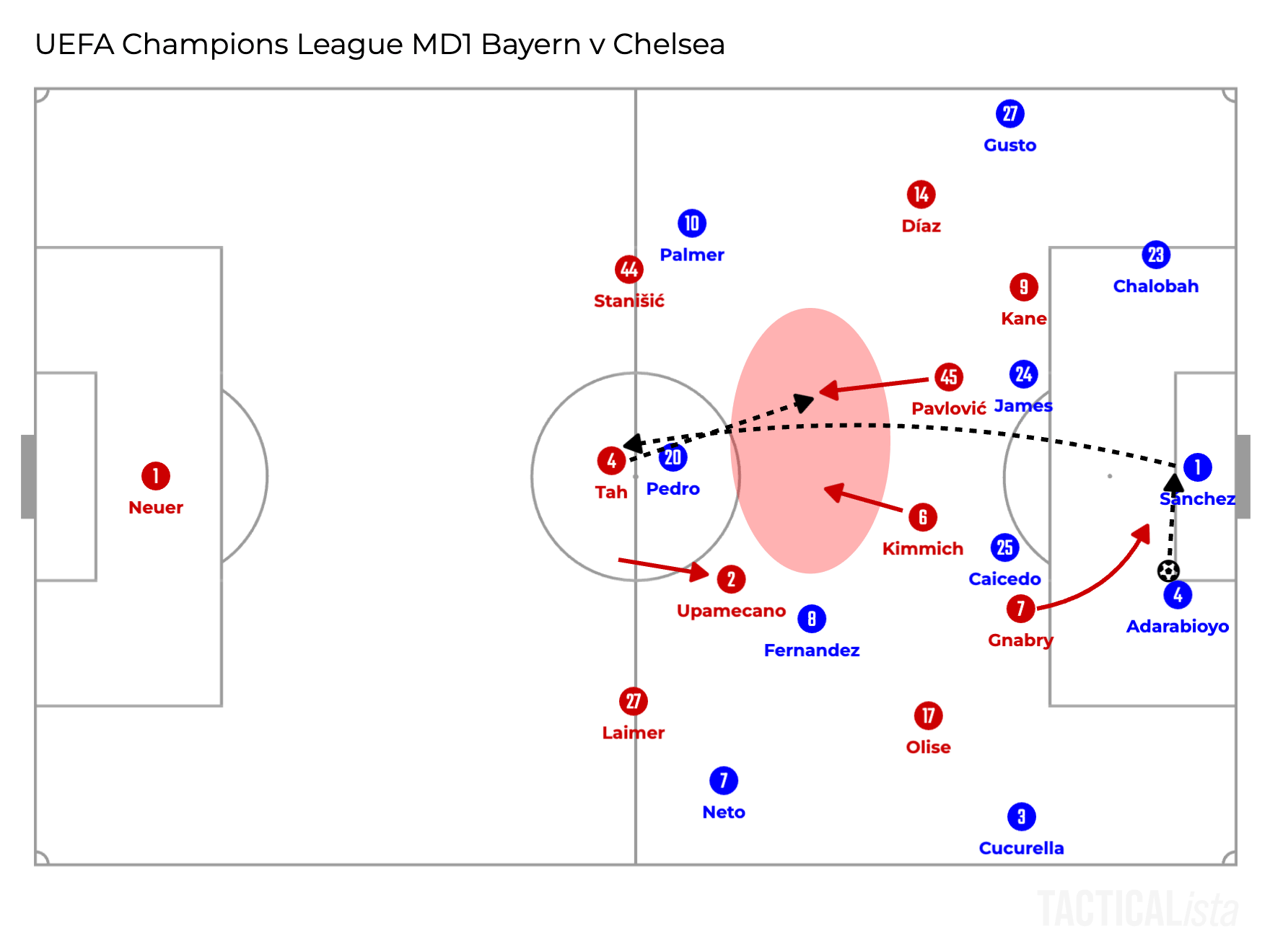
Chelsea decided to launch and let João Pedro to compete in the air, then the ball was dropped in between the lines. This time, it was also Bayern’s player to regain it. Pavlović left their position earlier to get there before the opponents arrived.
This type of intelligence, which reads the game well and switches from man-marking to zonal-marking is essential to press better than just man-to-man pressing.
Man-Oriented Defensive Block
However, man-oriented defending is not always the best answer. They keep this approach even in the middle third or defensive third, so the vulnerable space at the back is often exploited and eventually cost themselves in the Champions League.
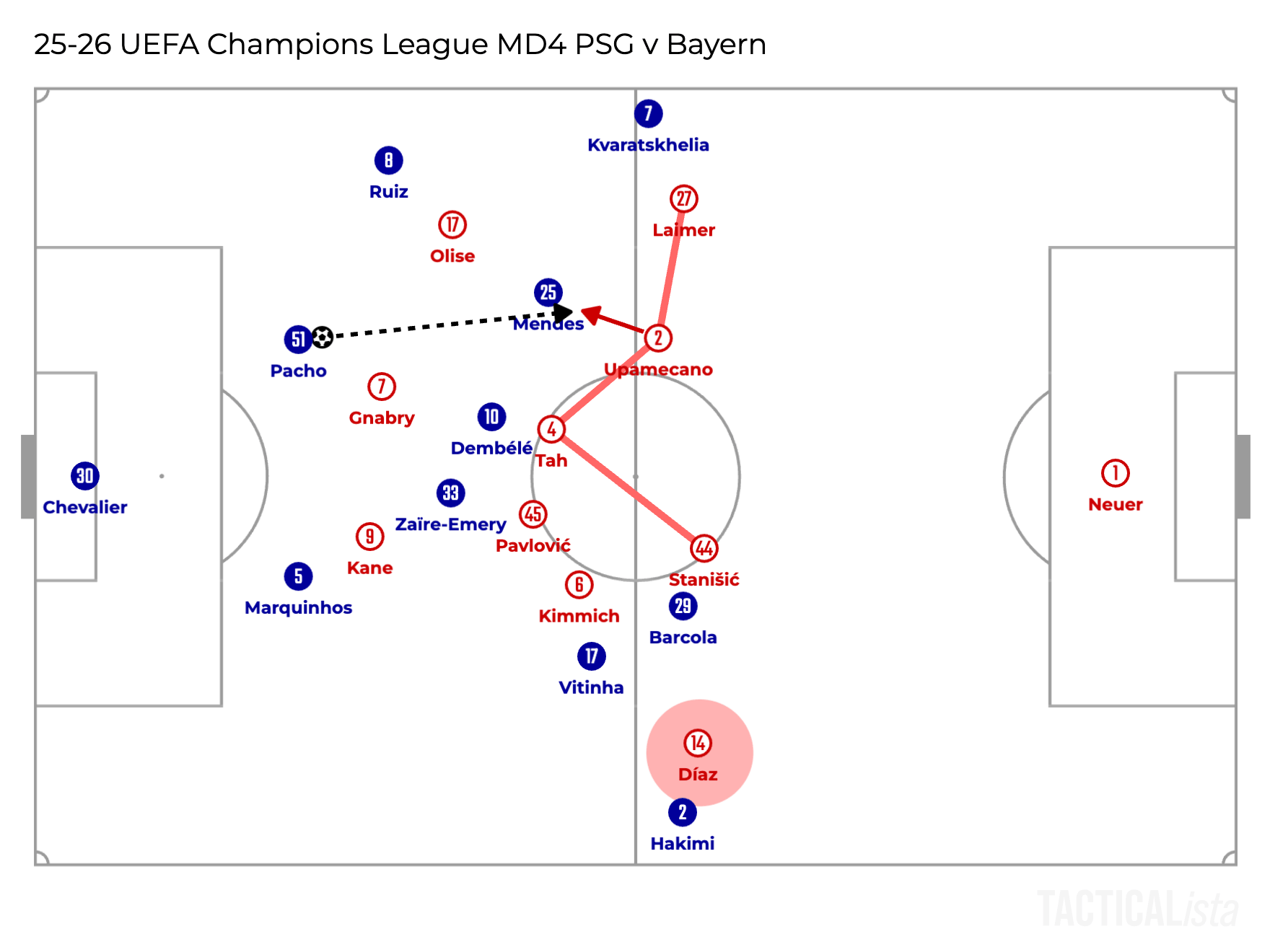
As you can see here, they keep man-oriented defending in the middle third, so the back line is not organised and even the winger needs to drop back in the defensive line when the opposition fullback steps higher.
However, the wingers are not the defenders, so they cannot defend in the same way. Additionally, the fullback only focused on the opponent in front of him, so he is not ready to cover the space in behind.
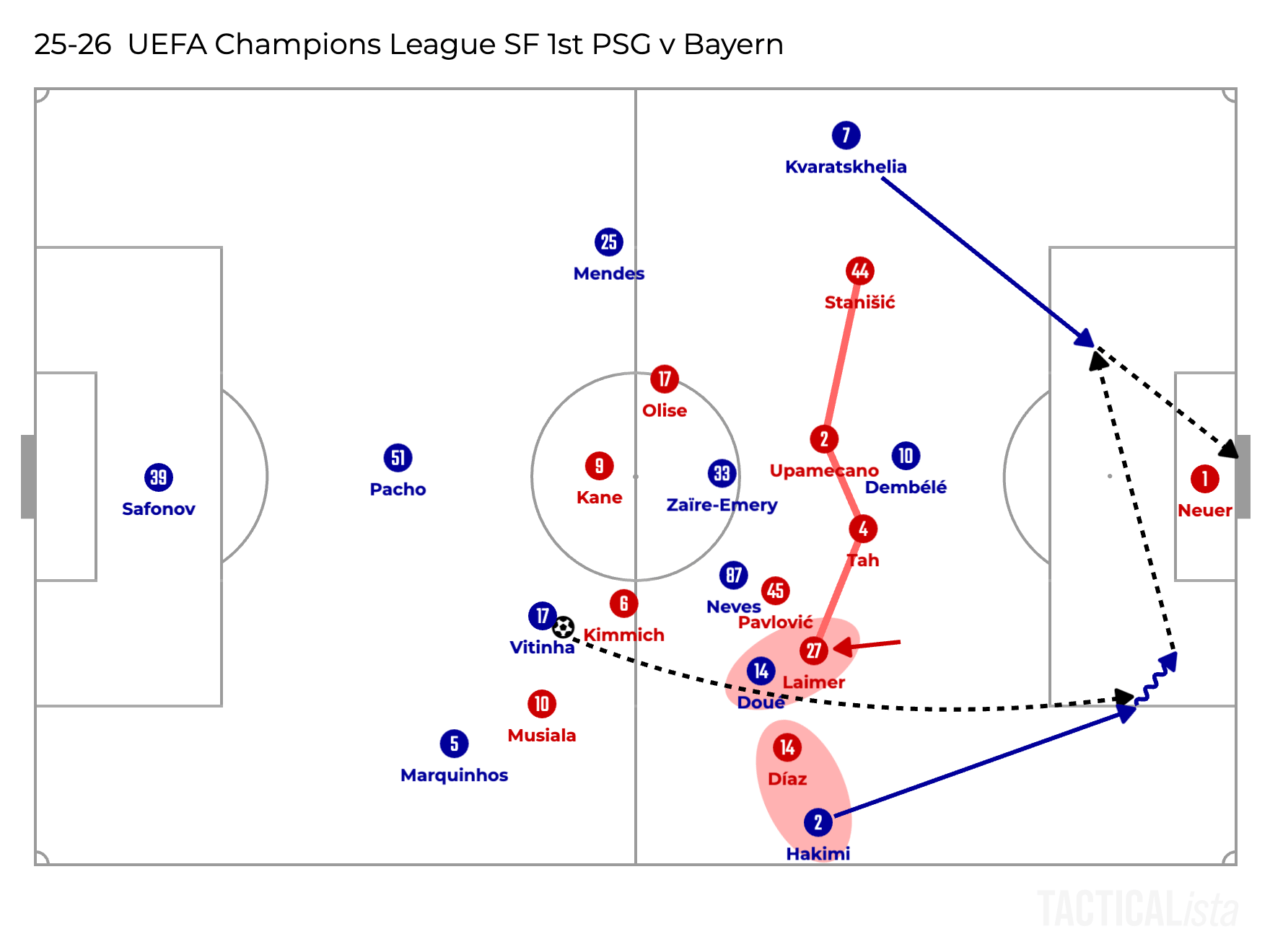
This is how they conceded a goal against PSG. Achraf Hakimi stepped higher but Díaz was not ready to defend the space behind him. And Laimer committed to Désiré Doué, so couldn’t deal with the long ball in behind.
And here’s another one.
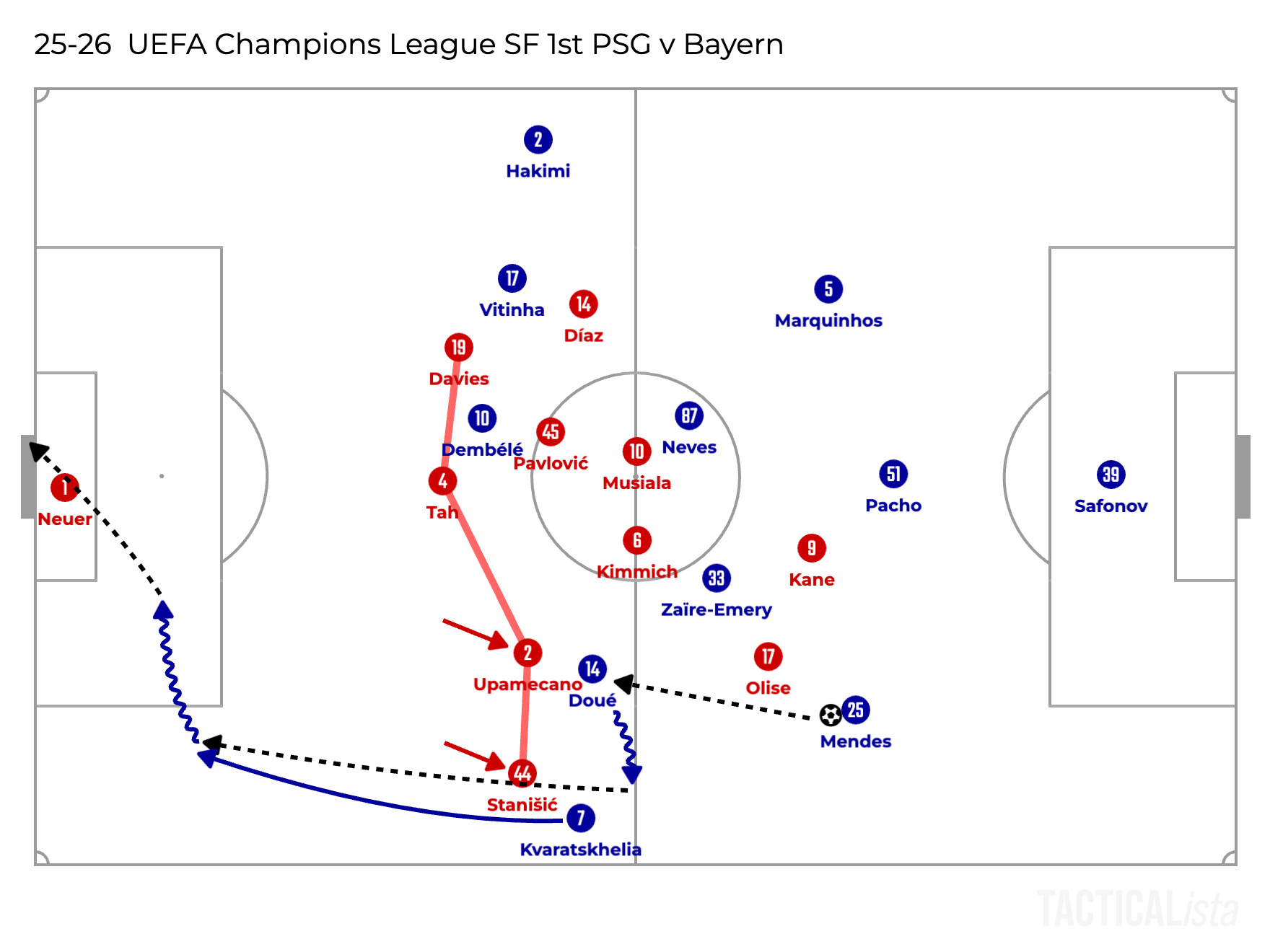
On the right, there was a 2v2 but PSG solved this better. Doué wasn’t pressed by Dayot Upamecano enough and Josip Stanišić easily got beaten by Khvicha Kvaratskhelia. This happened again in the second leg of the semi final in the Champions League, which gave away the early goal for PSG and Bayern couldn’t turn it around.
So in the end, their aggressiveness cost themselves in the Champions League, but this is also the truth that they’ve shown us what the future football will look like and entertained most football fans. The only thing he needs to achieve is just the Champions League, but Pep also spent seven years at Man City, so no need to rush.