Rúben Amorim & Michael Carrick’s Manchester United Tactical Analysis 25-26
Finally, there was a sense of hope around this club.
Michael Carrick has just signed a new contract to become the permanent head coach of Manchester United for two more years.
After taking over Rúben Amorim who led them to the final of the UEFA Europa League last season but couldn’t break out of the mid-table this season, the former Man United player unlocked their full potential to beat all of Man City, Arsenal, Tottenham, Chelsea and Liverpool to qualify for the UEFA Champions League.
He got the entire squad pulling in the same direction and removed every doubt within the squad to unleash their talent. For the big clubs like Man United who can acquire the best talents from all over the world, all it took was this style of management to let them believe in themselves.
However, it doesn’t mean a tactical approach is unnecessary. Rather, the way they played after Carrick’s arrival was really structured and organised as a team. And this harmony between tactical structure and man-management has revived them and the tactical side was hugely the legacy of Rúben Amorim.
In this article, the tactics of Manchester United are going to be analysed in detail from Amorim’s struggle to Carrick’s resurgence.
In Possession
After securing the moves of Bryan Mbeumo, Matheus Cunha and Benjamin Šeško ahead of this season, how to adapt them into the squad was one of the biggest challenges for Amorim at the beginning.
Mbeumo and Cunha can thrive especially in transition, thanks to their pace and technical standard when things move quickly, so recreating this kind of situation by playing out from the back has been the main theme in possession throughout this season.
First of all, in this chapter, how Carrick simplified build up strategy to make the most of the pacy attackers is going to be analysed.
Build up into Fast Breaks
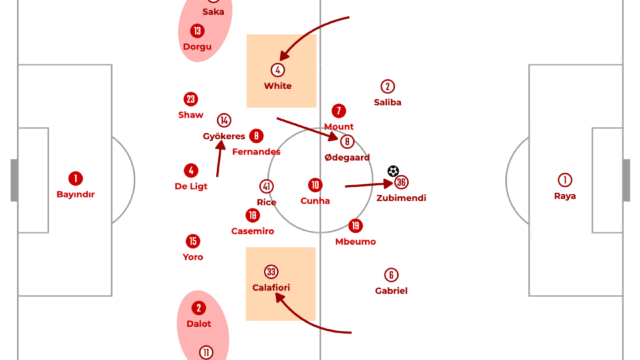
Firstly, let’s see the picture to recall Amorim’s fresh idea. Here’s how they played out from the back in the opening game against Arsenal.
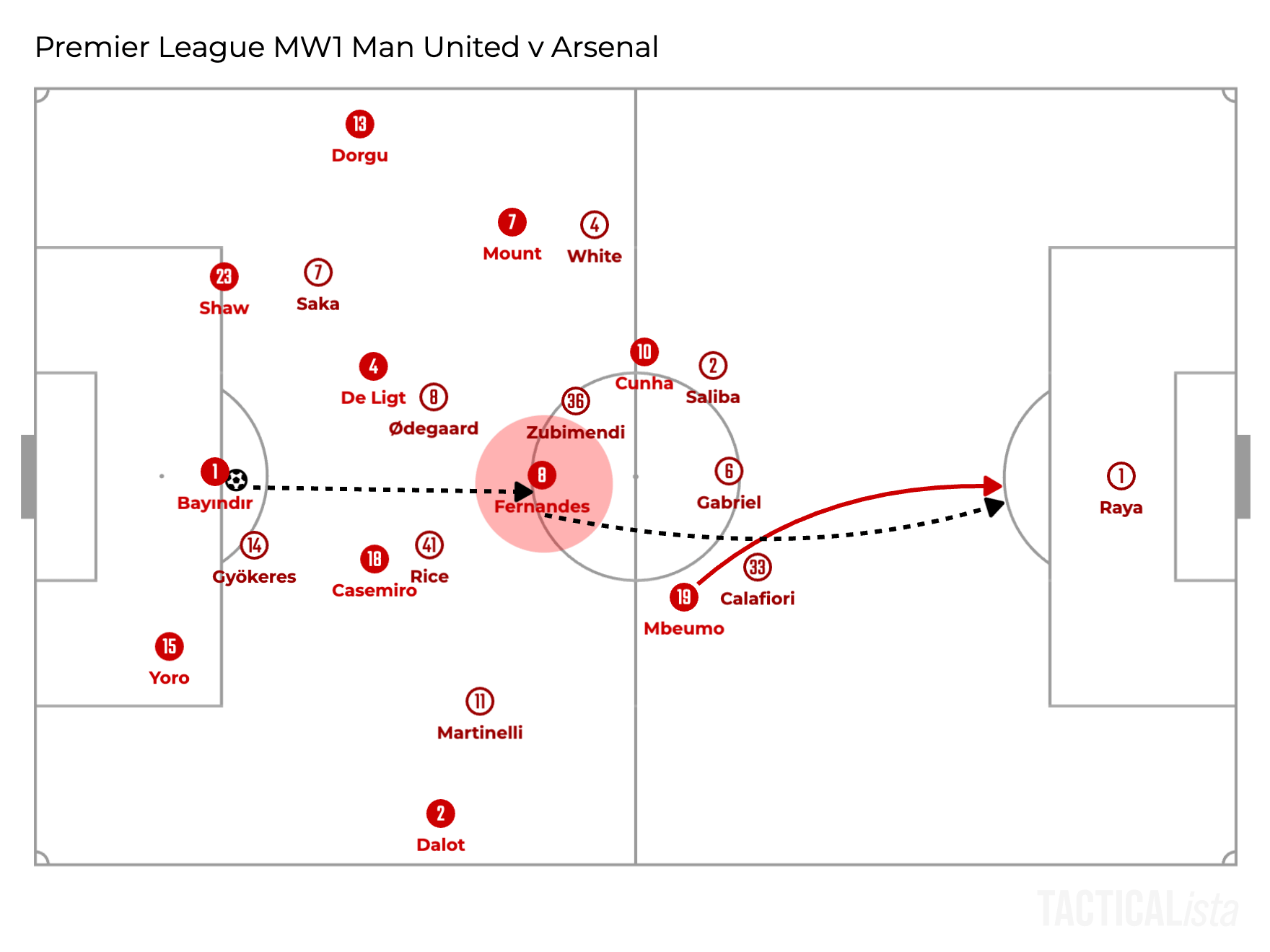
In this illustration above, it is possible to find the similarities between Amorim and Carrick. Bruno Fernandes received in between the lines and played through to find Mbeumo sprinting in behind, which has been seen recently as well.
The main principle is nothing different from now, but the differences are the complexities at the back. As Amorim’s basic system was a 3-4-3 and Bruno played as one of the defensive midfielders, they had to rotate dynamically to make sure they were in the position where they could thrive.
The rotation at the back is the strength of the back three when it is properly executed, but the rotation itself doesn’t always help the players. To get Bruno higher, which was successfully operated, Amorim needed to let the central centre back (Matthijs de Ligt in the illustration above) play as a pivot, which wasn’t a suitable role for those of United’s centre backs. Only John Stones can do it.
After Carrick’s arrival, the player who was most benefited was Kobbie Mainoo and he played a vital role in the build up play. He is very good at helping Senne Lammens, who is also the new signing of this season, when playing out from the back.
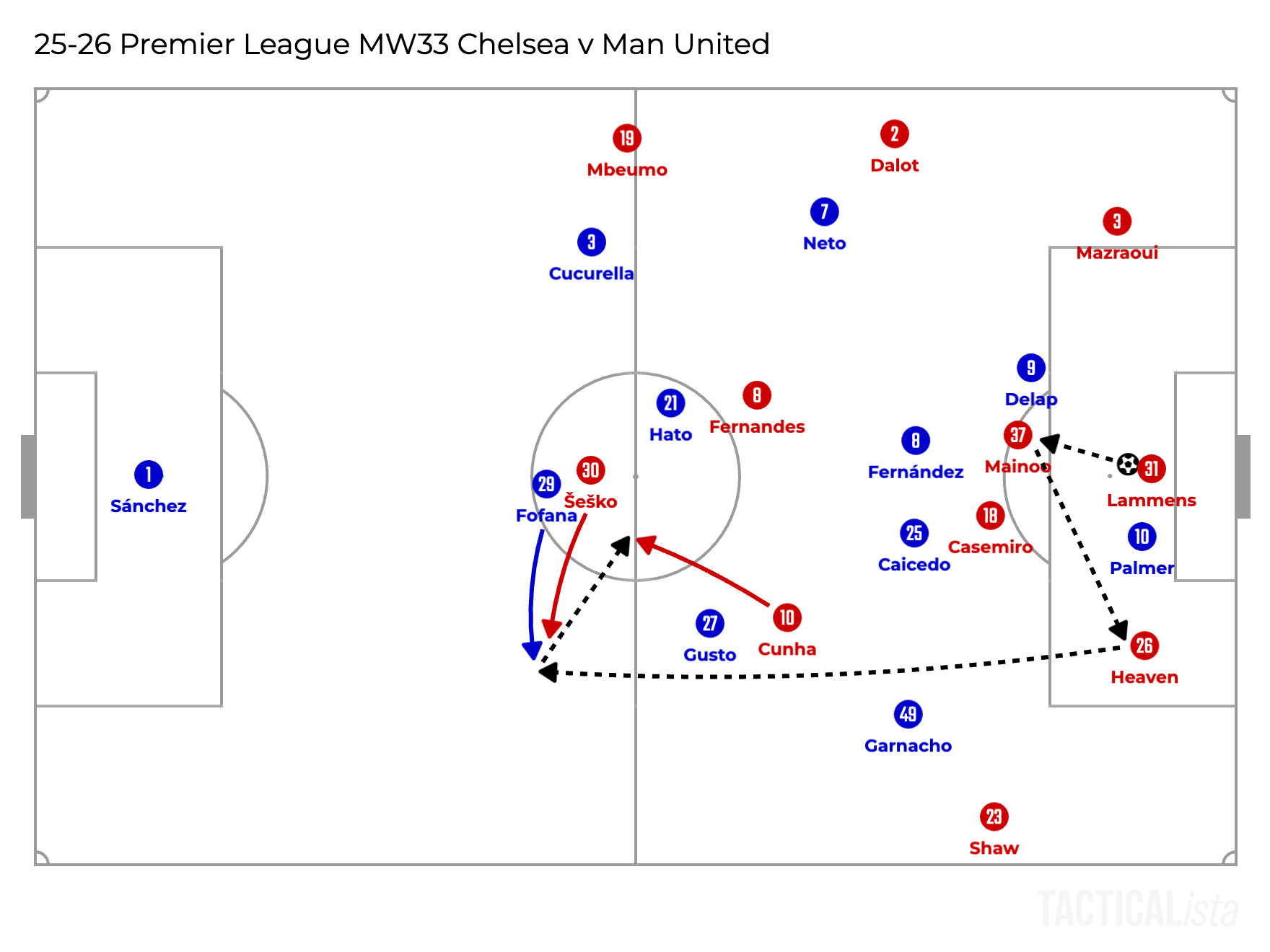
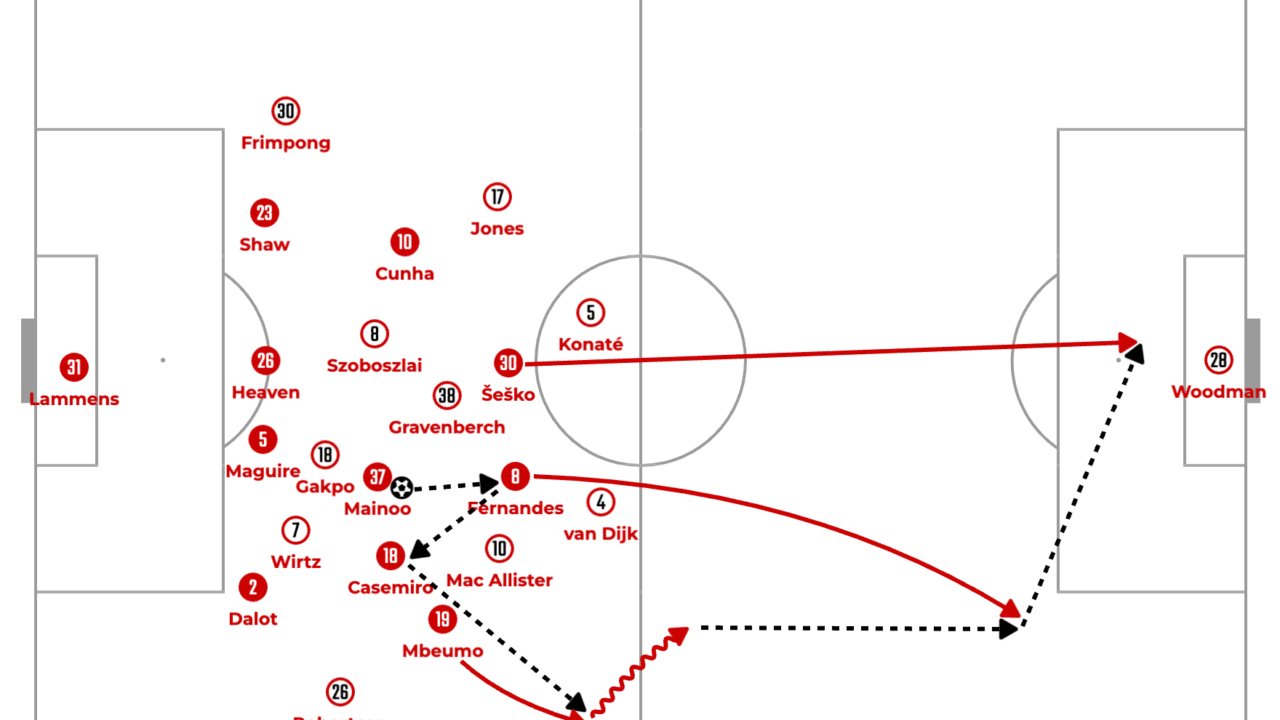
Although this pattern of play in a 4-4-2 system is very common in recent days, Mainoo can provide an option for the goalkeeper and find the spare centre back to reverse the opposition pressure. This literally helped United to play safer when playing out from the back.
Compared to Amorim’s build up tactics, Carrick’s one is quite simple. They don’t rotate a lot, and after Mainoo beats the opposition pressure, the centre back on the ball plays directly. It is sometimes a hopeful long ball, but if they can secure the second ball like the illustration above shows, they can create the transition moment in which they love to live.
This might be slightly exaggerated, but Mianoo changed everything in this phase of the game. His contribution in build up is so exceptional and Carrick successfully make the most of him.
Switching Play
They are such a simple team in possession.
When playing out, after Mainoo nullifies the opposition pressure, they go forward without any hesitation. Then, as soon as they find space on the opposite side, they switch the play and accelerate the attack.
The illustration below shows what was discussed earlier and the switching play against Liverpool at Old Trafford.
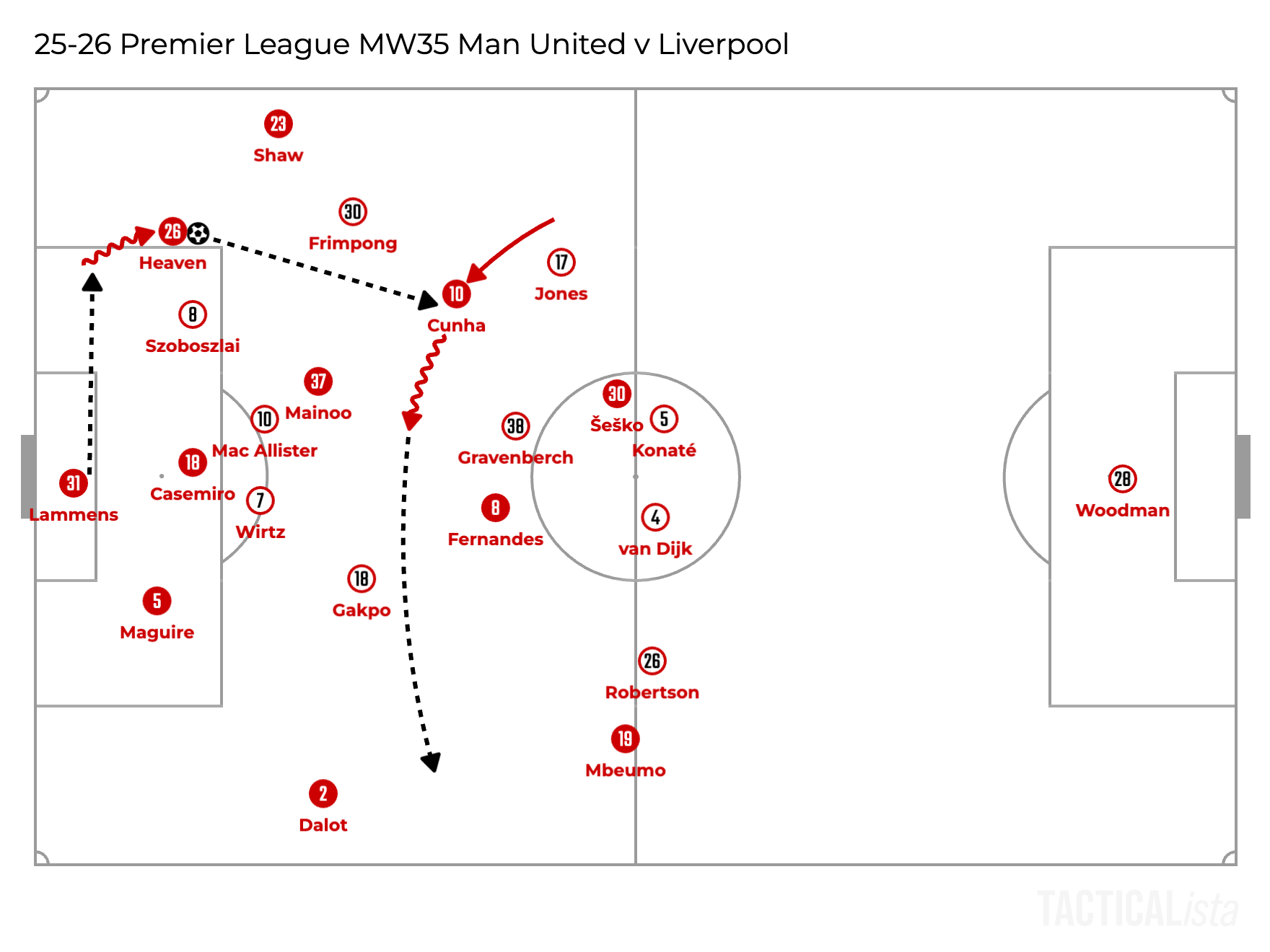
Cunha received the ball in between the lines, which is one of the United’s successful patterns of build up play, and he switched the ball as Liverpool shuffled across towards the ball side and vacated huge space on their left side. Then, Diogo Dalot carried the ball down the line as if he was driving on the motorway.
This pattern of play was often executed under Amorim too. At the moment, they mainly played with a 3-4-3, so thanks to the wingbacks keeping the width, it was more beneficial when they switched the ball to the opposite side.
Here’s the example in the other game against Liverpool. Again, Cunha received the ball while dropping and switched the ball to find Amad Diallo on the right side.
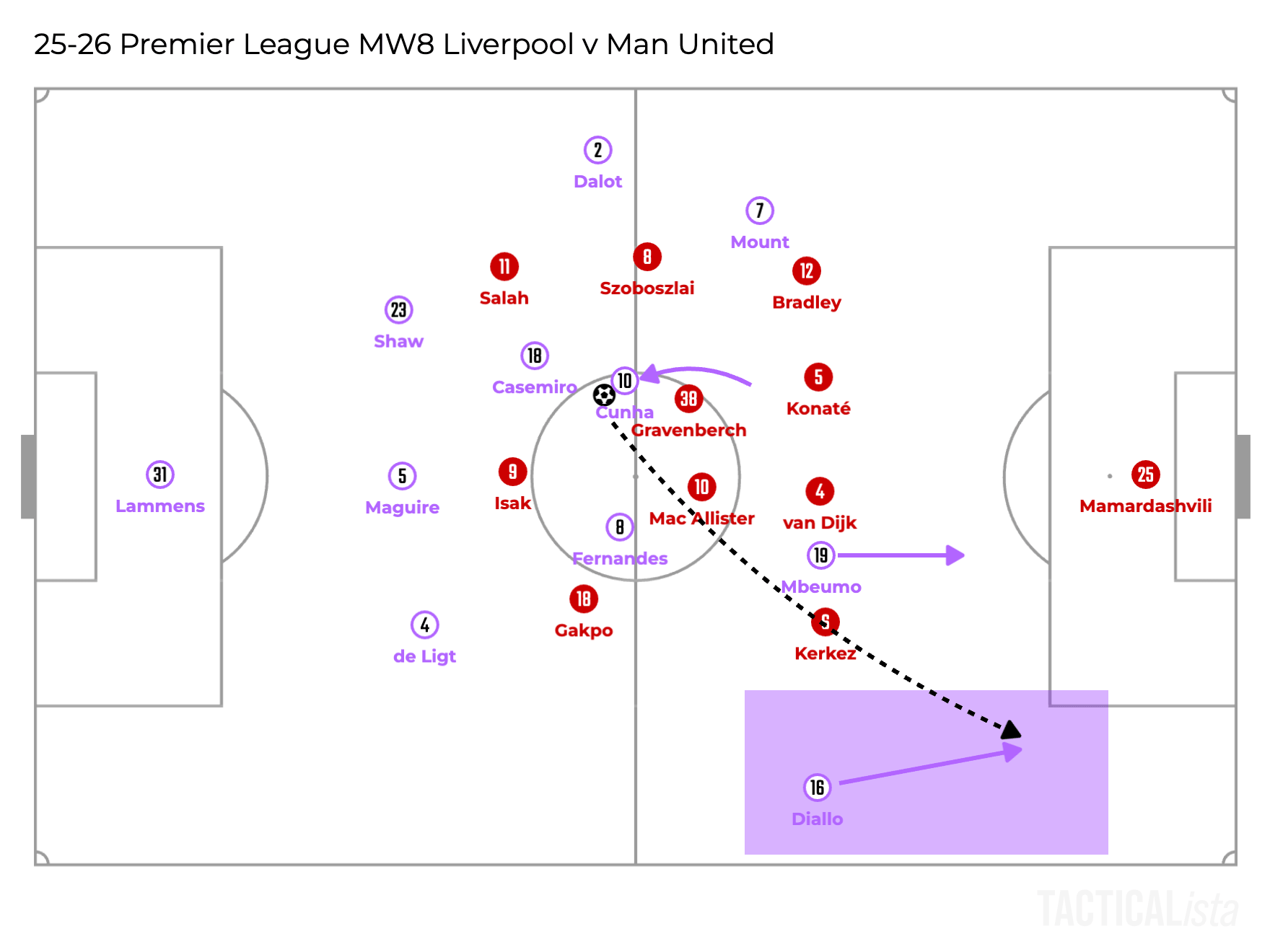
Switching play is one of the key tactical principles in football, and United do the basics. Similar to the idea of simply attacking the space in behind, switching play also aims to exploit the larger space, which physicality matters more than technique. In this context, it is fair to say that both Amorim and Carrick understand where they have the advantage and try to make the most of it.
Positional Structure
When it comes to breaking down the opposition defensive block, there were more similarities. When they can (or are forced to) possess the ball, they adjust the shape into a 3-2-5, which is a very basic system of playing positional football.
In the previous chapter, it was discussed that they often try to switch the play to exploit the larger space, but it doesn’t mean they cannot play through the middle, as shown below.
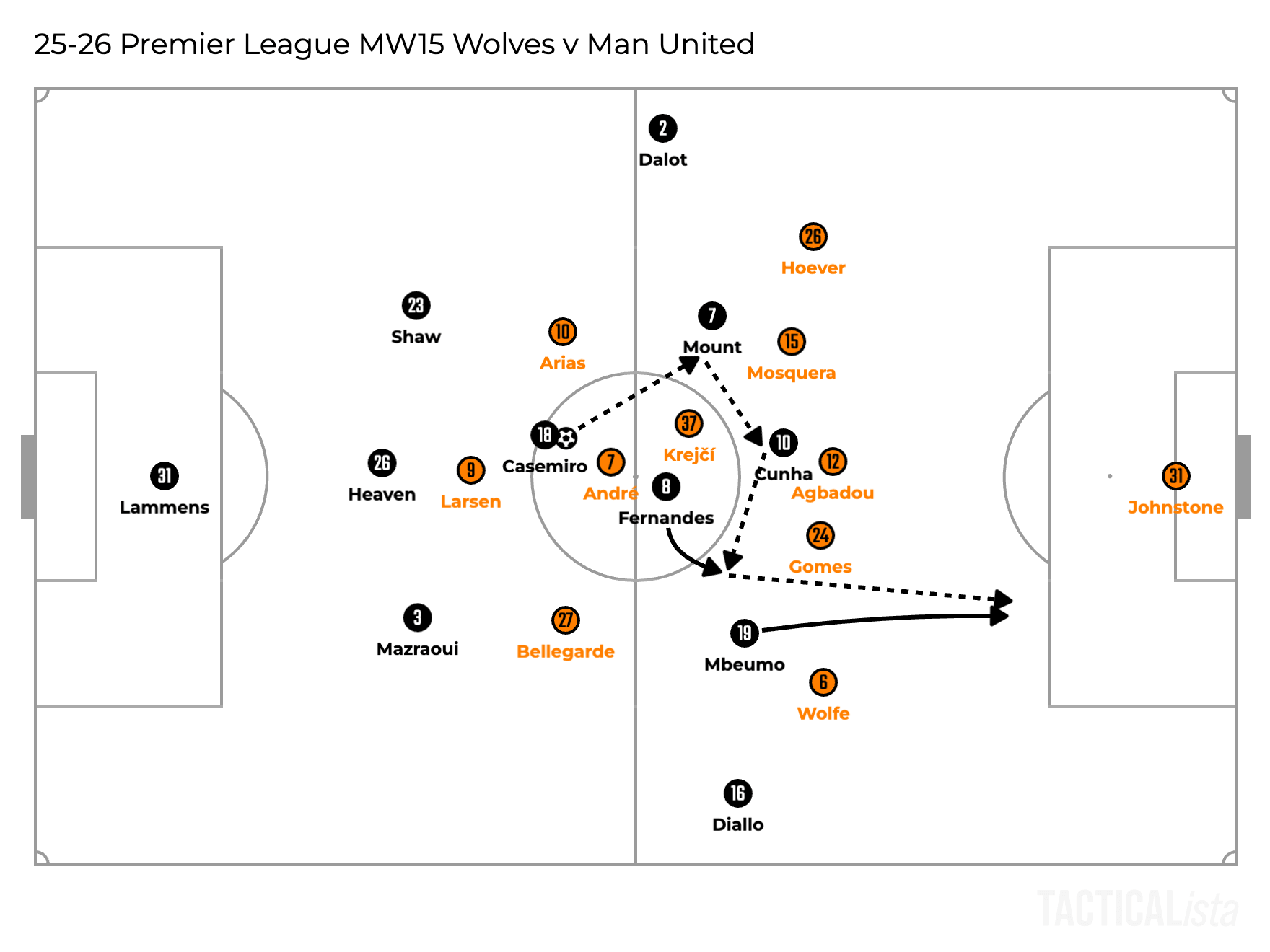
Bruno Fernandes roams in the middle to provide an extra option up front and as soon as he receives the ball, he splits the defence with a through ball. And then, Mbeumo is always there.
Another pattern of play is that Cunha drifts into wide areas. He doesn’t stick to play inside and he often provides an option to play around the opposition midfield line. This is a really common method especially when the opposition closes the middle well.
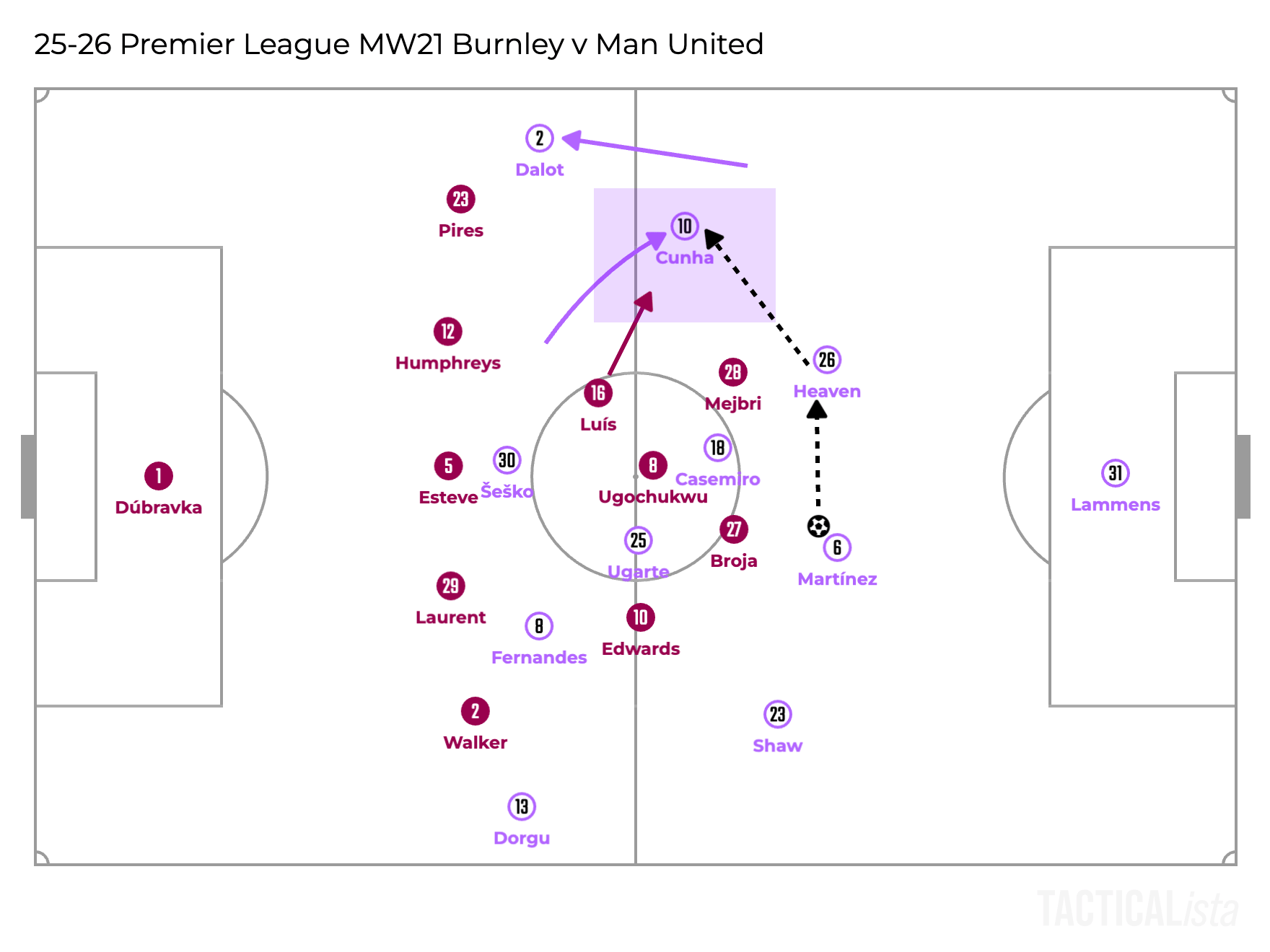
And this Cunha’s movement can be seen after Carrick’s take over. The new manager basically defends with a 4-4-2, but in possession, he tweaks it to the 3-2-5 and Cunha plays the same role.
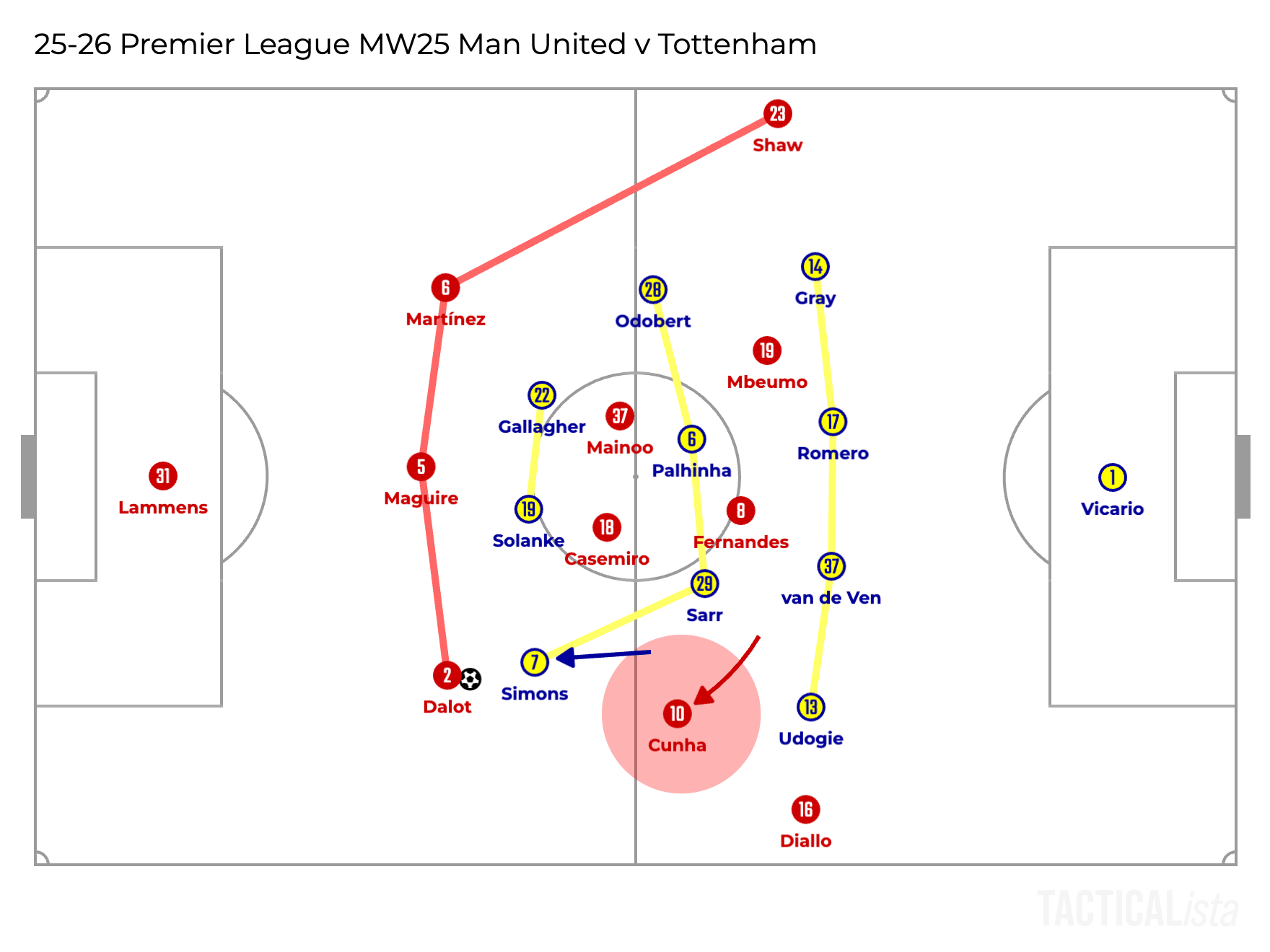
The system is the same, but the differences are Luke Shaw started to step higher than before while Dalot initially stayed deeper. This is because, on the left side, Cunha or Mbeumo prefers to come inside, but Amad is a pure winger on the right, so both fullbacks adjusted to their pair on the flanks.
Not sure if this is what they intended, but the change of the initial position of the fullbacks strengthened their attack in the final third.
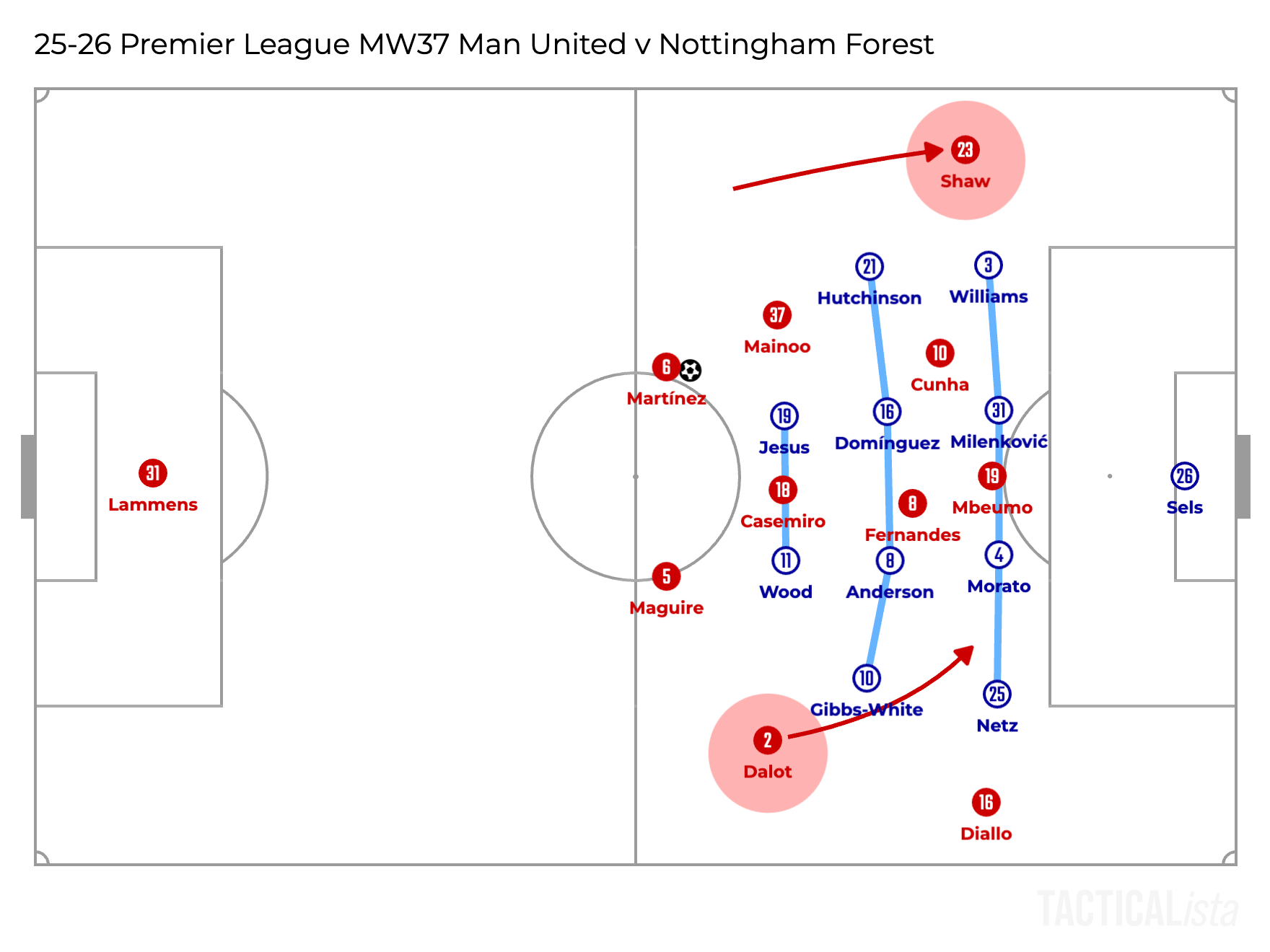
Dalot is often deep in the middle third of the pitch, but when they are attacking the box, he finds a pocket of space and joins them from the back. He can overlap or underlap depending on Amad’s position to generate a threat from the right side.
Overall, Carrick’s job in possession was to make it simple and make the most of Amorim’s legacy. He carried on Amorim’s idea with a different system in build up, but comes back to his 3-2-5 as he thinks it is the best in the specific phase of play. When things are clear to them, these talents can thrive and he is very flexible to find the solutions for the players.
Out of Possession
The biggest change after Carrick’s appointment was their mentality out of possession.
They used to be passive, but he enabled the team to defend more proactively. This includes the more effort, such as coming back to fill the gaps around the box, but there was also tactical change which made them more energetic.
Especially when pressing high, they used to press man-to-man, but he changed the shape and instilled zonal pressing with a 4-4-2, which both wingers keep their positions higher to press on the centre backs. This pressing method also helped Man City to beat Arsenal twice later this season, including their triumph of the Carabao Cup.
From Man-to-Man to Zonal Pressing
This is how Amorim let the team press against Arsenal on the opening day of this season.
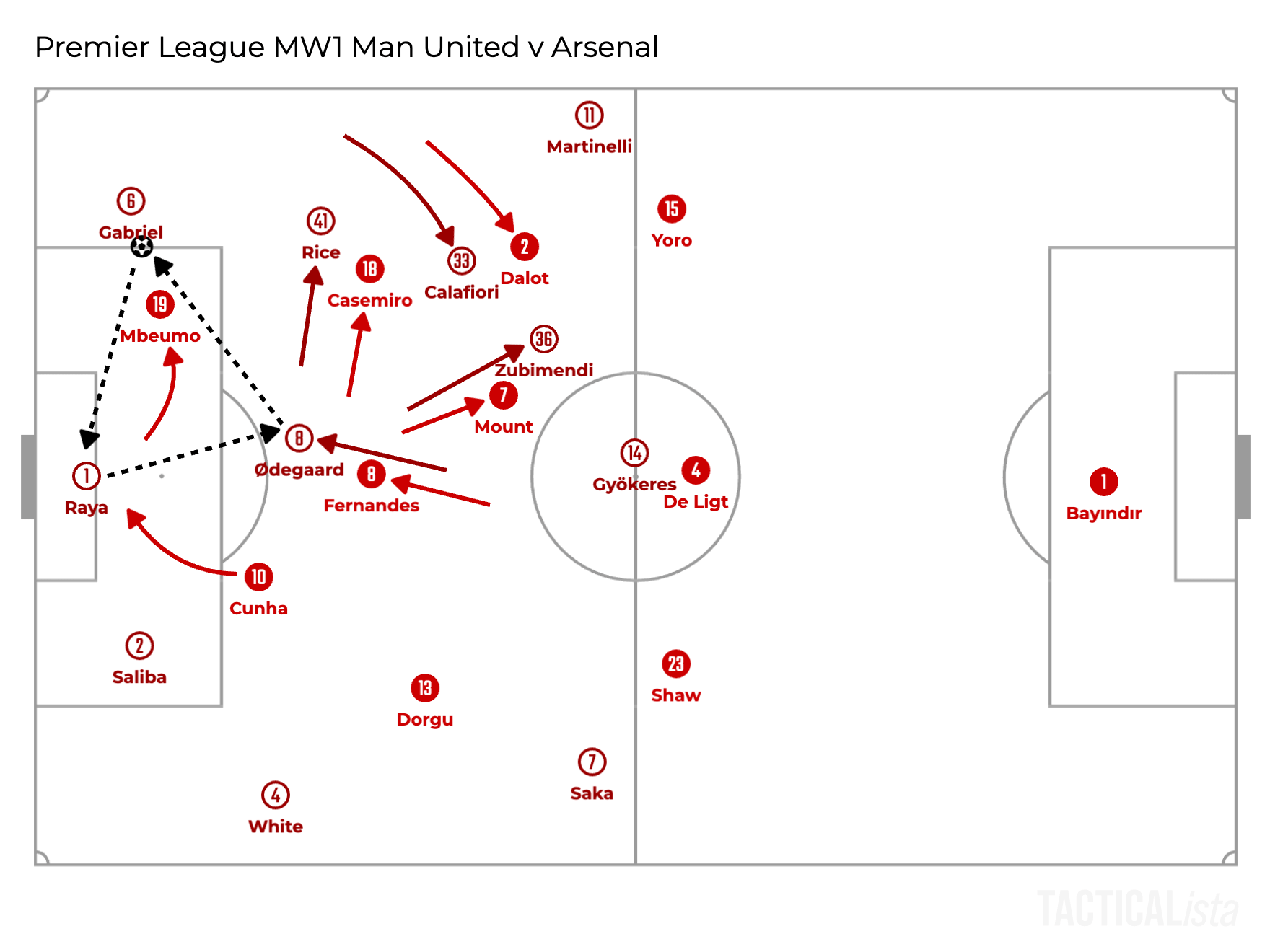
Against their build up play, they matched up their shape to go man-to-man, tracking their rotation in the midfield. This type of pressing is a recent trend, so tactically nothing wrong, but it just required higher intensity which probably Amorim couldn’t get the best out of his men.
In contrast to Amorim, Carrick instilled a zonal pressing with a 4-4-2 shape.
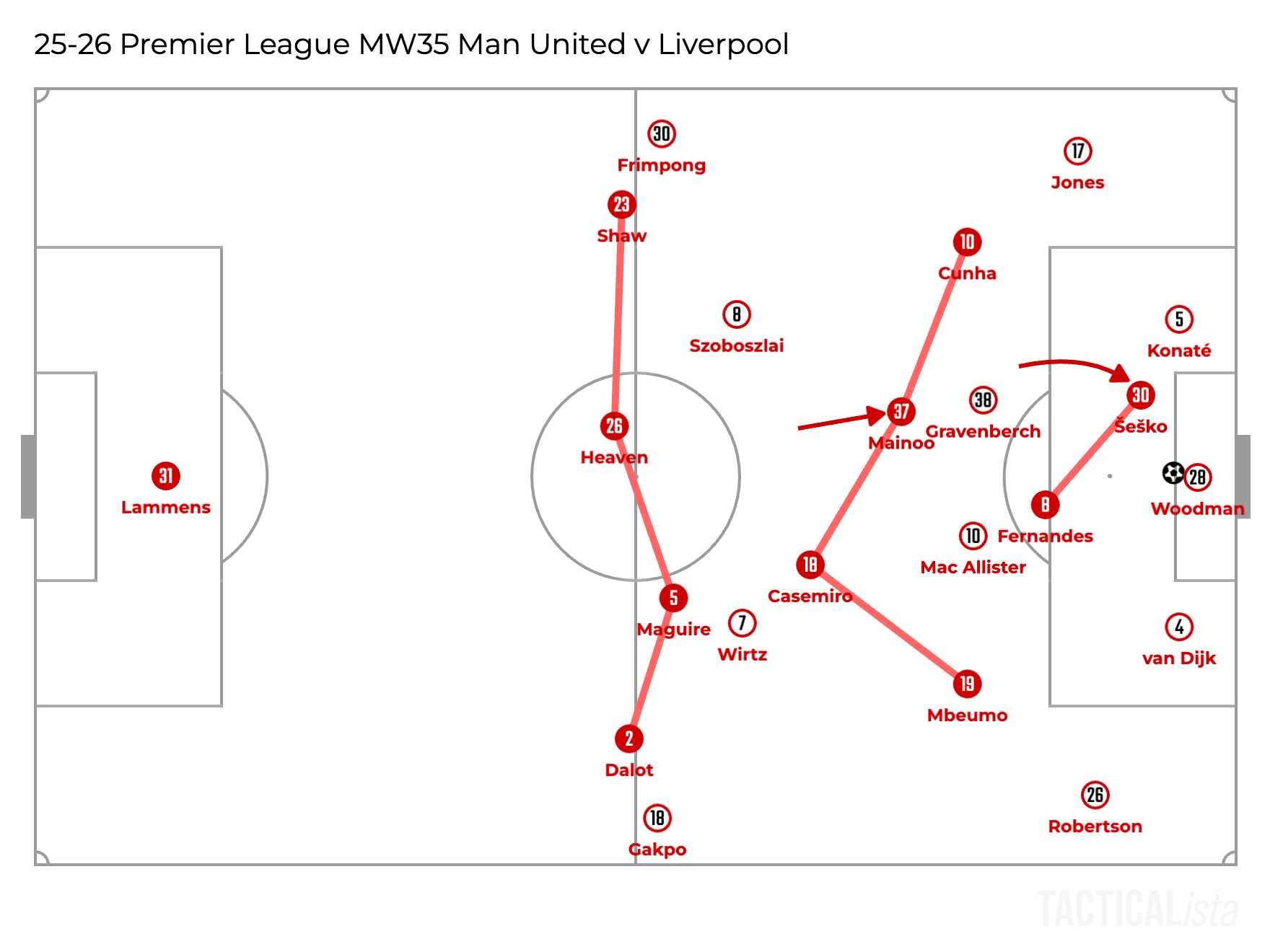
As shown above, while Šeško applied pressure on the goalkeeper on the ball, Bruno Fernandes screened the passing lane to the opponent on his back, Mac Allister. This helped Casemiro hold his position in the deep midfield, minimising the risk of being exploited there.
Another more obvious example is Carrick’s tactics against Chelsea. In this game, both Šeško and Bruno Fernandes stayed closer to focus on screening the opposition defensive midfielders behind them, and both wingers were even higher than them to press on the opposition centre backs.
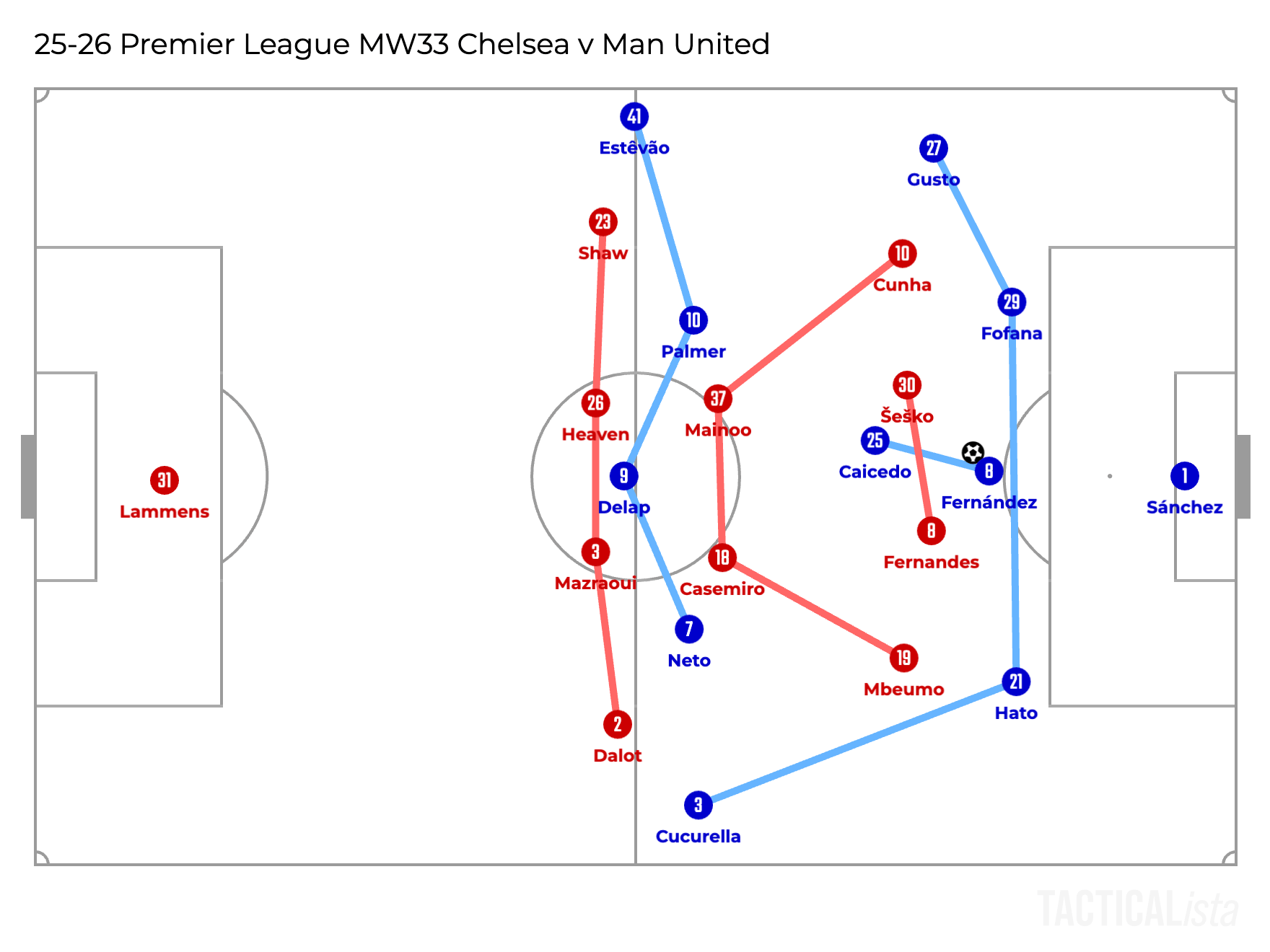
As similar to the previous illustration, thanks to the first line to stay deep, both defensive midfielders Mainoo and Casemiro didn’t need to commit forward and were able to manage the opponents in each half space, Cole Palmer and Pedro Neto.
This zonal pressing enables the team to press proactively and take the initiative. Unlike the man-to-man approach, which can be manipulated by the opponents, the zonal pressing can secure the structure. This structure provides the overloads around the ball and ultimately organised threat in counterattacks.
Proactive in Defensive Third
Before talking about their counterattacks, their greater effort to protect the goal should be mentioned, as defending the goal is another objective of this game.
Here’s how they conceded the goal against Burnley, who relegated by finishing in the 19th position this season.
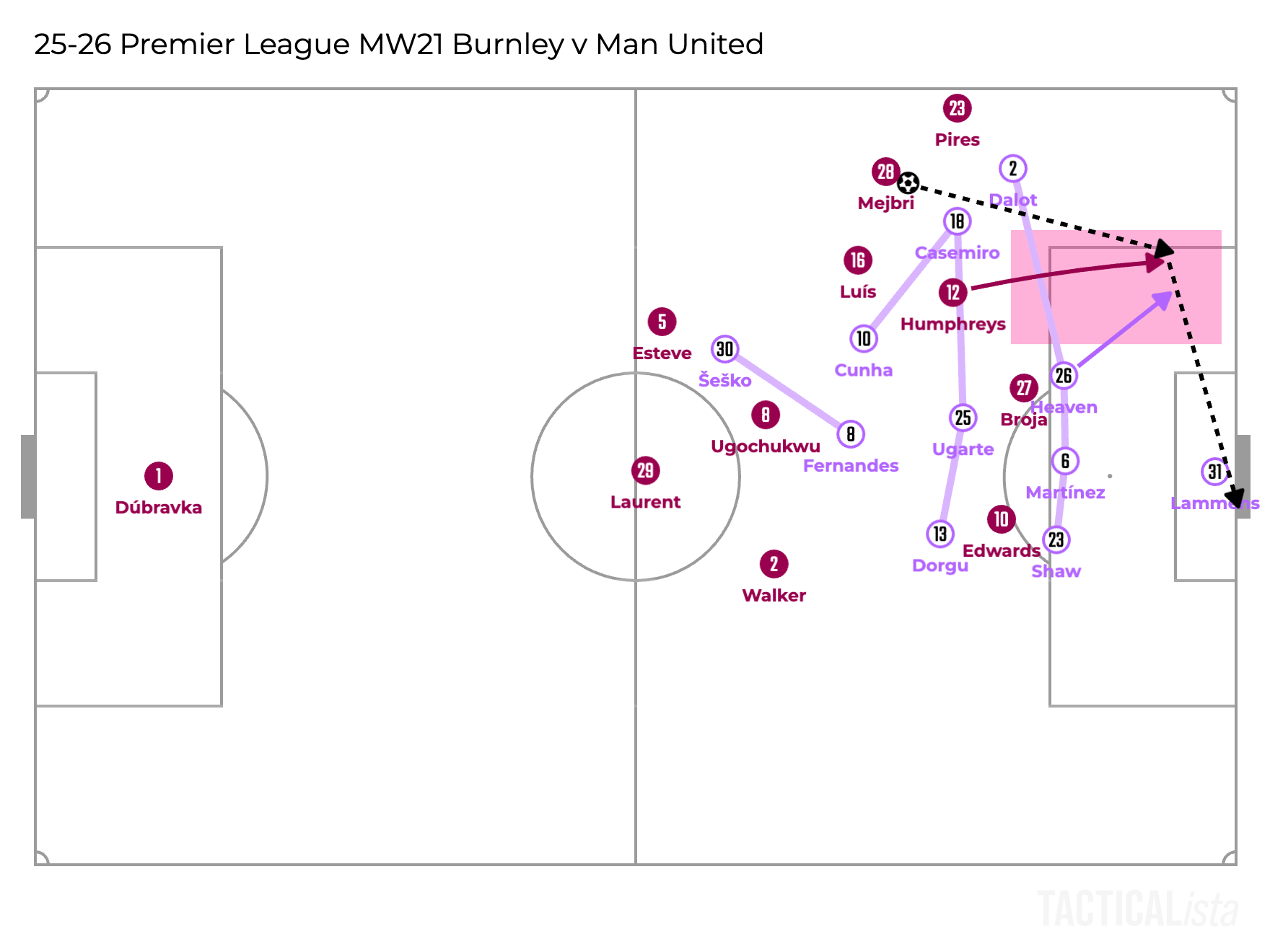
At the end of his era, Amorim tweaked the shape into a 4-4-2 and this game is one of them, and it is clear that the players didn’t understand how to defend with a back four as the relegated club could unlock the United’s defence. In that scenario, there was no protection of the channel, which is the space between Dalot and Ayden Heaven as Cunha didn’t come back and Casemiro was dragged away. Of course, there could be a motivational reason, but it was also true that they didn’t see the same picture of defending with the back four.
This is what Carrick has fixed.
Here’s how they defended against Arsenal at Emirates.
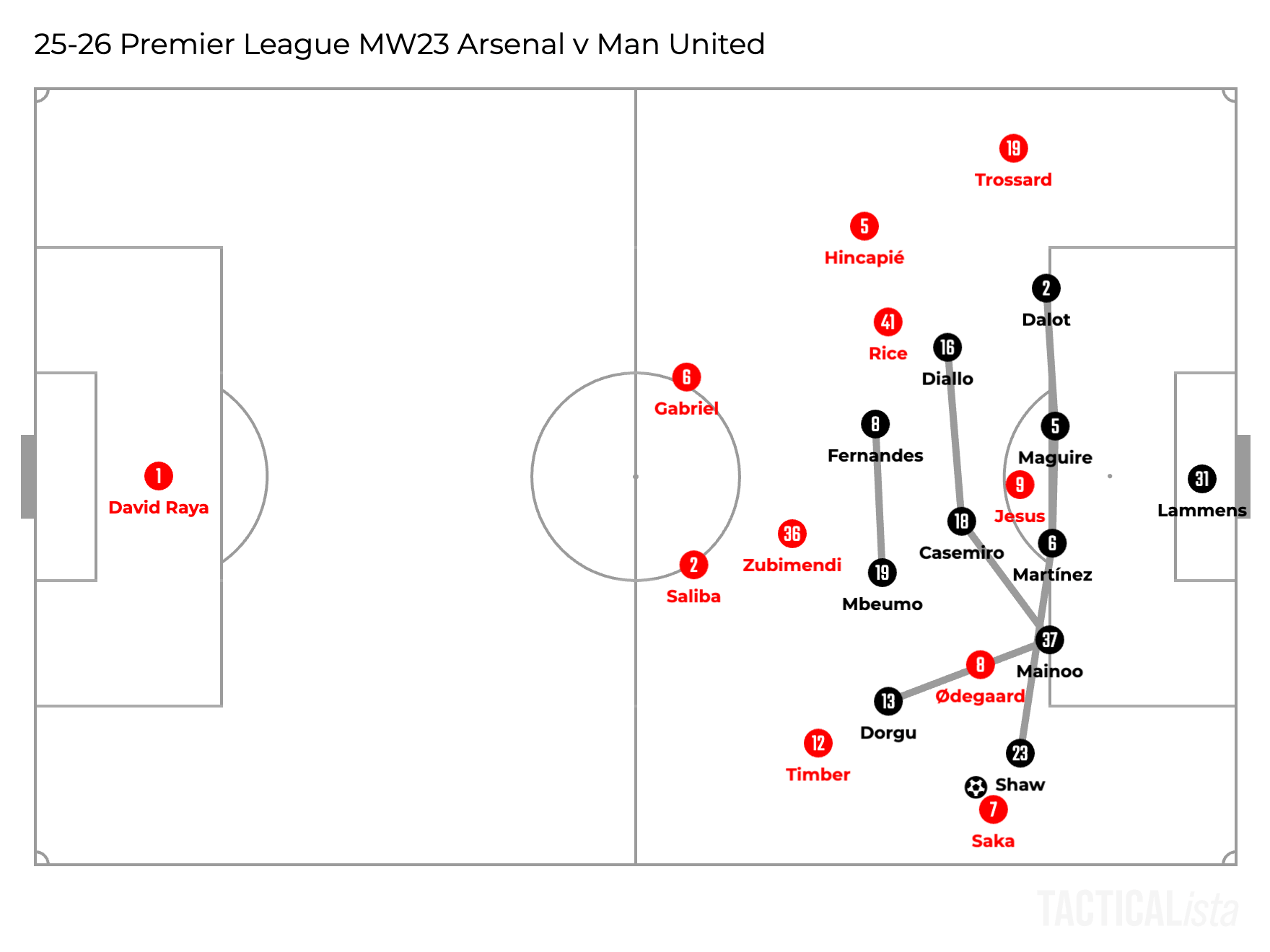
The left fullback Shaw committed to Bukayo Saka and at the same time, Mainoo dropped into the space between Shaw and Lisandro Martínez as shown above. In this game, they maintained this collective defence in their own third, which helped them to get all the points at Emirates.
In addition to the defensive solidity in front of the goal, their collective style of defence is designed to force the opposition to play back and push the lines up, not just sitting deep.
When defending deep, it is difficult to trigger pressing as the priority is defending the goal over pressing forward and the opposition can easily play around. However, their zonal approach can make it possible by regaining the initiative when defending deep.
As shown below, when defending deep, they try to force the opposition to play outside and prevent them from switching to the other side.
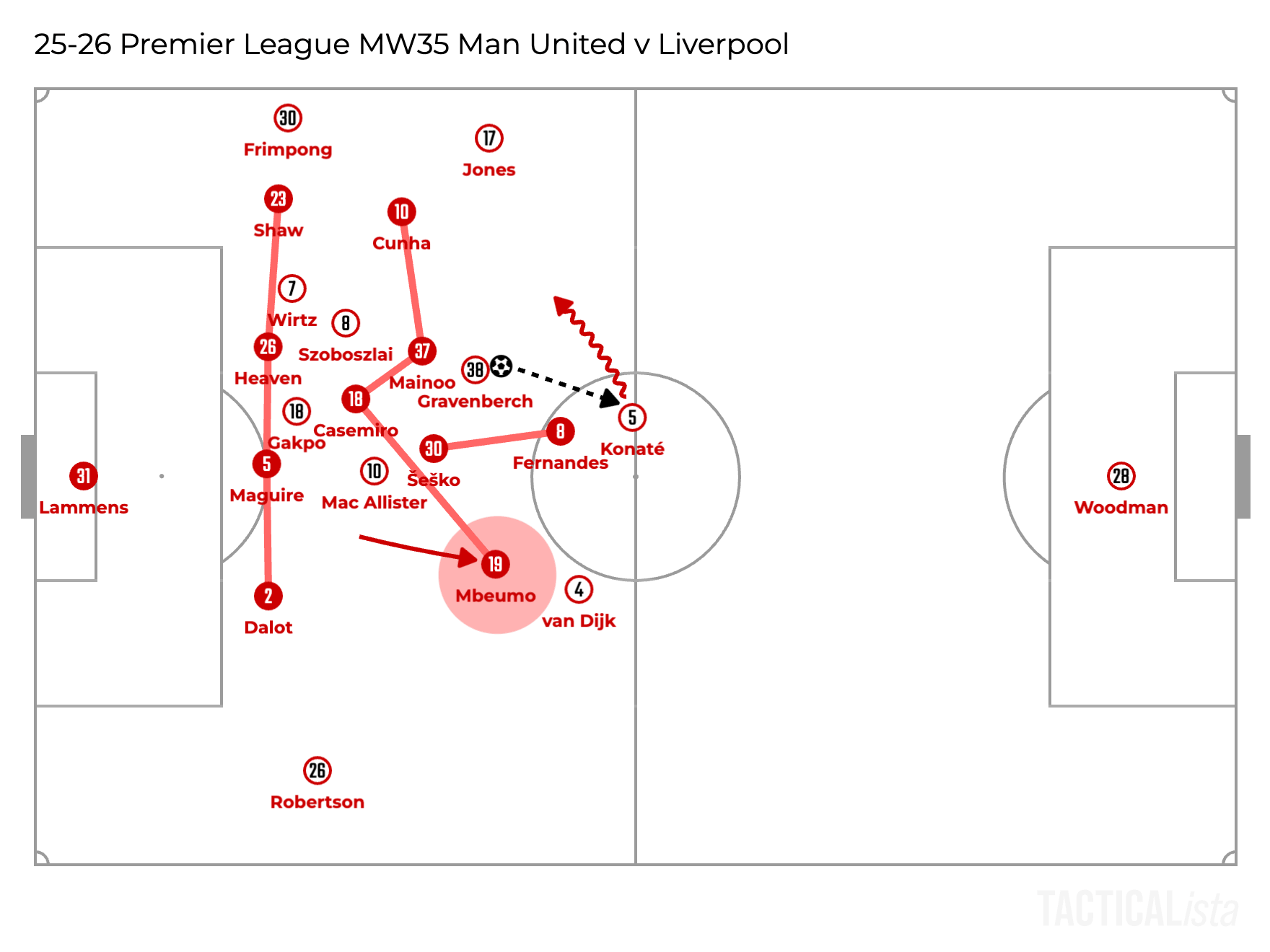
To achieve this, their key position is the opposite winger, Mbeumo in this illustration. When the ball is played on the other side, he doesn’t drop unnecessary and stays high to keep his eye on the opposition centre back, denying the passing option to play around.
This is typical behaviour of zonal defending. If they had kept defending with a man-oriented approach, Mbeumo would’ve tracked the opposition left fullback Andrew Robertson without thinking anything and dropped into the back line. However, they now stress the structure of their own, so they can take the initiative when defending, meaning that they can keep being proactive out of possession.
Ruthless in Attacking Transition
And the reason why they want to defend zonally is that they can play structured counterattacks rather than random ones. This transitional moment is their biggest strength, so their defensive approach is designed to generate effective counterattacks. The illustration below shows their counterattack against Brentford.
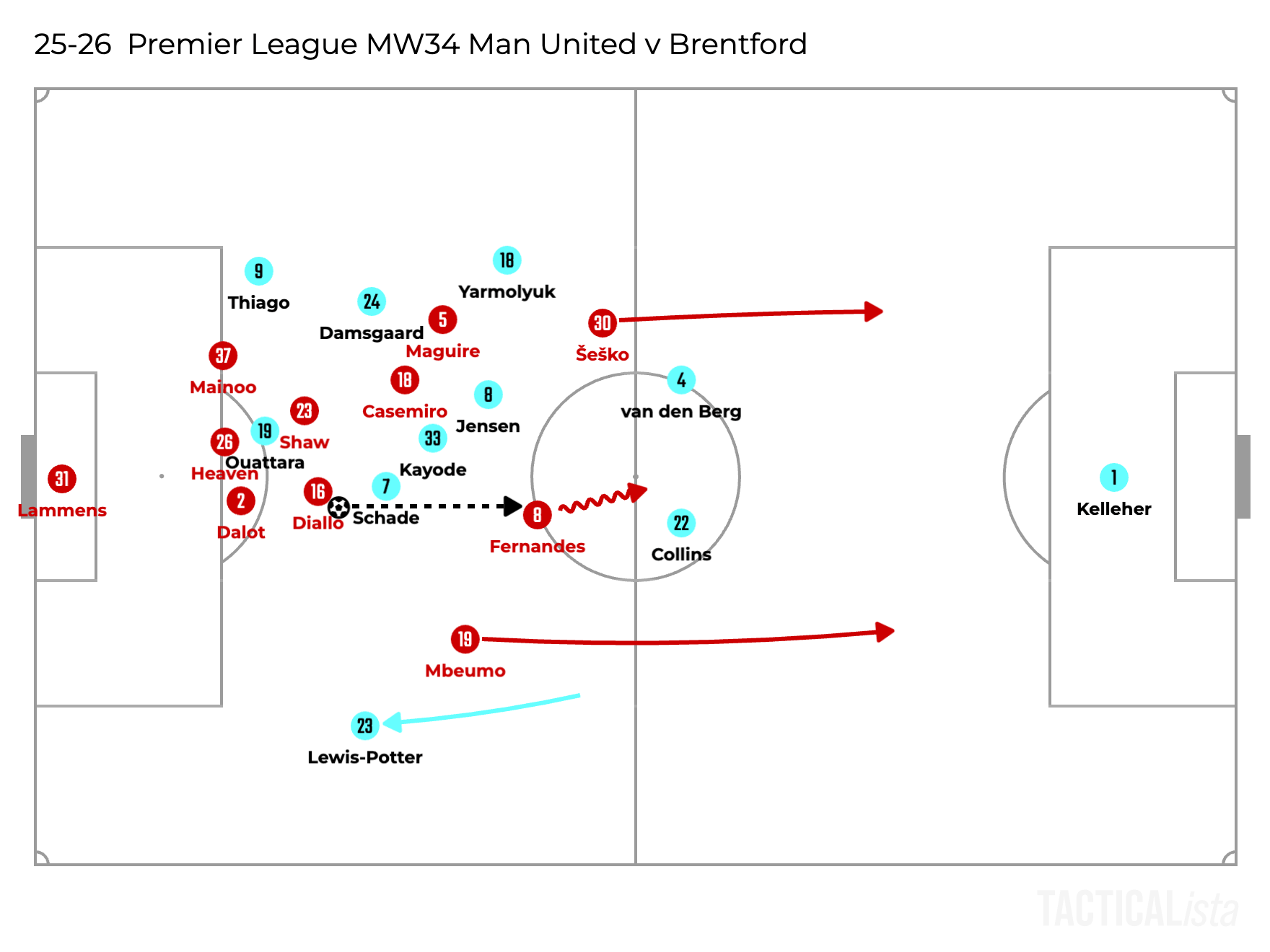
This counterattack originated from the moment when Brentford tried to break through quickly and United regained the ball. As soon as Bruno Fernandes received the ball in between the lines, both Šeško and Mbeumo burst forward alongside him to create the 3v2 overload to exploit.
Another one is the counterattack which led to the goal against Liverpool. They regained the ball in their own third, played a few passes to nullify Liverpool’s counter pressing and exploited the space in behind quickly.
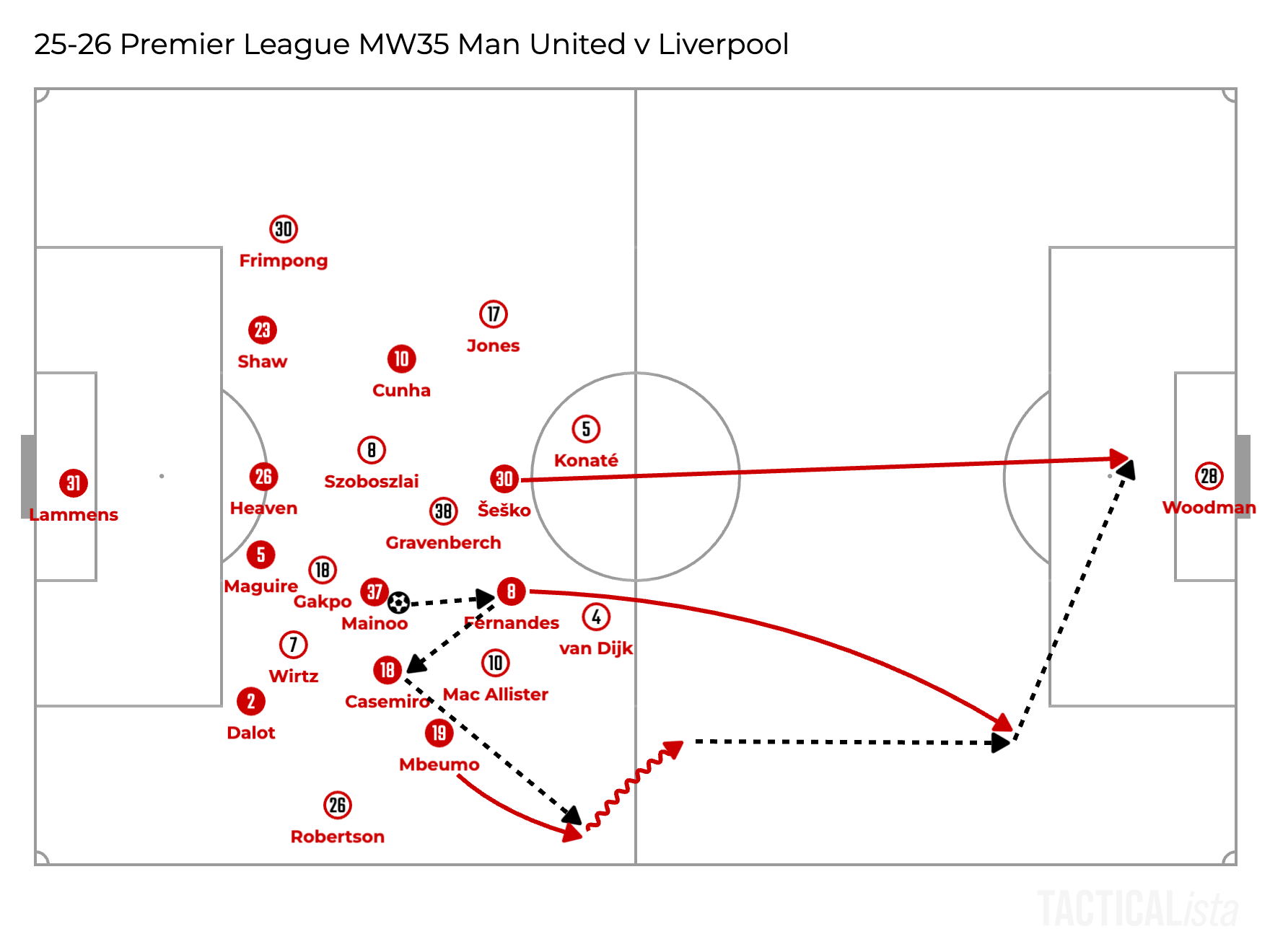
They could beat the opposition counter pressing thanks to their zonal structure as they maintained close distance to pick teammates instantly. Then, Mbeumo kept his position higher, so easily exploited the space behind Robertson and initiated the counterattack.
So overall, Carrick’s defensive approach is not passive anymore and organised to make the most of their strength in attacking transitions. This transformation is something most vital in their revival in the league.
The possible weakness is likely to be how they can break down the opposition deep defensive block when they don’t have space in behind. This is a typical problem to solve to win the league, but similar to Arsenal, they scored a lot from set pieces this season. However, as Casemiro is leaving, this area might need to be improved towards the next season. Surely, Man United are back.