Pep’s Tactical Evolution & Why? [Pep Guardiola’s Manchester City Tactical Analysis 25-26]

Introduction
Manchester City are currently 2nd in the league, the finalist of Carabao Cup, the quarter finalist in FA Cup and still competing in the Champions League. This sounds great for most teams, but not enough for those who know the taste of winning the silverwares.
Pep Guardiola, who has been in charge of Man City for a decade, has already tried to adjust the team for the modern games with faster tempo and more transition after the disappointing season in 24-25 season, but further tweaks were made during this season with the new signings in the January transfer window.
Marc Guéhi from Crystal Palace and Antoine Semenyo from Bournemouth immediately strengthened the squad after several injuries in each position and provided Pep with more options, which pulled the trigger on tactical changes.
In this article, how Pep changed their game and the positive consequences, including the improvement of high pressing to generate dangerous attacking transitions, faster tempo of their game and the central overload are going to be analysed in detail.
Before moving on, here’s the tactical change of Man City at the beginning of the 25-26 season. This will definitely help you understand the reason why Pep needed to adjust the team now.
Improvements in Pressing
Firstly, how the tactical change helps Man City press effectively is going to be discussed as this part of the game has been the main topic of Pep’s side in this season after adding Pepijn Lijnders as the assistant coach, who had experienced working with Jürgen Klopp.
As it has been already identified in the early stage of this season and analysed in the article above, their high press had a lot of risks to get the rewards, and the only flip side of it appeared on the pitch. They set the high line, but the opponents often managed to break through while staying onside. They locked the opposition in the ball side and squeezed the space, but the lack of intensity of pressure on the ball often let them switch the ball easily.
Of course, it is never easy to encourage the players who are used to playing slow-tempo and possession-based football to chase the ball like Red Bull clubs, and it seemed a long way to achieve this project. However, the new signings, especially Guéhi’s individual brilliance and the tweak of the shape have accelerated their evolution.
From the 4-5-1 or 4-3-3 defensive shape, Pep’s side switched to the 4-Diamond-2, which one of the holding midfielders of the 4-4-2 steps up to be the top of the diamond midfield. This crucial role has been often performed by Bernardo Silva, who is the most intelligent and hardworking player.
The illustration below shows how the new pressing tactics worked against Liverpool at Anfield.
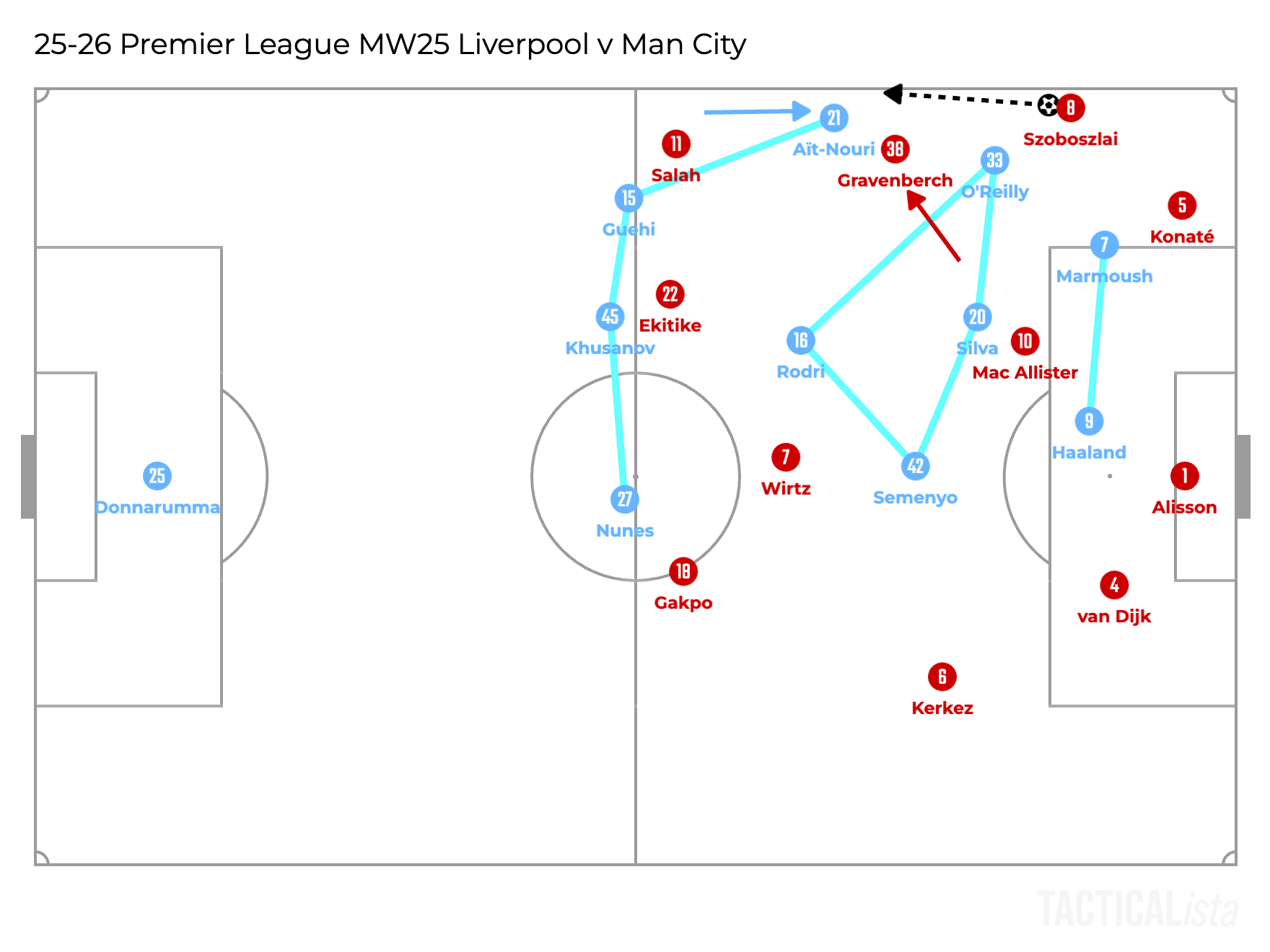
The two forwards and Silva closed any passing routes through the middle to force Liverpool to play outside. Then, one of the wide midfielders, Nico O’Reilly this time, jumped to press on the ball and the ball side fullback followed the press with other defenders sliding across the pitch. This is how to lock the opposition in the compact area.
There are two main differences.
The first one is that both wingers, or technically wide midfielders, stay narrower. Before this tactical change, the opposite winger was often positioned wider and vacated the space inside, which had been exploited by the opposition a lot of times. Semenyo, on the other hand, keeps his position more inside than other wingers, and originally O’Reilly is a midfielder, so doesn’t mind staying narrower.
Another key factor is that Pep reduced the movements in pressing. He prefers zonal pressing to man-to-man pressing, therefore, especially the midfielders needed to shuffle across for a long distance repeatedly.
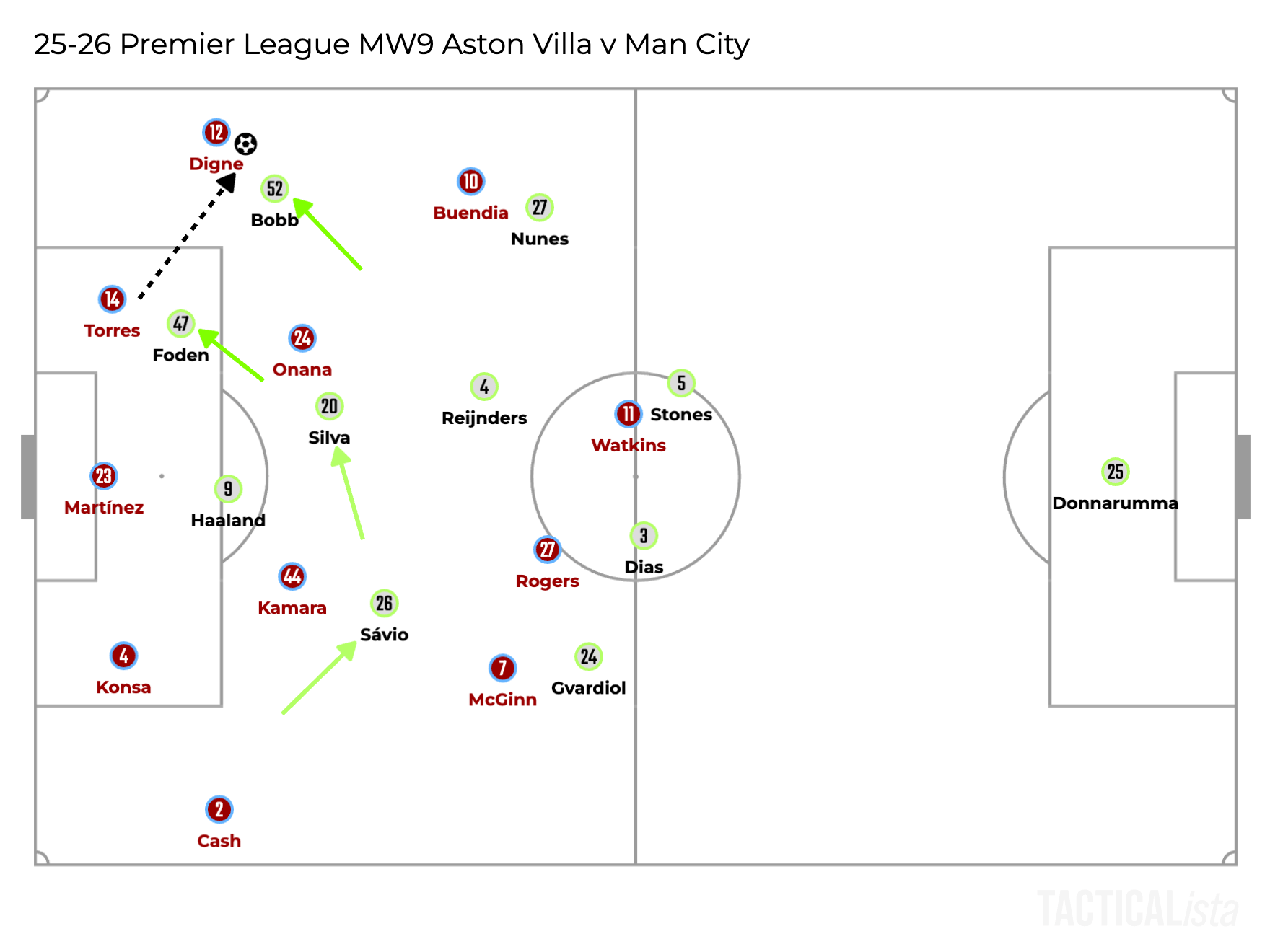
The image below illustrates how the midfielders worked against Aston Villa’s build up play. As soon as Pau Torres played to the left fullback, City’s midfield line slid across to the right side.
On the other hand, when Villa switched the ball to their right side, they needed to do the opposite.
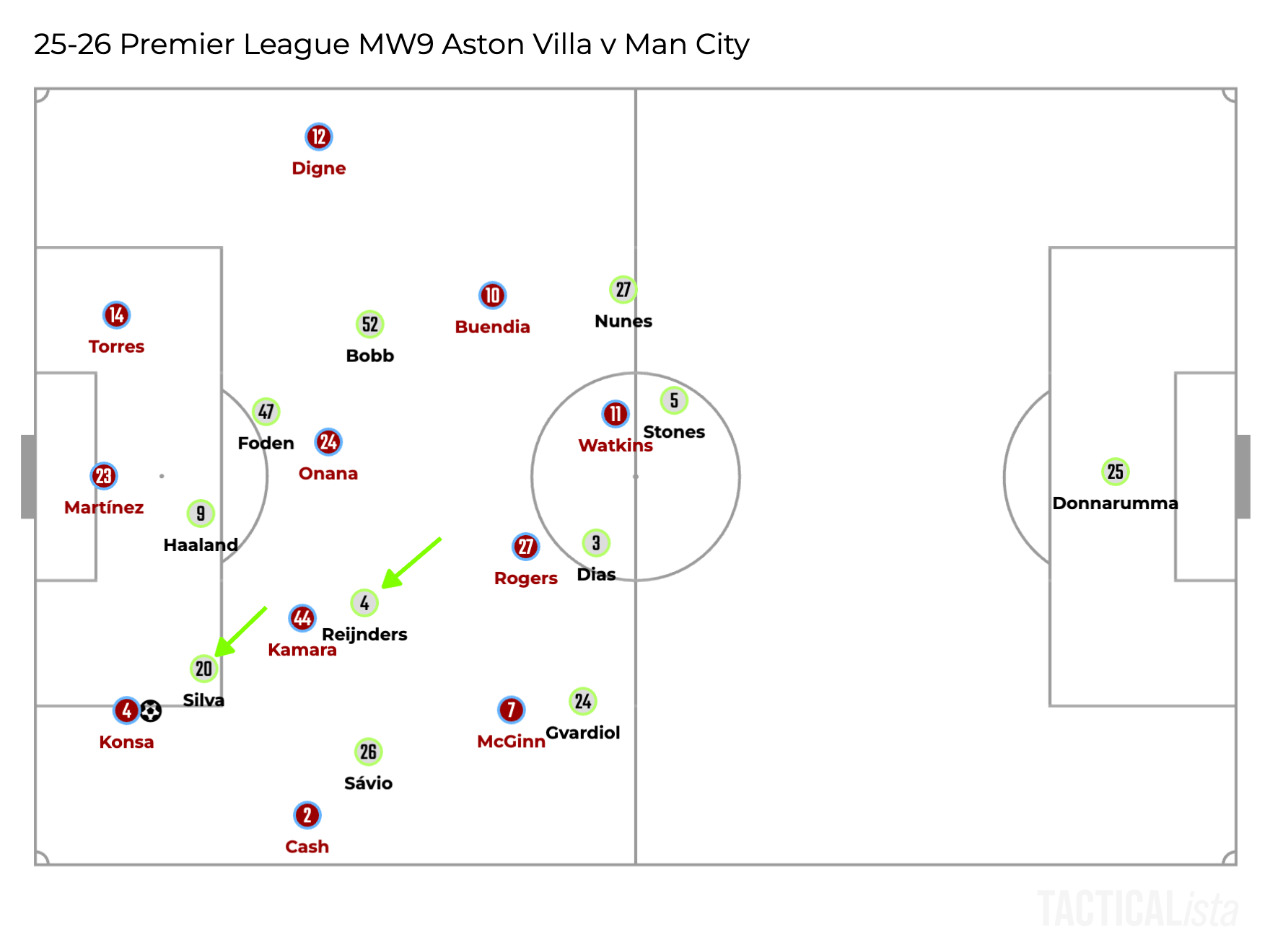
What should be focused on here is the difference of the opponent to look after in each scenario. When the ball was played to City’s right, the right attacking midfielder Phil Foden pressed on the centre back on the ball while the left attacking midfielder Silva was marking the opposition defensive midfielder. However, on the other side, it was Silva to press on the centre back on the ball and Foden to mark the defensive midfielder.
This press & cover structure can work only if the opposition is not good at playing with the ball. If the opposition cannot play quicker, City’s players can be there on time. Nowadays, however, many teams can move the ball faster than the human can move in reality.
Therefore, Pep clarified what to do in each position. Two forwards press on the centre backs, the top of the diamond midfield marks the opposition defensive midfielder, the wingers stay narrower and press on the fullbacks, and the remaining defensive midfielder covers the space in between the lines. This helped them effectively close the gaps inside of the pitch, which forced the opposition to play outside and locked them in.
The narrow shape can not only help them to win the ball but also turn it into an immediate threat. As City’s players are close together, after winning the ball or securing the second ball, they can link up smoothly. Here’s the example of the attacking transition after regaining the ball against Fulham.
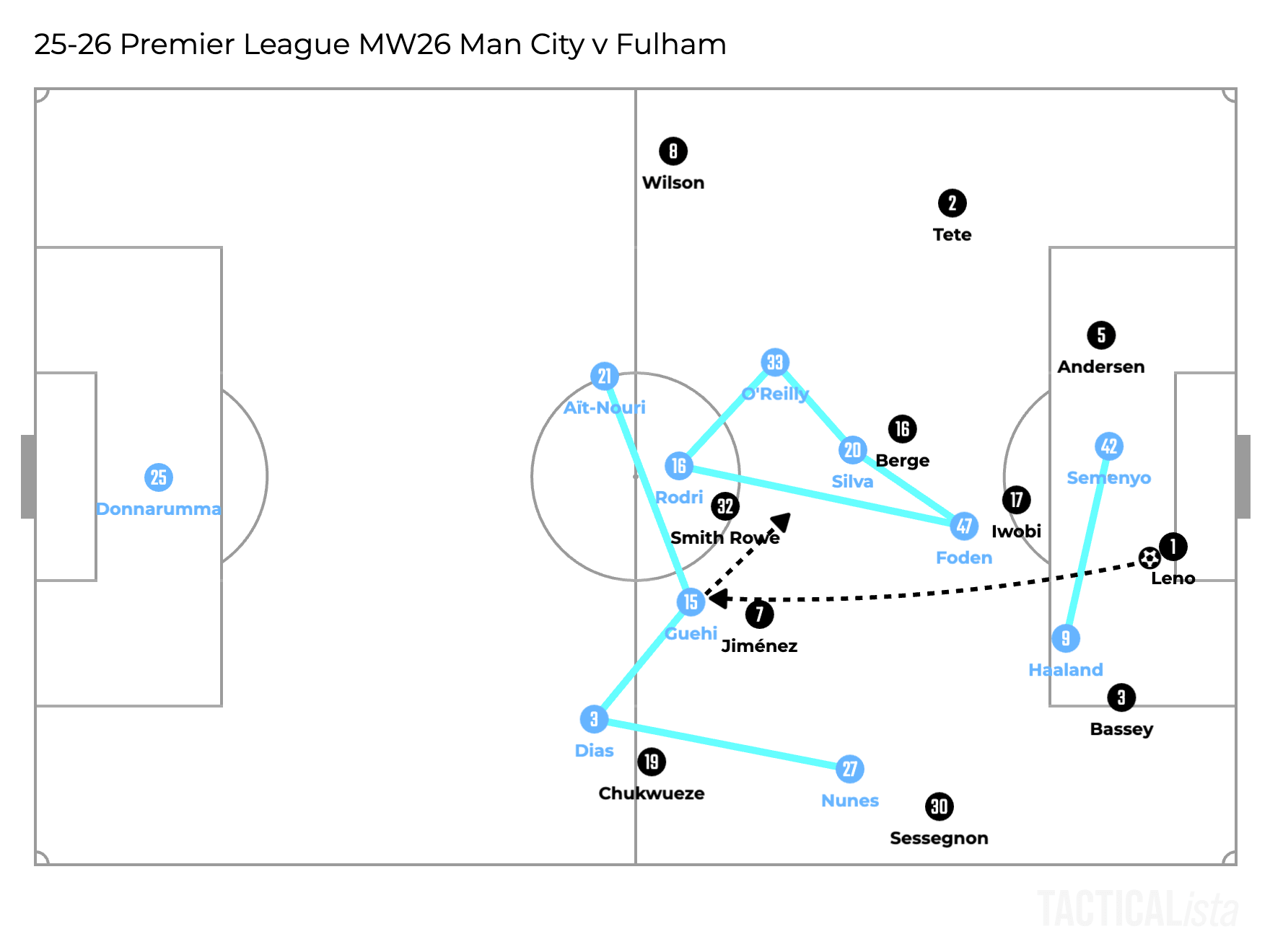
The front two and Foden cut off the nearest options from Bernd Leno, who could only launch the ball, and Guéhi won the aerial duel.
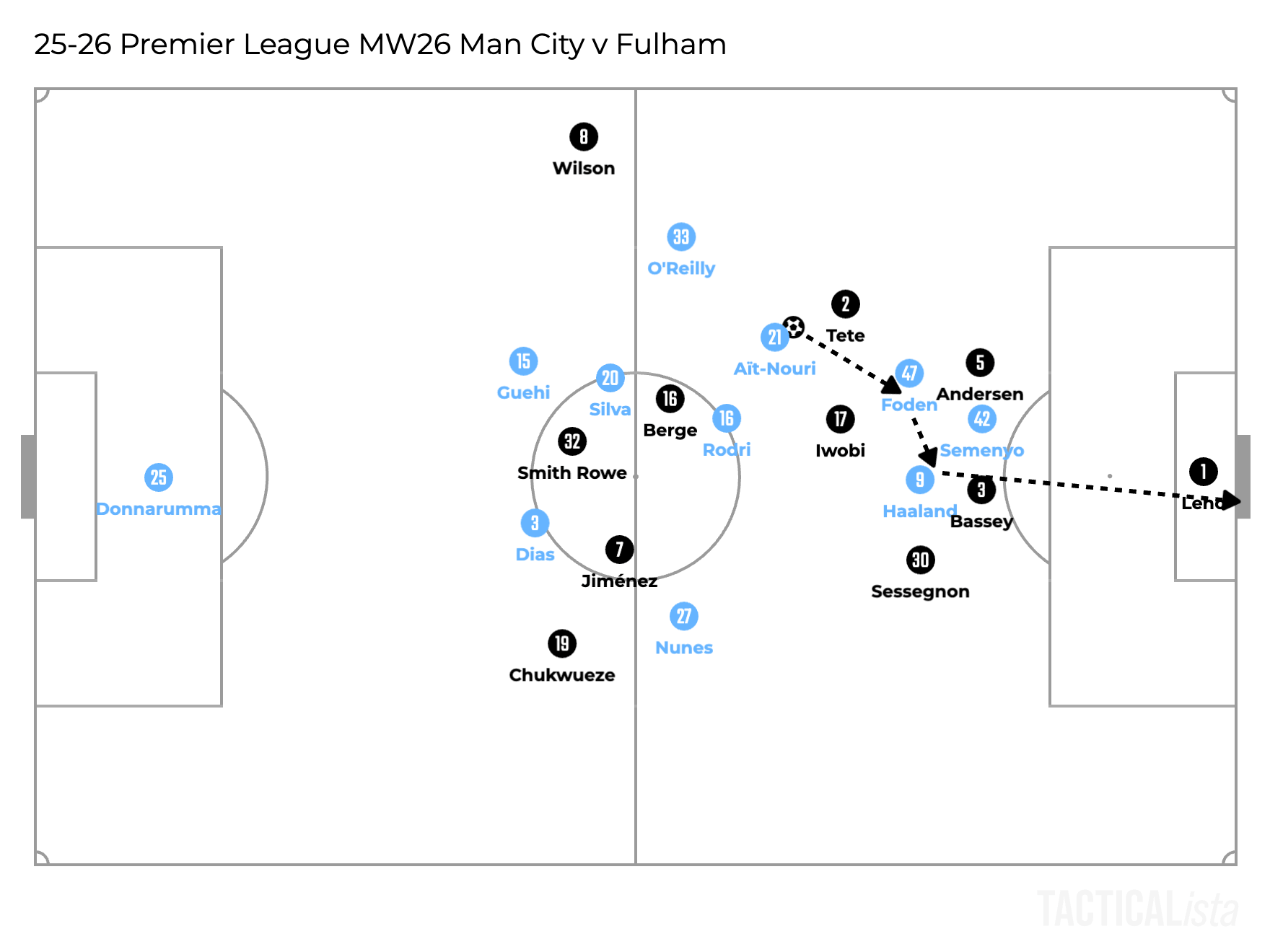
Then, the left fullback Rayan Aït-Nouri secured the second ball and played to Foden, and he passed to Haaland who scored from the outside of the box. The central overload will be analysed in the following chapter, but it is not only about the possession but also pressing and transitions. In addition to the shape, their mindset was also changed, though.
This pressing shape is nothing new in the Premier League. Their current title rival, Arsenal have used this structure. The illustration below shows how they pressed Chelsea in the recent league encounter.
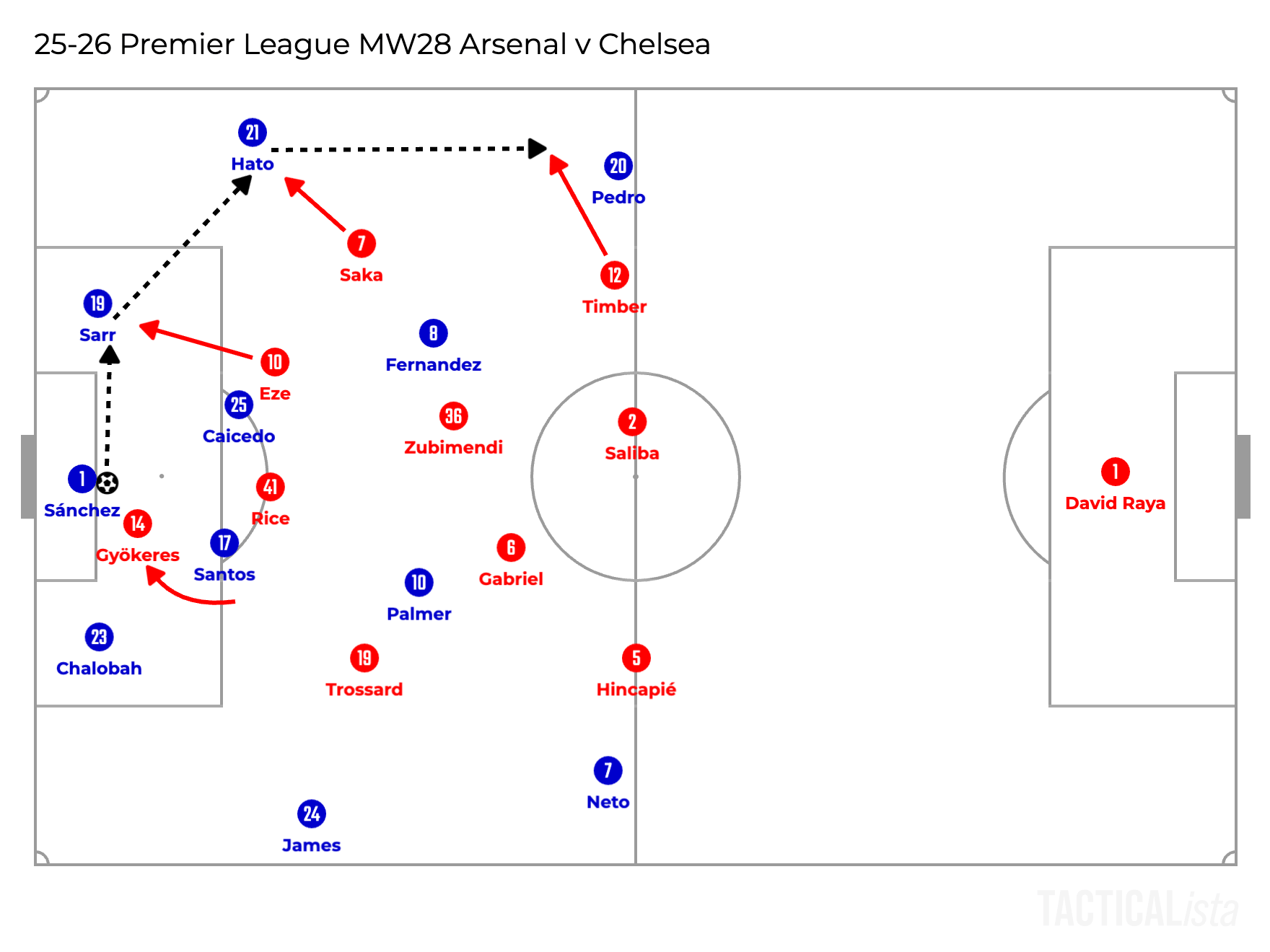
Arsenal deployed Viktor Gyökeres and Eberechi Eze as the front two and Declan Rice as the top of the diamond midfield, and both wingers tucked inside. The structure is the same, but there is a slight difference. Arsenal dictate the pressing direction by the striker pressing on the goalkeeper on the ball from a certain side, but City don’t.
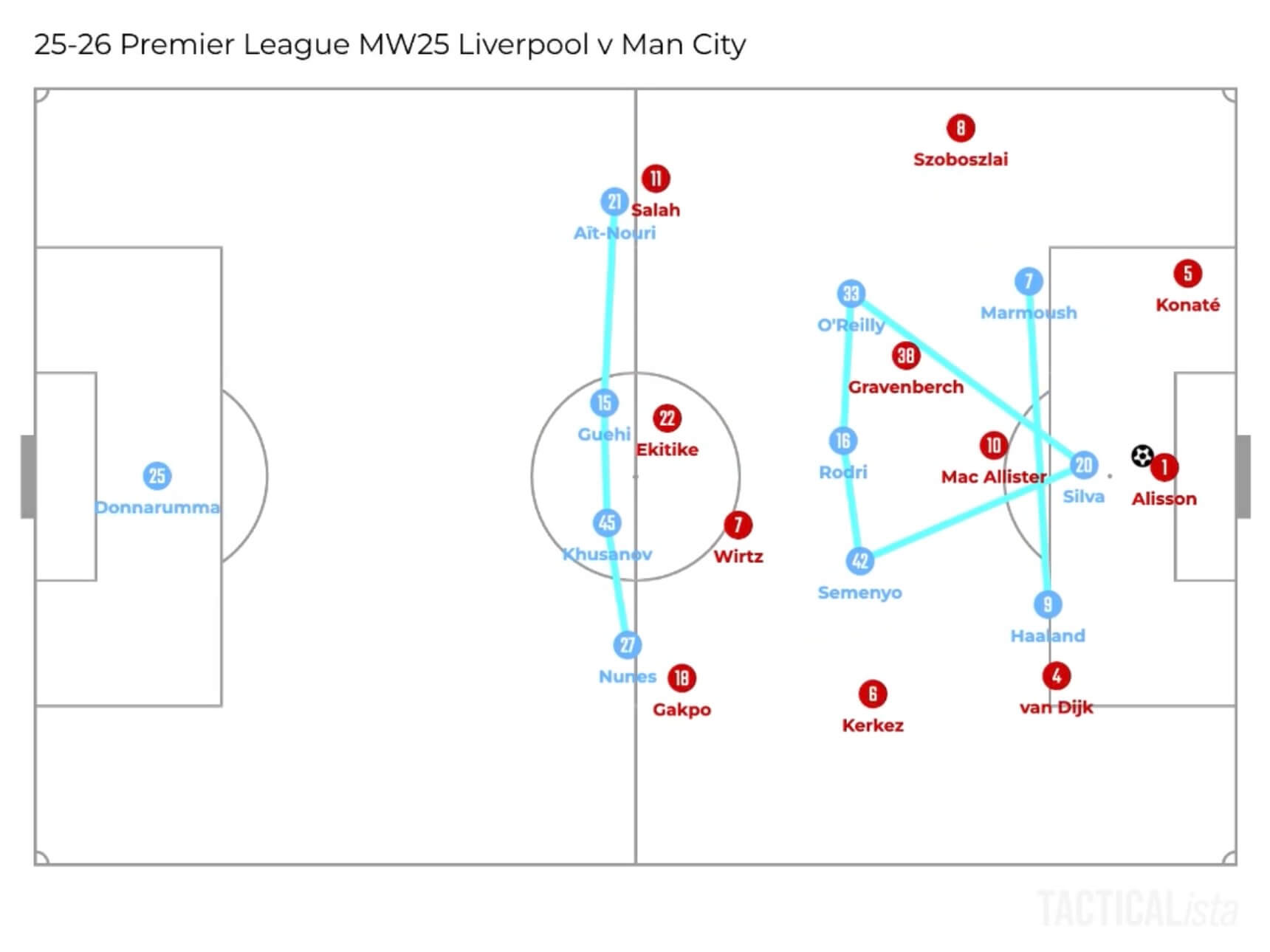
Like the example above, it is often Silva who presses the goalkeeper on the ball. The opposition goalkeeper can decide which way to play, but at least, to outside. Arsenal’s type of pressing can be beaten and they showed how to do it by themselves.
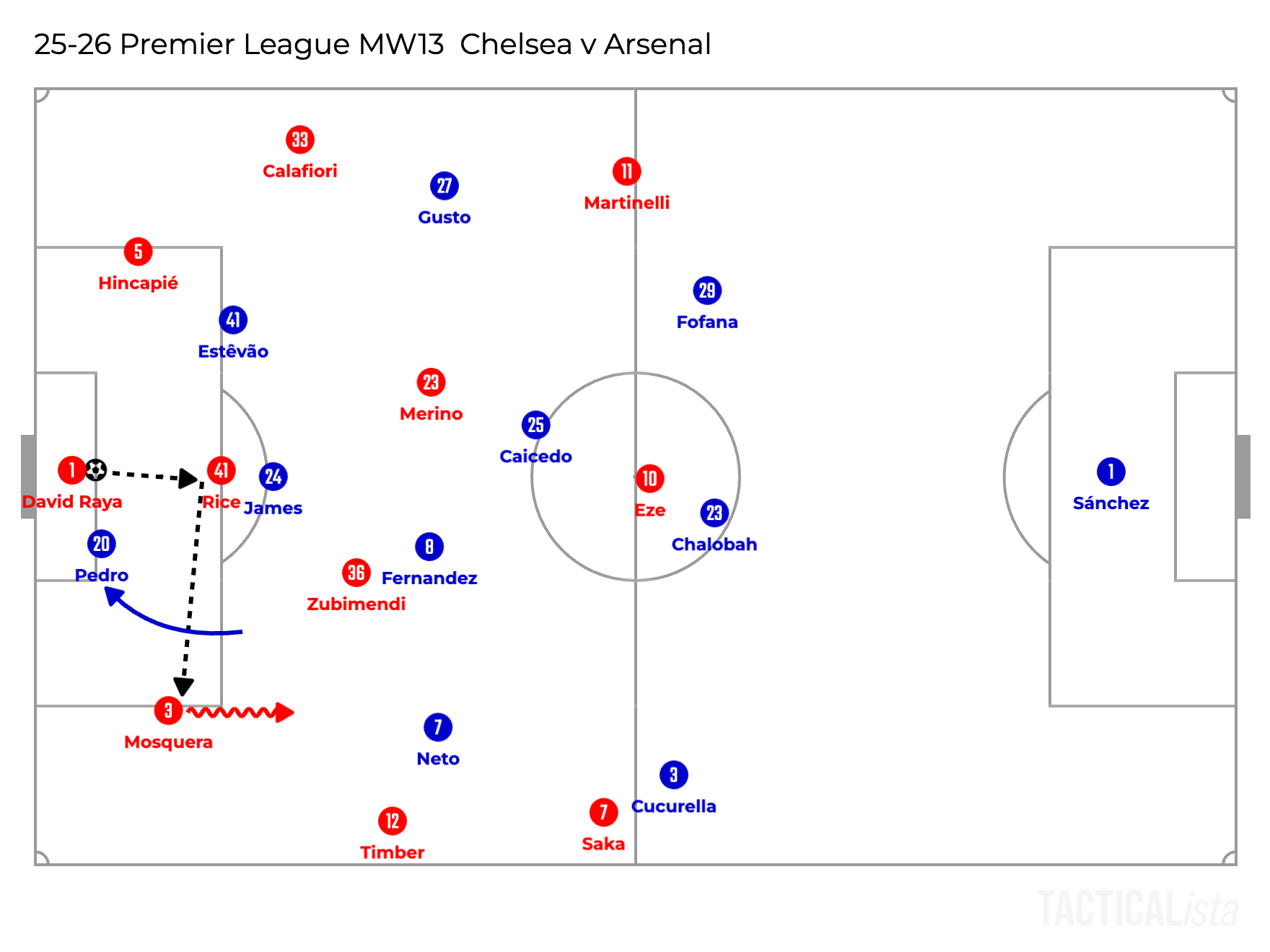
Chelsea’s striker João Pedro curved his run to press on David Raya on the ball from his right, but by using Rice as the 3rd man, they could reverse the pressing and find the free centre back.
This cannot happen against the City’s structure because neither centre backs are free. If the opposition goalkeeper can play through the City’s first line, it seems to be possible to beat the press, but there are three midfielders waiting for the prey to come.
Of course, not every pressing tactic is perfect. The obvious weakness is the vast space on the opposite side. As City want to maintain compactness on the ball side, if the opposition manages to switch the ball to the opposite side, things can change quickly. But in the end, the individual qualities can solve everything.
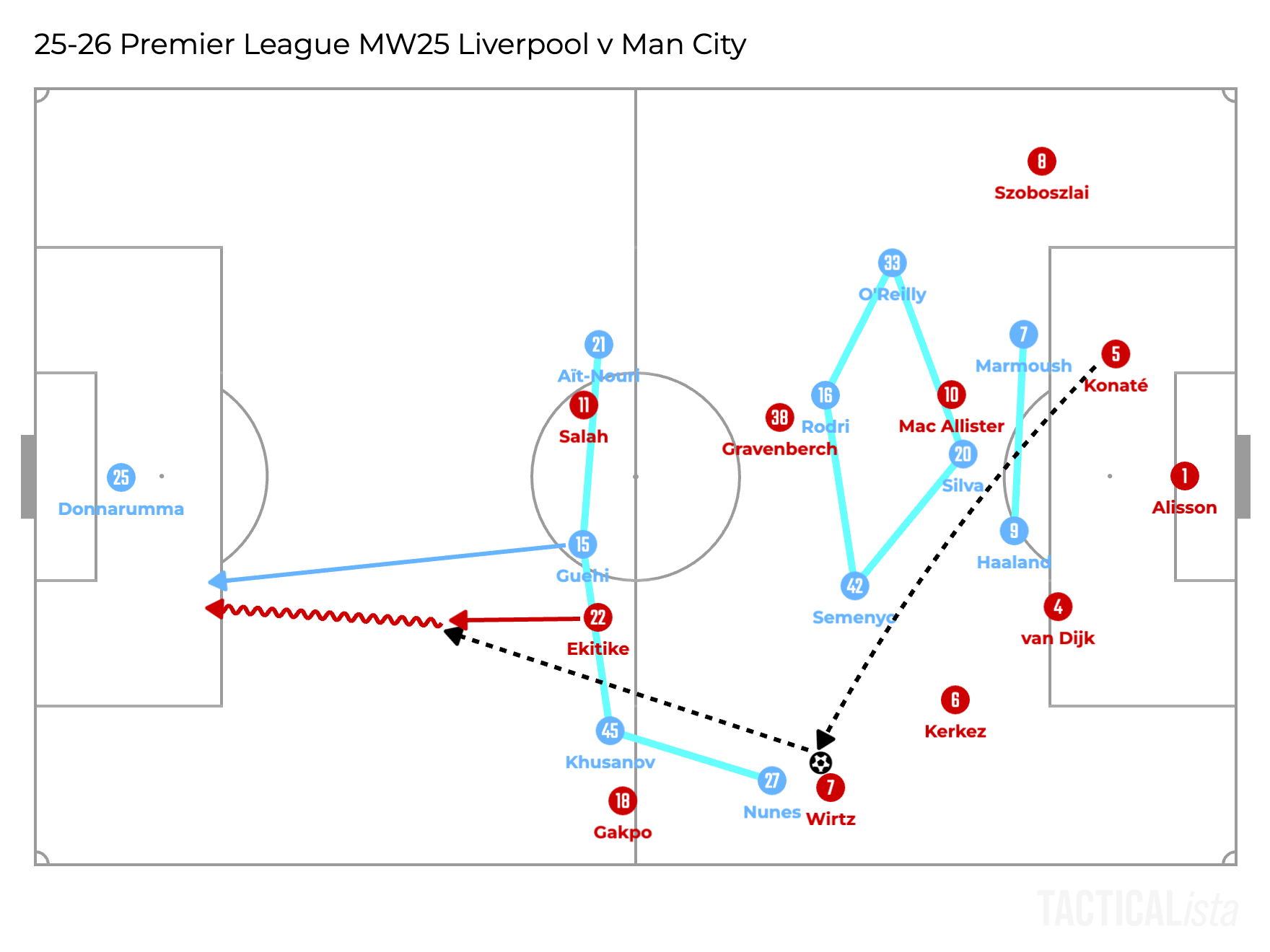
Liverpool had managed to beat the City’s press by the diagonal switch to Florian Wirtz, who played through and generated the 1v1. However, there was Guéhi. That’s it.
The pair of Guéhi and Abdukodir Khusanov is the key part of cerrent City. Their defensive abilities help them keep the line high and play the games with more transitions. Without them, City wouldn’t have been where they are now.
This is what changed in high pressing. And in this chapter, the aspect of transition has been mentioned a lot, so let’s dig deeper.
Sharper in Fast Breaks
Man City used to play slow-tempo football, but the game is getting faster and faster. To adapt themselves to the modern games, they began to play more vertical football, especially after winning the ball or beating the opposition pressure. This has been something they have tried to develop throughout this season, but again, the recent tactical change fostered the improvements.
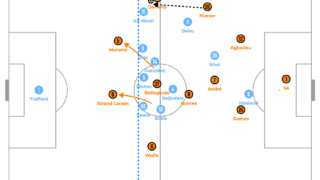
In the 4-D-2 system, both or either of the front two was a winger (Semenyo or Omar Marmoush). Unlike the usual front two, they often spread wide and get ready for exploiting the space in behind. And also, this can pin the opposition defensive line and leave space in between the lines. The illustration below replicates a certain moment in the game against Newcastle in Carabao Cup at the Etihad.
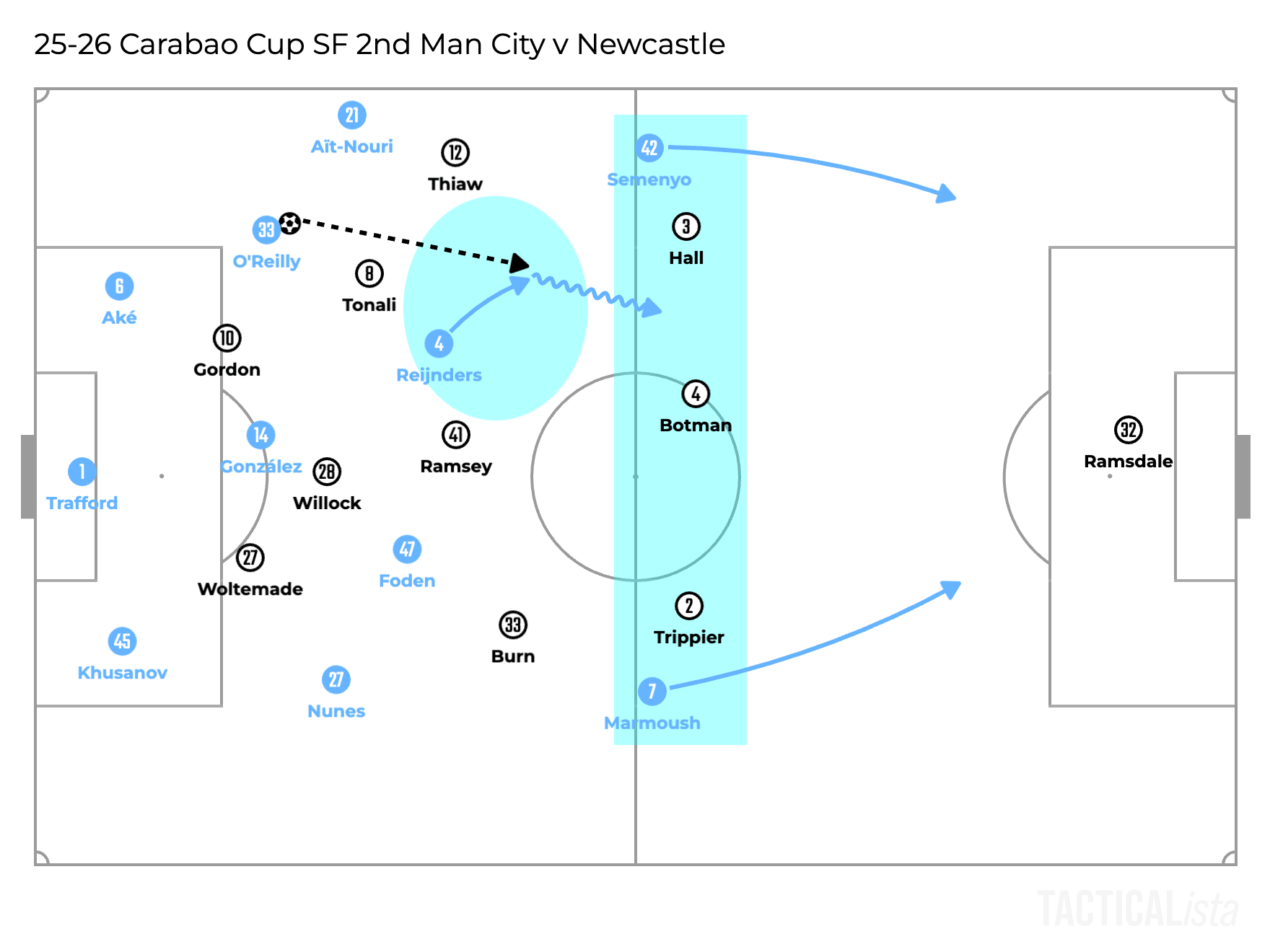
As Semenyo and Marmoush stayed wide and sought to run in behind, the opposition defenders were pinned. Then, Tijjani Reijnders, who is also the new signing ahead of this season, received the ball in the space in between the lines and carried it forwards to play the fast break. He is also one of the most impactful additions as his ability of carrying the ball forwards is something necessary in the game with more transitions.
And even after winning the ball deep, the front two can help to play long counterattacks. Erling Haaland can be the target player to generate time and Semenyo can threaten the space in behind. And surprisingly, O’Reilly recently flourished his scoring ability by running from deep and the illustration below shows his goal against Fulham.

Having two pacy forwards up front is, needless to say, effectively working to add fast breaks into Pep’s game. And Semenyo or Marmoush, who can play anywhere, encourage the midfielders or fullbacks to over/underlap to accelerate the attacks. If they stay narrow, the fullbacks can overlap and if they keep the width, like the example above, the midfielders can join the attack through the inside channel. This flexibility makes their fast breaks unstoppable.
Central Overload
When the game is static, it used to be what Pep’s side wanted it to be, but to break down the opposition deep and compact defensive blocks became more and more difficult due to the higher dedication of teams in the 5-4-1 or more defensive effort.
I’m not talking about Relationalism, but Pep now created central overloads to create and exploit the gaps in deep and compact defensive blocks. He doesn’t stick to deploying players with good balance on the pitch anymore, and encourages them to flexibly combine in the small area, although this is not something new to him.

In the 4-D-2 system, only the fullbacks keep the width and other players often stay in the central lane to create overloads. They don’t just stand still, but keep moving to link with others to manipulate the opposition defensive block. Oh, this looks like a classic 4-3-3 with a false nine, revival!
Here’s the example of breaking through the opposition last line with an overload.

In the end, they played through the back line with the one-two by Marmoush and Reijnders. If you just focus on this, they successfully created a 2v1 against the opposition centre back. To create and find this kind of advantage around the ball, it is important to get closer to the ball and teammate, and this is quite the opposite idea from traditional positional play.
This central overload is not newer than the tactical changes in pressing, as in the match week 10, against Bournemouth, City scored from this kind of central overload.
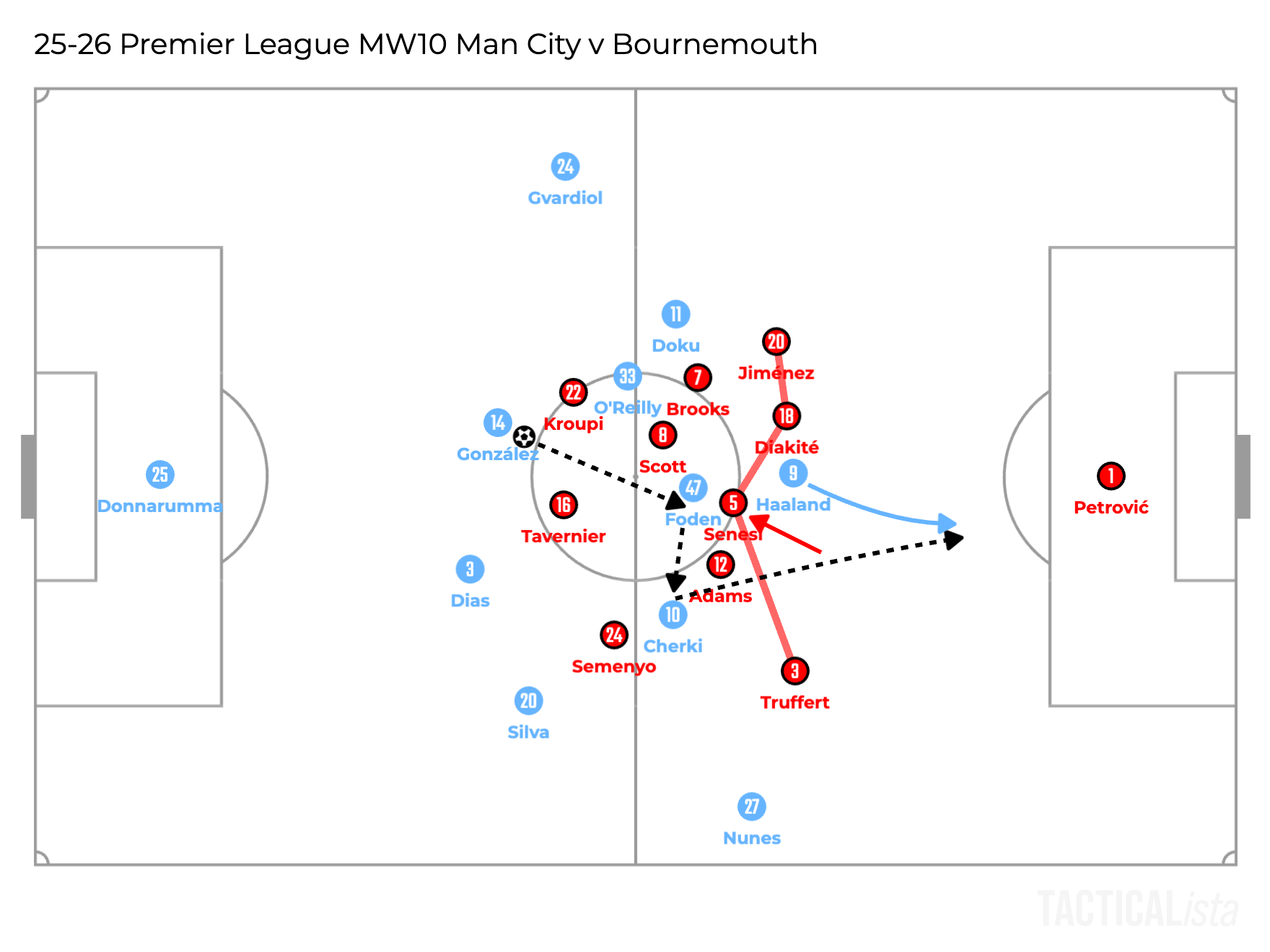
As it is obvious, except for the fullbacks, they stayed narrower and closer to each other around the centre circle and successfully dragged the opposition centre back and exploited the space in behind. This wasn’t a one-two, but a great 3rd man combination.
Pep’s new system was exactly spot on to overcome the struggles to accelerate their development to adjust their game to the modern game. Over the decade, Pep has been the pioneer, but now he is the challenger. He was about to be outdated, but is still surviving, and evolving.