Roberto De Zerbi’s Tottenham Hotspur Tactical Analysis 26-27
Tottenham were in crisis again, but things might turn around soon.
When entering into the first international break in 26-27 season at the end of September after five league games, they were at the bottom of the league. They couldn’t score a single goal in the first four league games and in the fifth game of the league against Aston Villa, they finally scored two goals but conceded three, and ended up in the defeat at home. After the break, they managed to equalise at the end of the game against Manchester United with 10 men at Old Trafford and finally they beat Coventry, the newly promoted team, in the seventh game of the league.
Roberto De Zerbi saved Tottenham last season, but they’ve been struggling again, even though they signed Sandro Tonali for €108 million, Mateus Fernandes for €99 million, Sávio for €87.7 million and Jan Paul van Hecke for €60 million in addition to free transfers of Marcos Senesi and Andrew Robertson and loan transfers of Omar Marmoush and Mykhaylo Mudryk.
In this article, what Tottenham are struggling with, why De Zerbi’s famous tactic isn’t working and how they can turn things around are going to be analysed holistically both in possession and out of possession.

In Possession
Baiting the opposition pressure by playing out from the back and quickly breaking the last line of defence to generate chances is the signature tactic of De Zerbi. Now, however, the oppositions know the solution for De Zerbi’s system. It became a formula that everyone learns and many managers take inspiration from this. On the flip side, many managers have faced this style and developed a tactical response, which has been constantly improved. So let’s have a look at what the formula is and how the oppositions are trying to deal with it.
*This article was written three years ago, but I recommend you give it a quick read. It discusses the 4-D-2 pressing system, which is a recent trend of pressing, but invented to press against De Zerbi’s system.

Build up
First of all, let’s briefly explain what De Zerbi wants to do.
The formation can be difficult to be named, but let’s just say it’s a 4-2-4. The famous tactical characteristic is that both of the two central attackers, which are mostly a pair of a striker and number 10, drop deeper while both wingers stay high and wide.
Then, they try to play out from the back to bait the opposition pressure and find either of two central attackers in between the lines or play in behind with diagonal runs from the wingers.
The idea is simple and it has worked really well, given the trend towards the high pressing. A few years later now, however, it has gradually become less effective as the opposition came to know how to nullify it and the intensity and effectiveness of high pressing improved a lot.
In recent games, when De Zerbi’s side tried to play out from the back, the opposition teams applied intense pressure and successfully forced them to kick the ball away. The diagonal runs from the wingers were also anticipated by the opposition fullbacks.
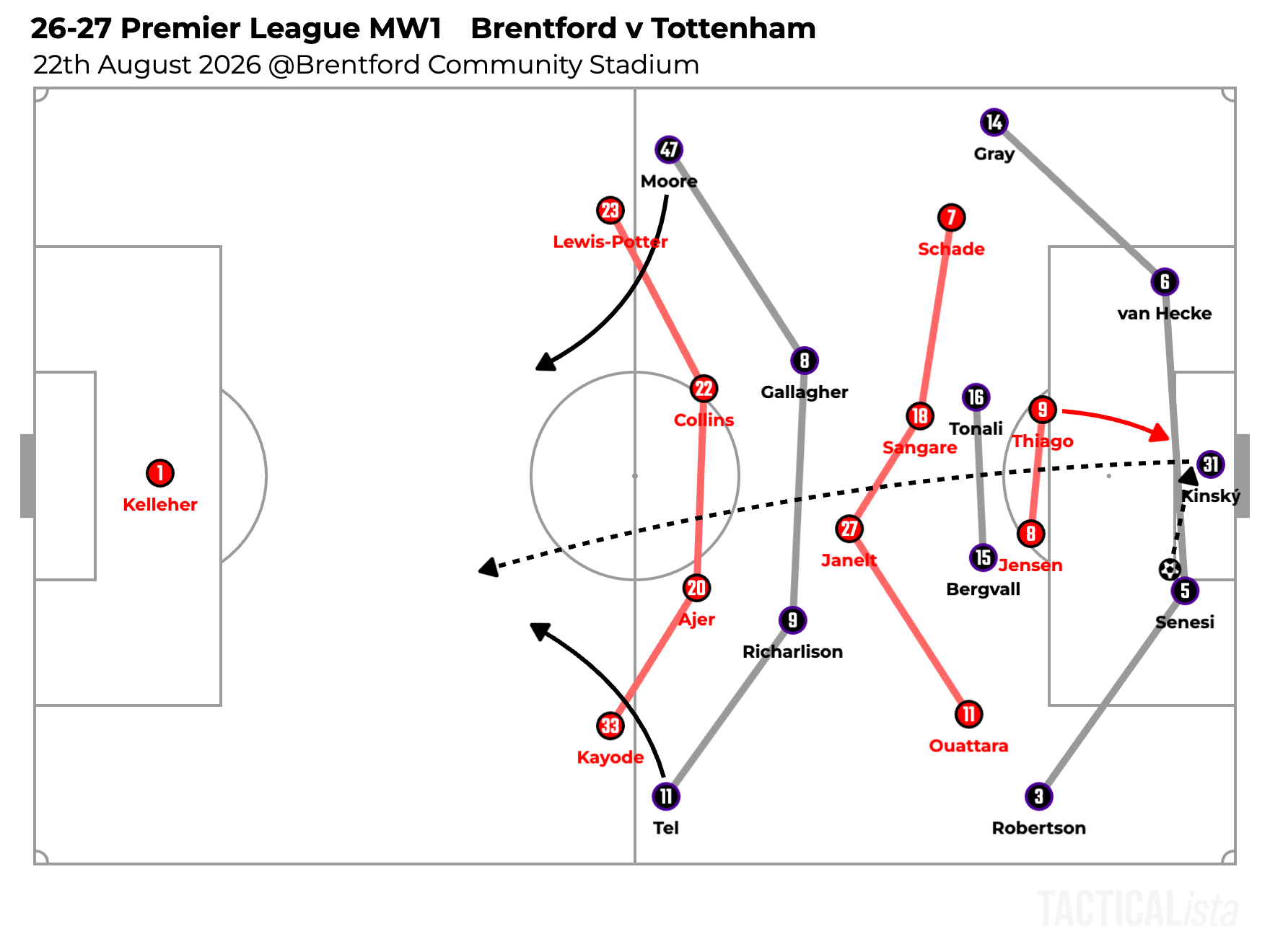
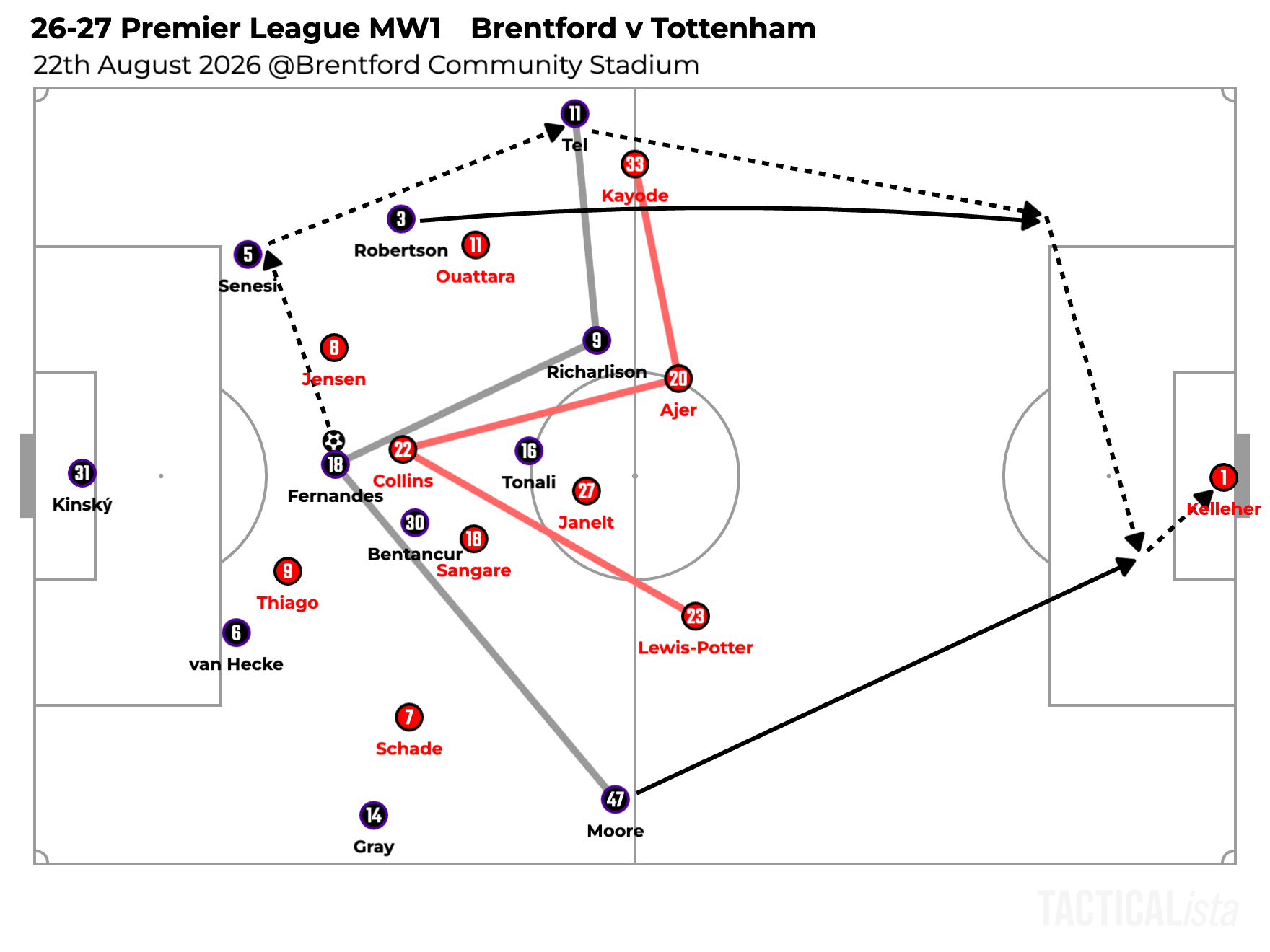
And the tactical solution was also shown by Brentford in the first game of the season. Instead of pressing with man-to-man fashion, which leaves the risk at the back, they kept their holding midfielder deeper and tasked the attacking midfielder with screening Tottenham’s defensive midfielder and being ready to press on the centre back.
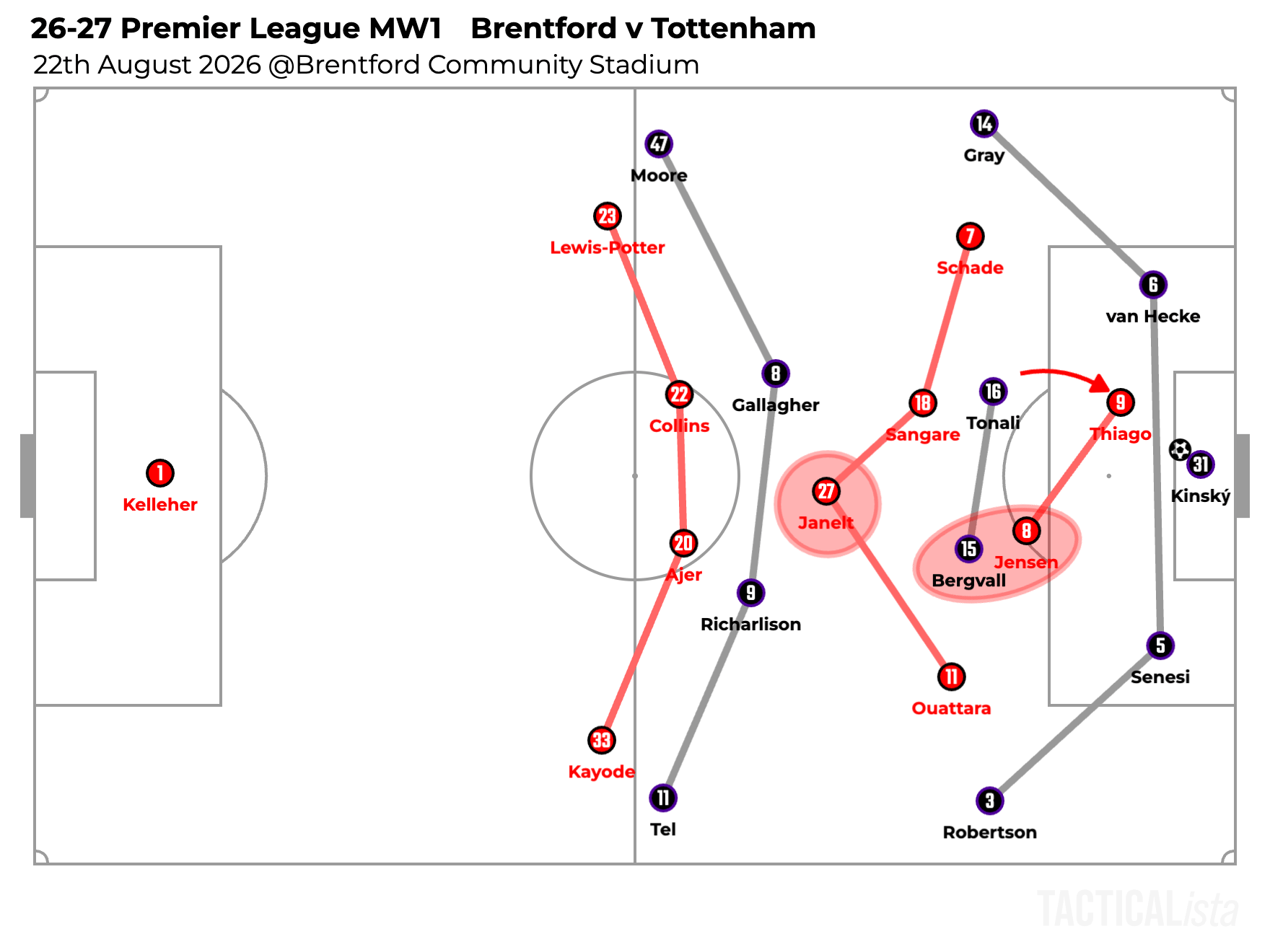
The biggest advantage of this is that they can maintain an overload at the back. This makes a difference when Tottenham are forced to play long.
Even though being not able to play an ideal long ball, for the attacking side, regaining the second ball is also a valid way to progress, and if the number of players is the same, the probability of winning it increases. For the team out of possession, therefore, it is vital to keep the numerical advantage at the back.
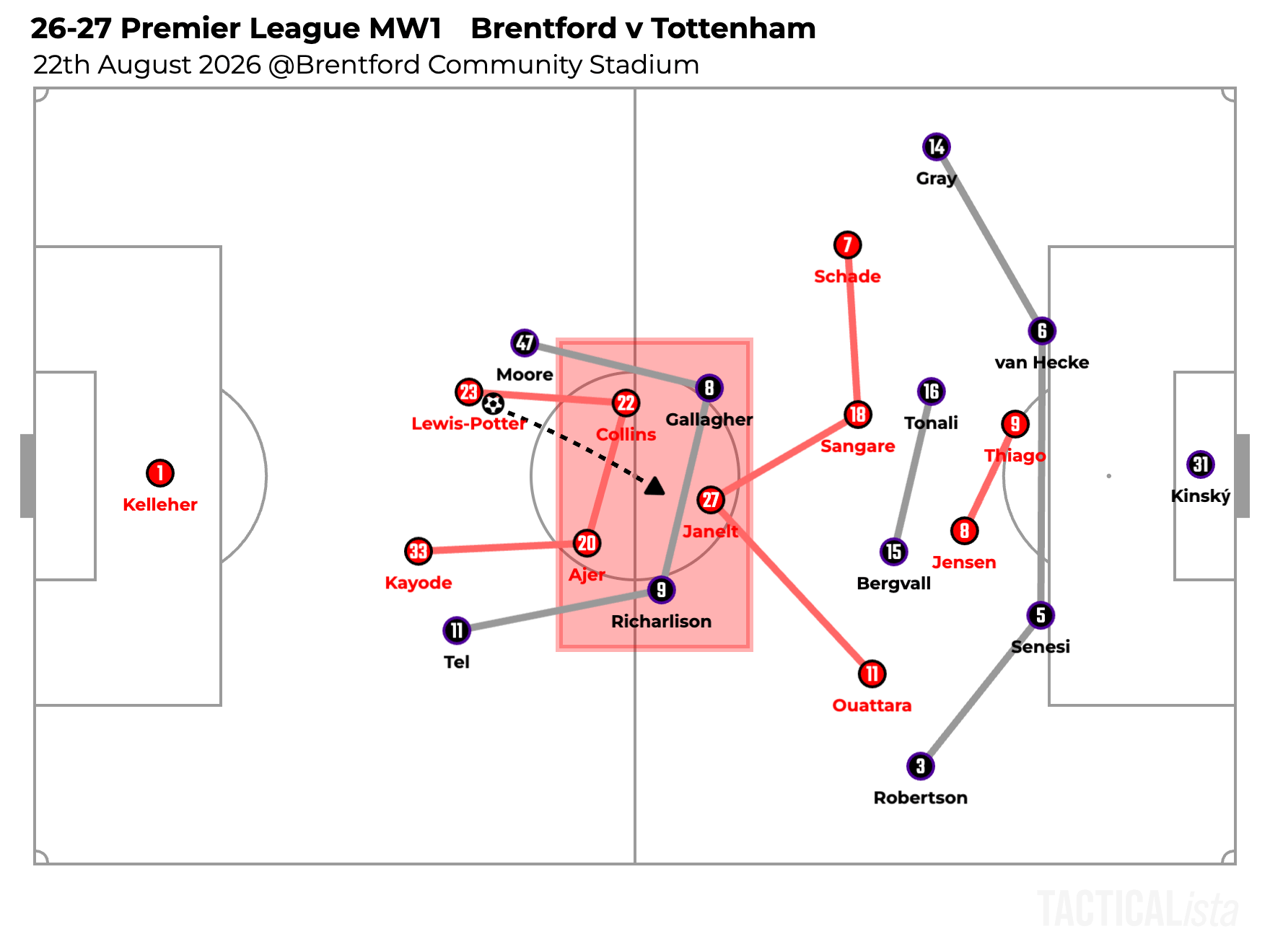
Like the illustration above, the shape of defence is likely to be bent and the long ball played in behind is often interrupted by the fullback. Then, it becomes a 3v2 overload in the middle of the pitch with the two centre backs and pivot, which increases the probability to secure the second ball after successful high pressure.
For De Zerbi’s team, how about playing out from the back with short passes? Still, they were locked in and struggled to find a spare player in between the lines. In the second game, Newcastle applied high pressure with the same structure as Brentford.
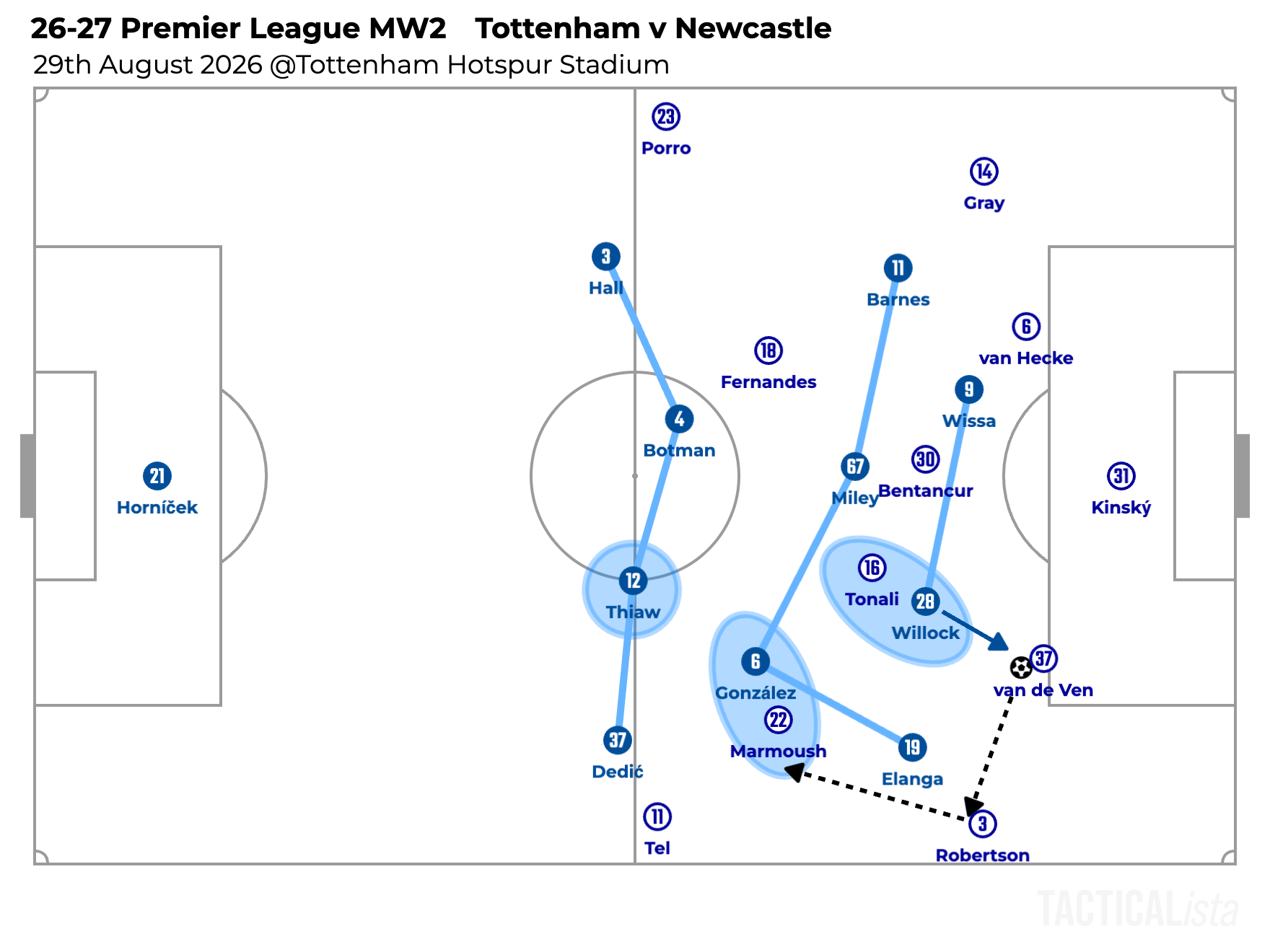
Like Brentford, Newcastle forced Tottenham to play to their left side. This might be because they didn’t want Jan Paul van Hecke to dictate the build up. Then, Tottenham tried to play around from their left side, but all the options were marked and the centre back, Malick Thiaw in the illustration above, could stay on the line as a spare defender.
So, what they want and need to do is to keep the possession in the middle to maximise the overload and they showed how to do it in the same game against Newcastle.
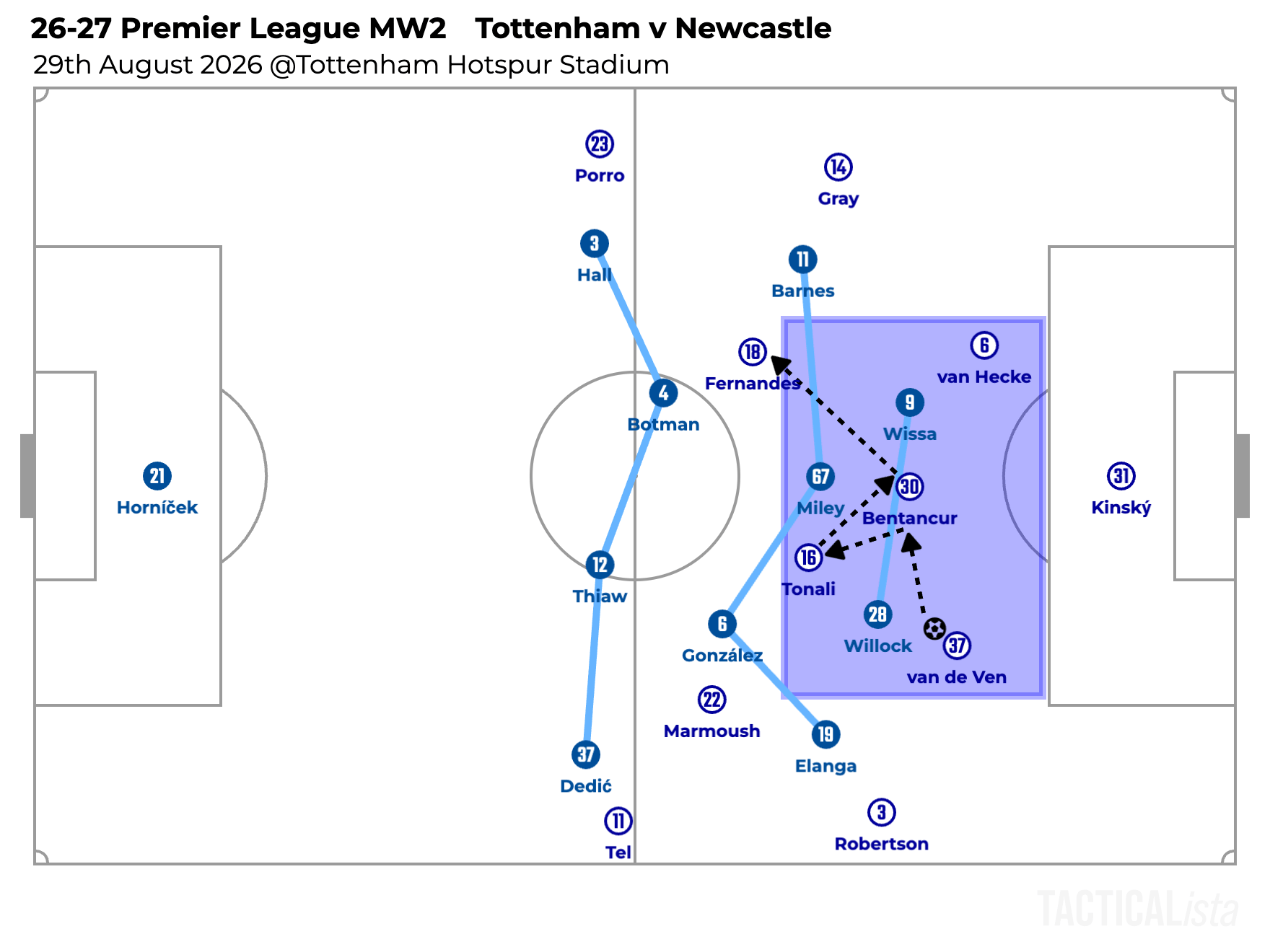
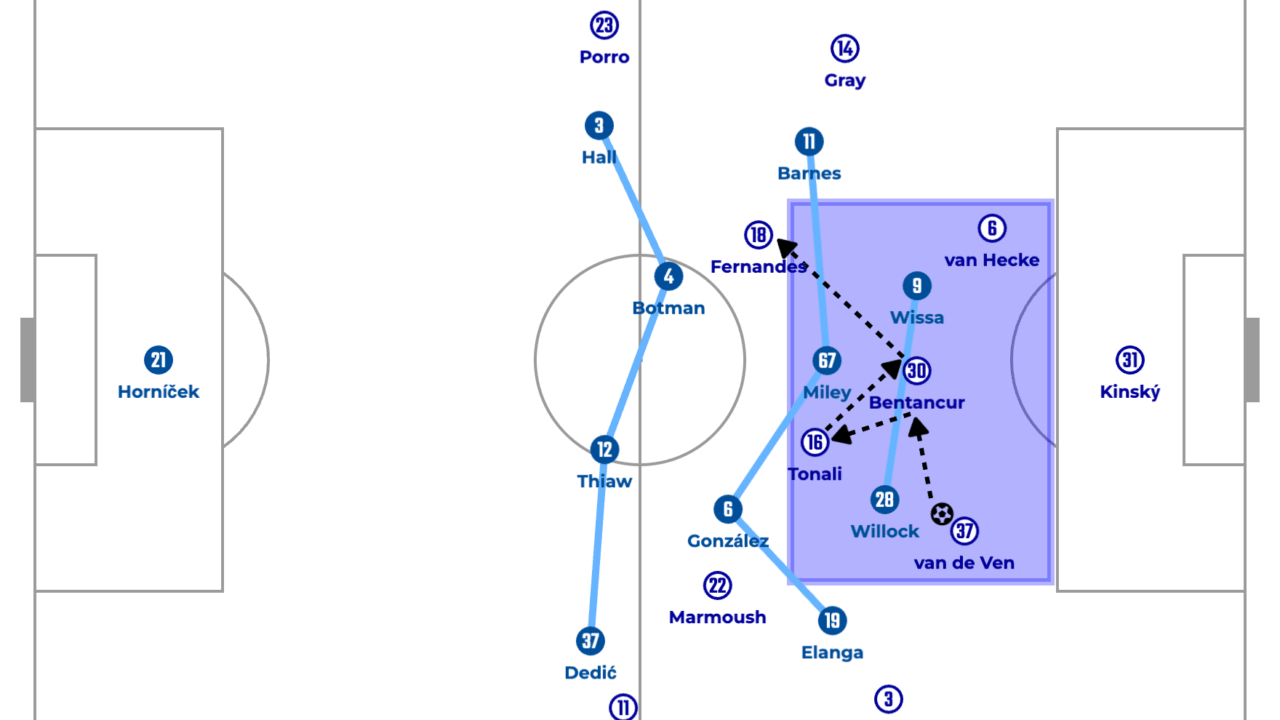
As Newcastle tried to press Tottenham’s two centre backs and two defensive midfielders with two attackers and a defensive midfielder. Therefore, Tottenham could find a spare player to beat the high pressing if they moved the ball properly.
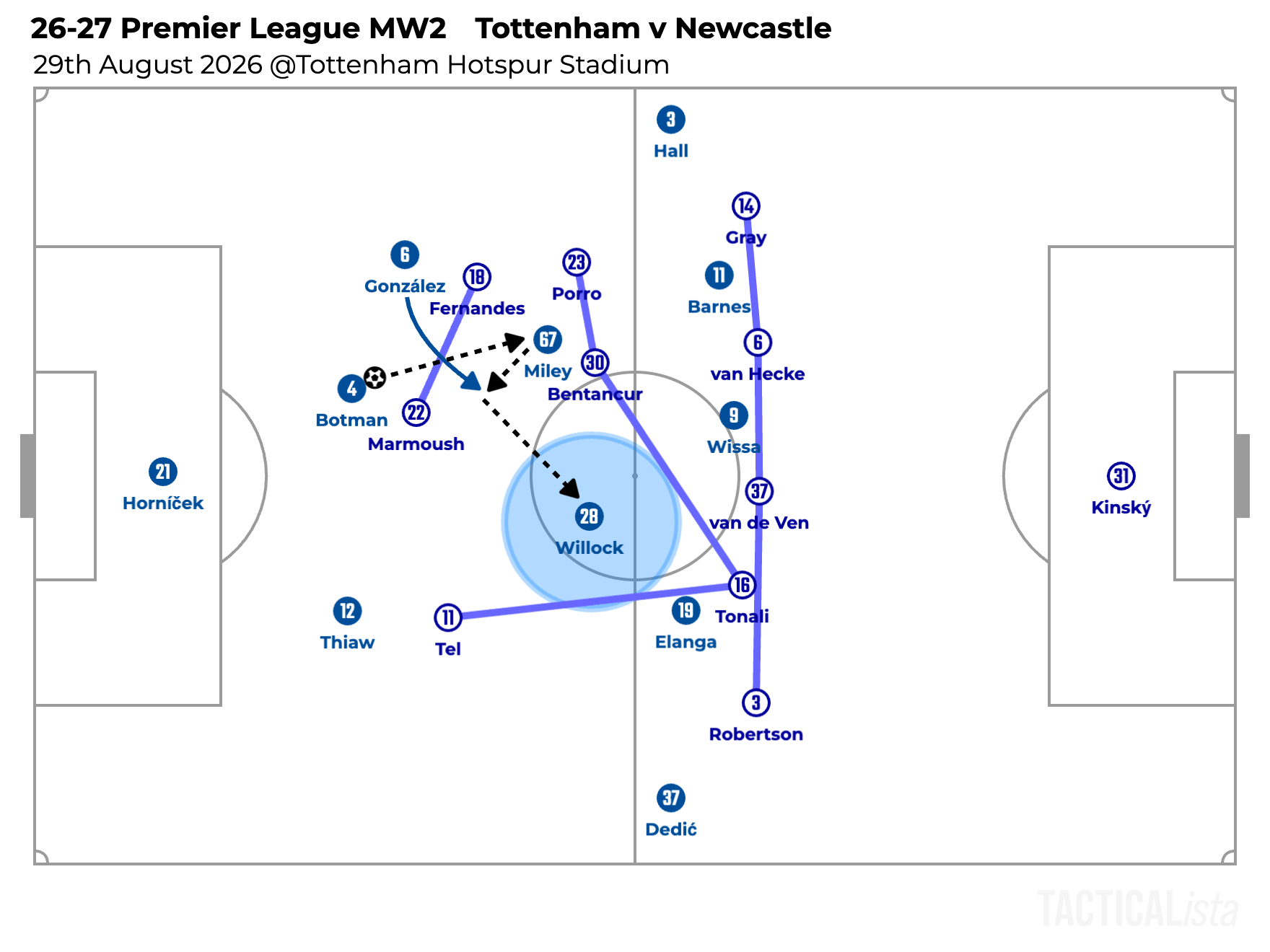
The key player was Rodrigo Bentancur, who acted as a pivot in the middle. He positioned himself in between the opposition two attackers to offer a passing lane for Micky van de Ven in the illustration above. Without him, van de Ven would’ve played outside and they would’ve been locked in. Thanks to his support, they could prevent Newcastle from triggering the high pressing, and after combining with Tonali, he could find Fernandes in between the lines.
And another vital player is one of the key signings of this summer, Mateus Fernandes.
He often plays as a number 10, but he drops deeper than other midfielders and gets on the ball. Against the opposition man-to-man pressing, one of the most effective ways is dropping across the lines as the centre backs usually hesitate to leave the last line by following the marker too much. And this has been the irreplaceable role of James Maddison. His inconsistency due to the injury really impacted Tottenham’s recent performance over the years.
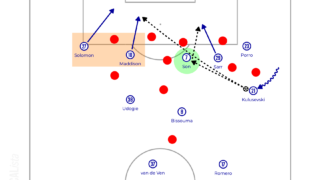
The illustration shows how he helped the build up against Brentford by dropping deeper.
In this case, Brentford’s man-to-man approach was very extreme and the centre back followed him all the way, but he couldn’t apply tight pressure on Fernandes and he created time to slow down the opposition’s high pressing.
Another notable thing is how they increase the tempo of attack when they successfully give the ball to the winger. As soon as Mathys Tel received the ball by the touchline, the left fullback Robertson made an underlap run to exploit the space in behind. At the same time, the opposite winger Mikey Moore accelerated to attack the box, resulting in the poor shot though.
This combination in wide areas worked well against Man United.
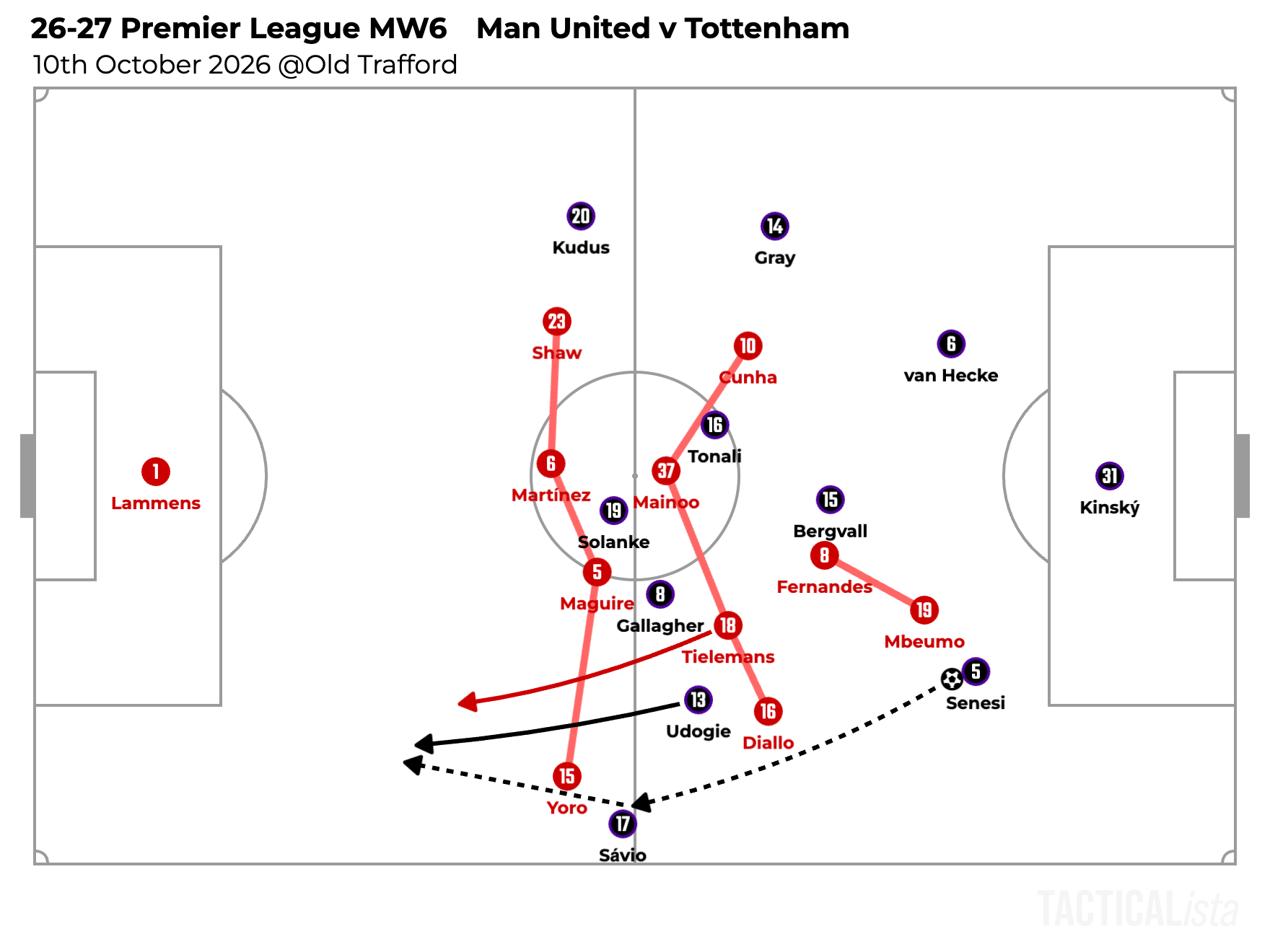
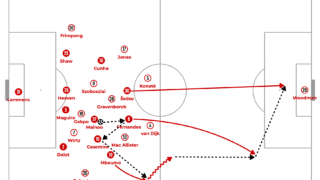
From Senesi to Sávio, then Destiny Udogie burst forward to exploit the space behind United’s back line.
Overall, De Zerbi’s side has struggled with building up as his tactic has been well analysed and the solution has also been developed over the years. However, Mateus Fernandes’s fit and the return of Maddison can bring something extra to the system and the quick break from wide areas has been improving through the games.
Positional Attack
No matter how many times you can build up from the back, only whether you can score a goal or not matters in a football game. And in this aspect, it was difficult to see how they try to score goals in the first few games. They hugely relied on the wingers, as especially after Sávio’s arrival, his 1v1s have been the only source of penetration, and no team-works have been observed.
Firstly, here’s their basic structure against the opposition defensive block and it is quite based on positional principles.
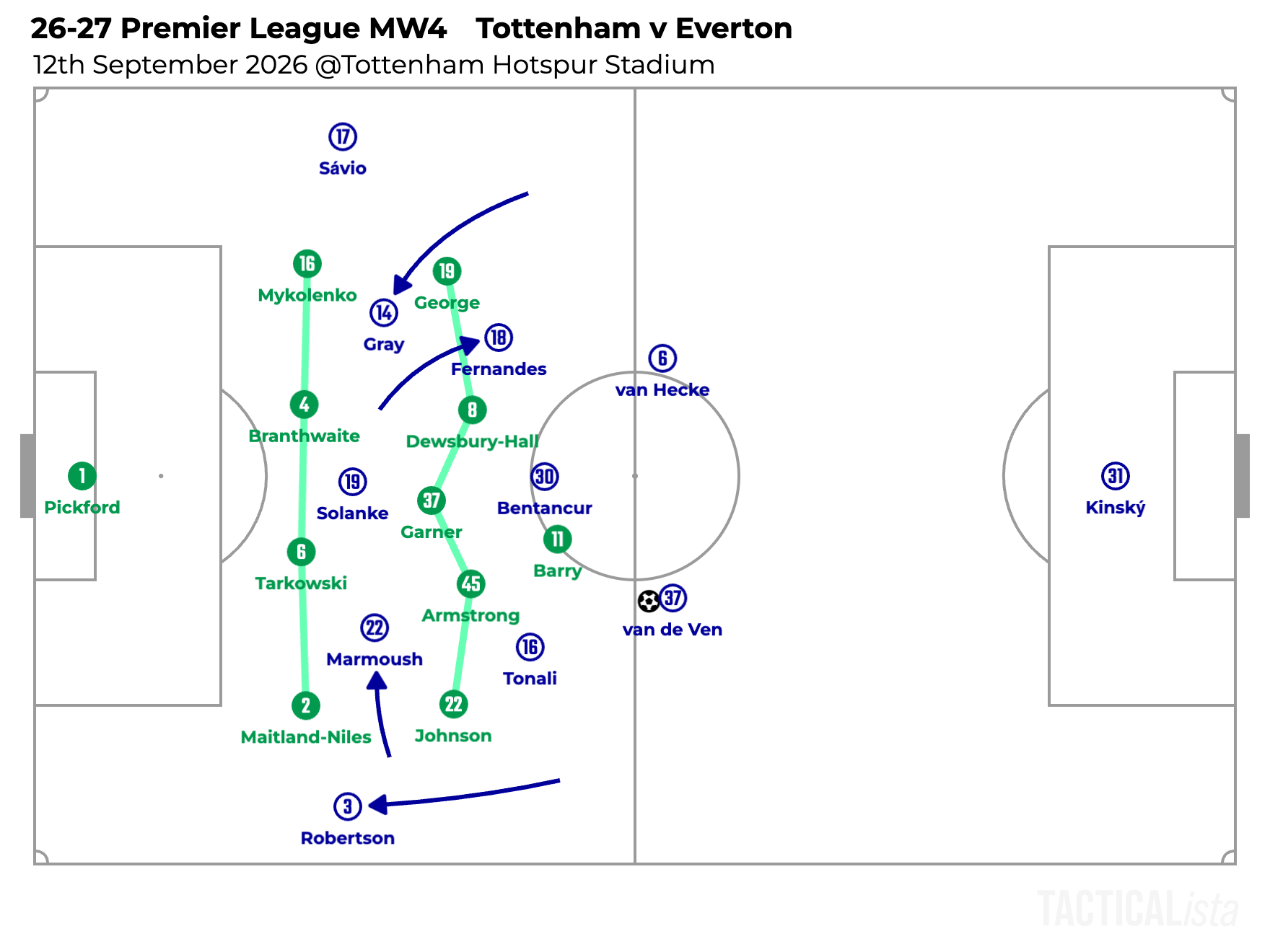
As a tendency, the left winger, Marmoush or Tel, come inside while Robertson or Udogie take up a high position. On the other hand, the right winger, Sávio or Mohammed Kudus, holds the width and Gray drifts inside to occupy the right half space.
Against United, the setup was really fixed 4-1-2-3 and the rotation on the left side worked very effectively. This is because United’s 4-4-2 was also static and basic and no complicated tactics were required.
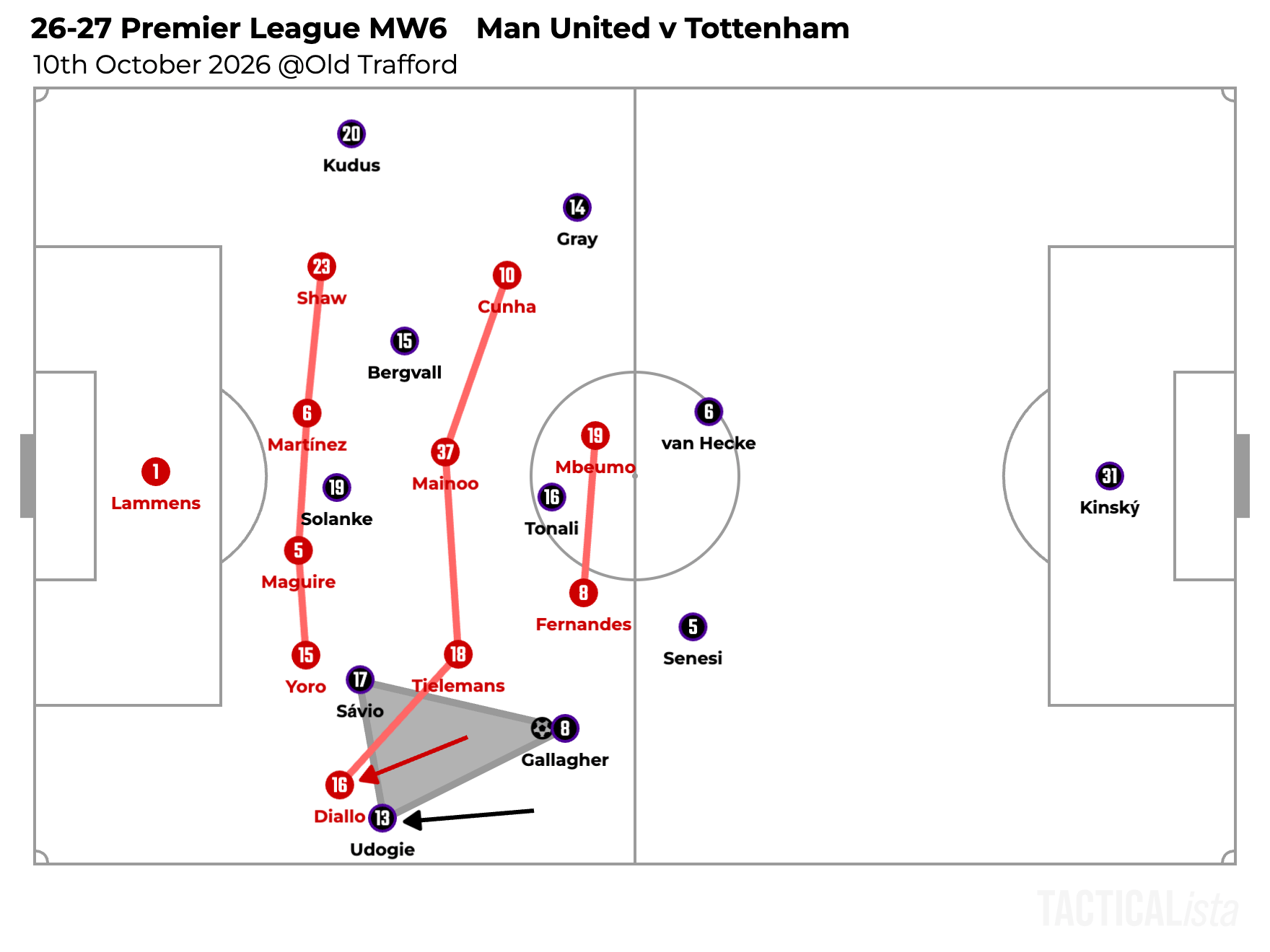
Conor Gallagher dropped deep to get on the ball, Udogie advanced forward and Sávio came inside to rotate and push back United’s defence throughout the game. This type of positional structure is the base of Tottenham.
And in the next game against Coventry at home, their positional structure looked differently. As Coventry’s defensive structure was flexible between a 4-4-2 and 5-3-2 depending on the position of the right winger Tatsuhiro Sakamoto, Tottenham deployed three centre backs at the same time and pushed Robertson higher.
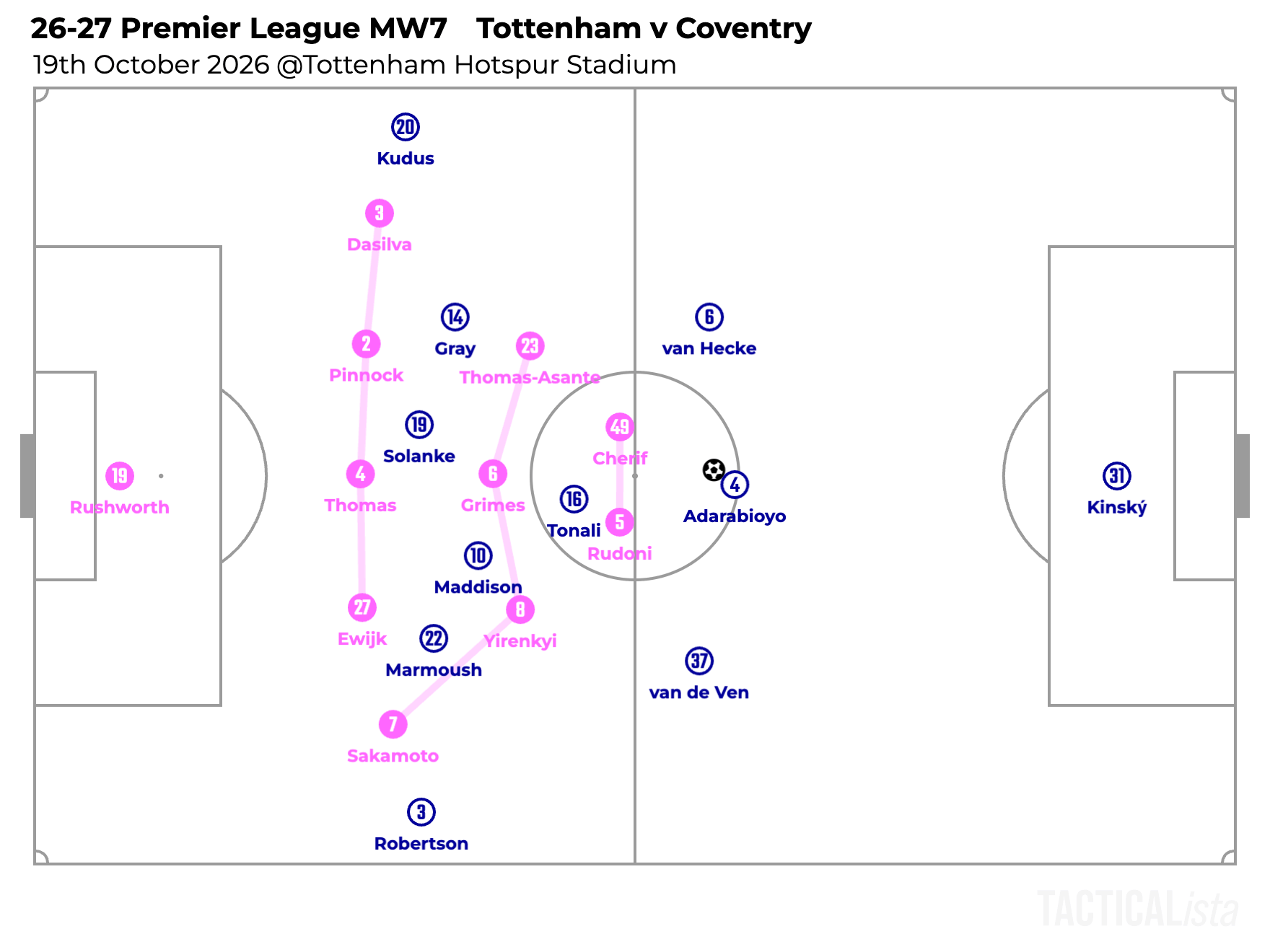
The clear idea is to maintain a three against two overload at the back to stabilise possession and occupy the space in between the lines with four players. They often lacked the number of players there, so these positional structures in the games against United and Coventry might be what De Zerbi worked on during the international match week.
But what really matters is how to progress the ball into the dangerous area rather than the positions of the players.
As it was mentioned, their attack depended on the quality of wingers and they often played around simply. However, this doesn’t disrupt the opposition defence and it is easy for them to defend by just shifting across the pitch. So, the lack of penetration through the middle has been the problem for De Zerbi.
Even though they struggled with this as a team, Marmoush often tried to adjust his position to receive a split pass from the centre backs.
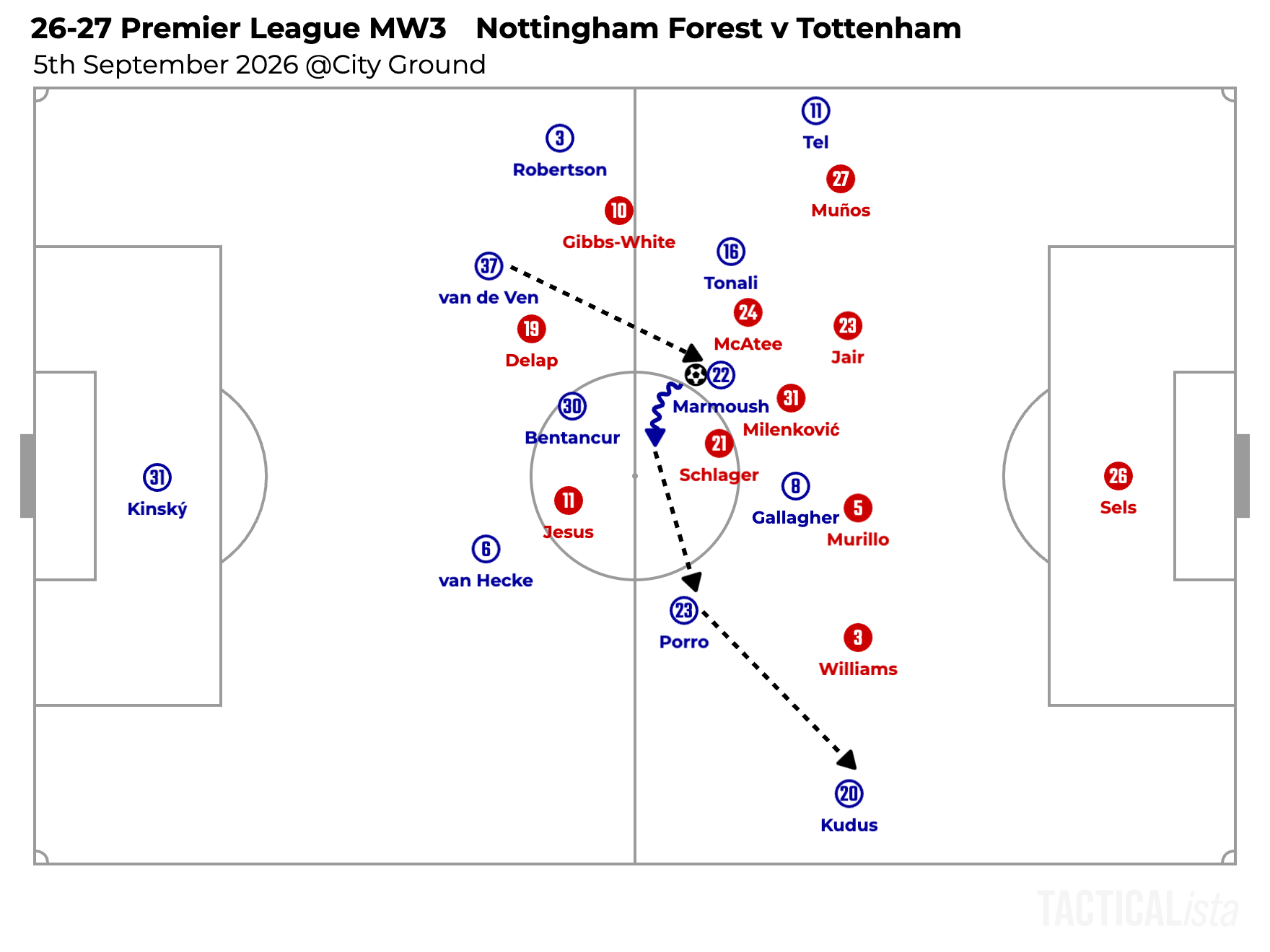
He is not the greatest at playing in between the lines as his biggest strength is attacking the space in behind though, he often worked as a hub and switched the ball to the opposite winger.
Then, the wingers take on the opposition fullbacks, which is the most repeated pattern when Tottenham seek to threaten the goal. Tel, Sávio, Marmoush and Kudus are elite wingers in the Premier League, but not every time they can beat the opposition fullbacks, so how to combine with the wingers is essential to increase the threat and the underlapping runs of fullbacks are the key like build up play.
The illustration below shows the underlapping run made by Archie Gray through the channel.
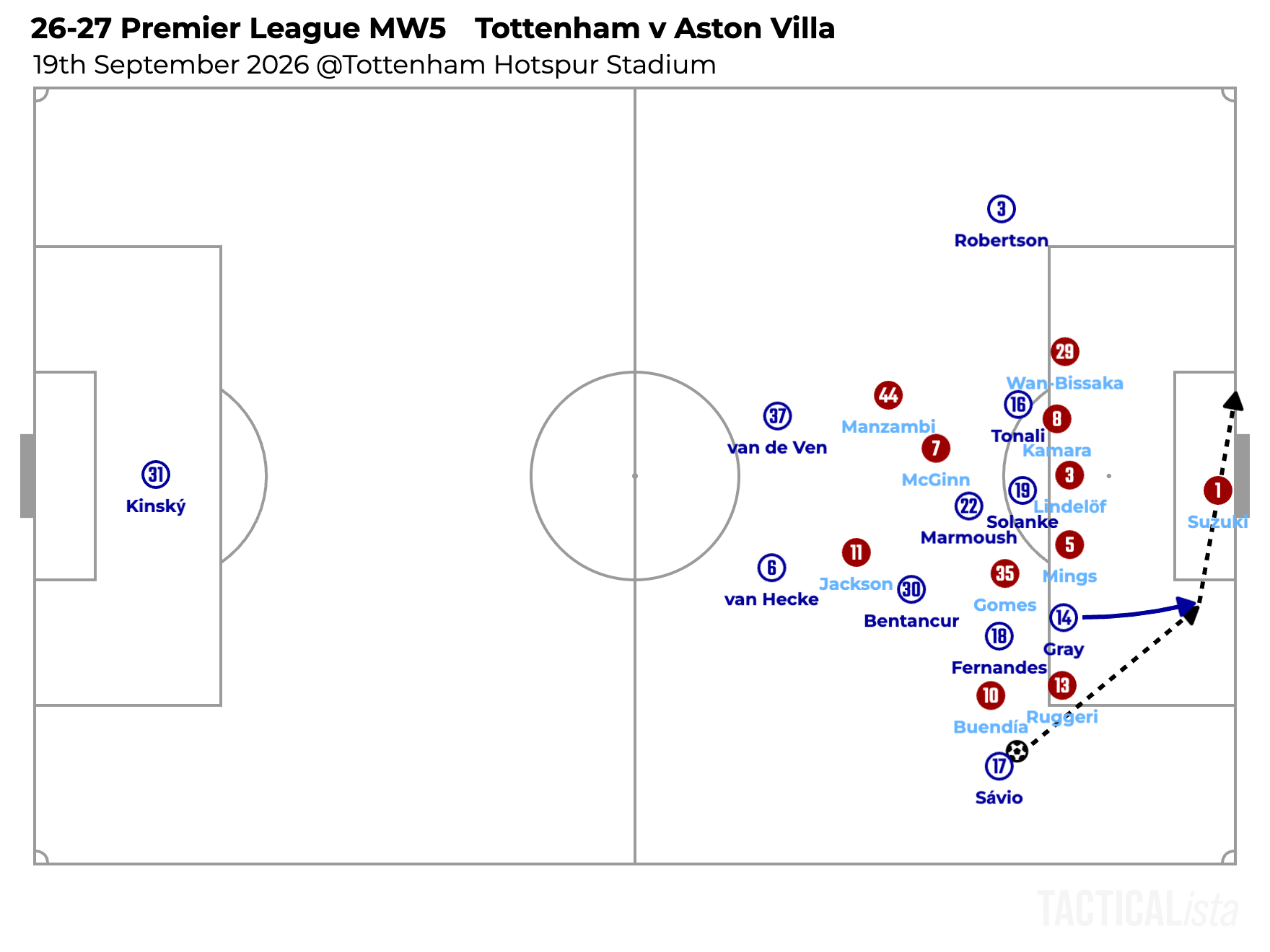
Even in the tight space around the box, it is one of their main patterns of play to break the last line to create chances. The opposition fullback and wide attacker are focused on Sávio and Gray found the gap to exploit.
The runs from fullbacks are not always like this. For example, Robertson on the left tends to make a diagonal run from the touchline into the box and it almost found the equaliser against Aston Villa.
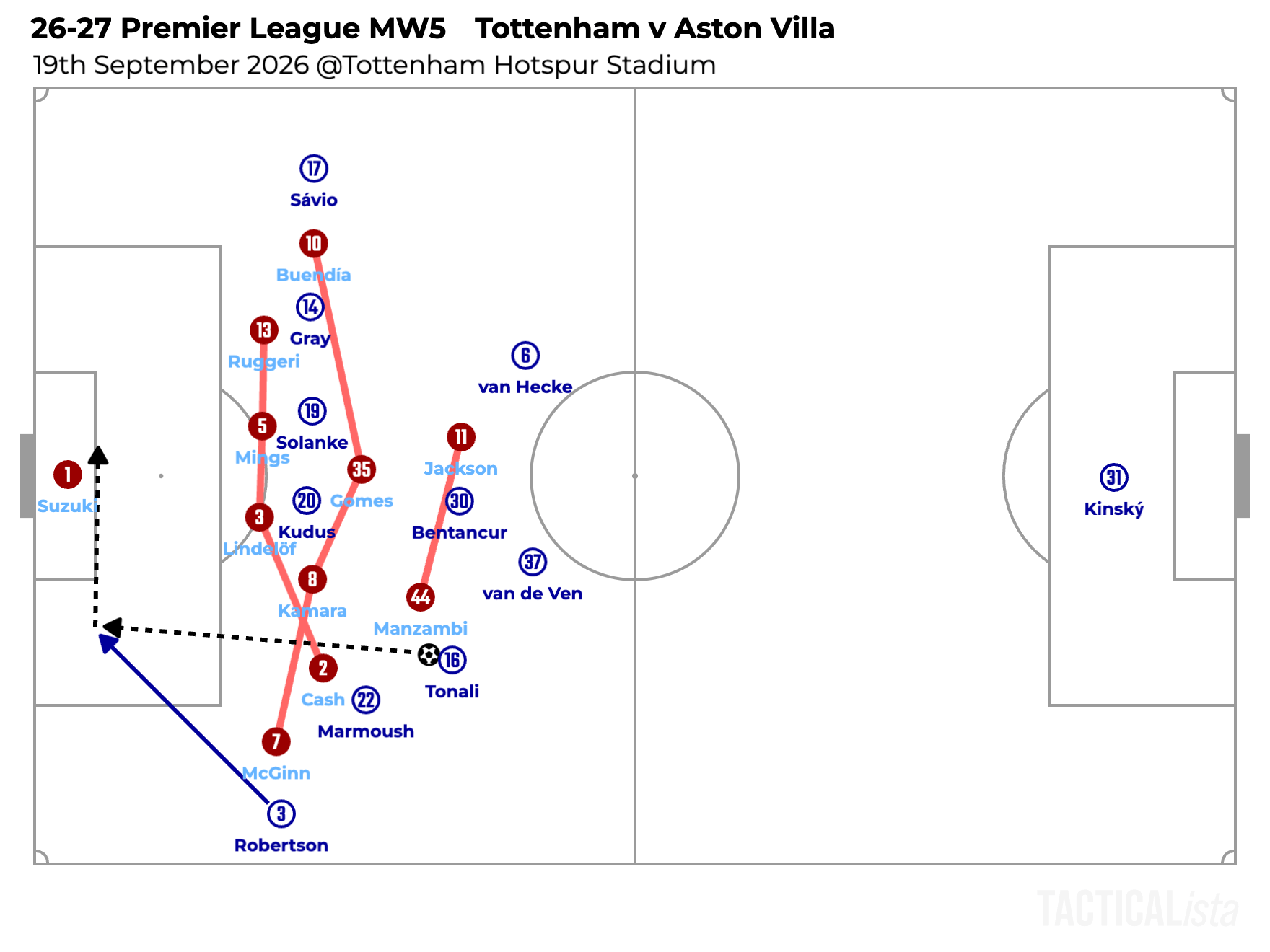
The left wingers, Marmoush or Tel often play inside and the opposition fullbacks keeps his eye on the winger. Therefore, his run tends to be on their blind side and difficult for them to follow.
In addition to the quality of wingers, the fullbacks play very important roles in the final third and actually they have been creating a lot of chances from this, which deserved to be goals. So, in my opinion, they don’t need to worry too much and just keep doing what they’ve done and things will turn around soon.
Out of Possession
De Zerbi’s football is based on possessing the ball and taking the initiative of the game, so they apply high pressure to regain the ball as quickly as possible.
It is very close to a man-to-man approach, and they bravely shuffle across the back line to match the shape of the opposition. Additionally, the two defensive midfielders also tend to mark the opponents tighter to deny the passing options through the middle.
Their high pressing is working quite well to take the possession away from the opposition, but it sometimes gives away fast breaks for them, which is a common risk of high pressing teams.
High Pressing
The high pressing structure is almost the same in every game. They tilt the shape to the right side by pushing the right winger and fullback higher.
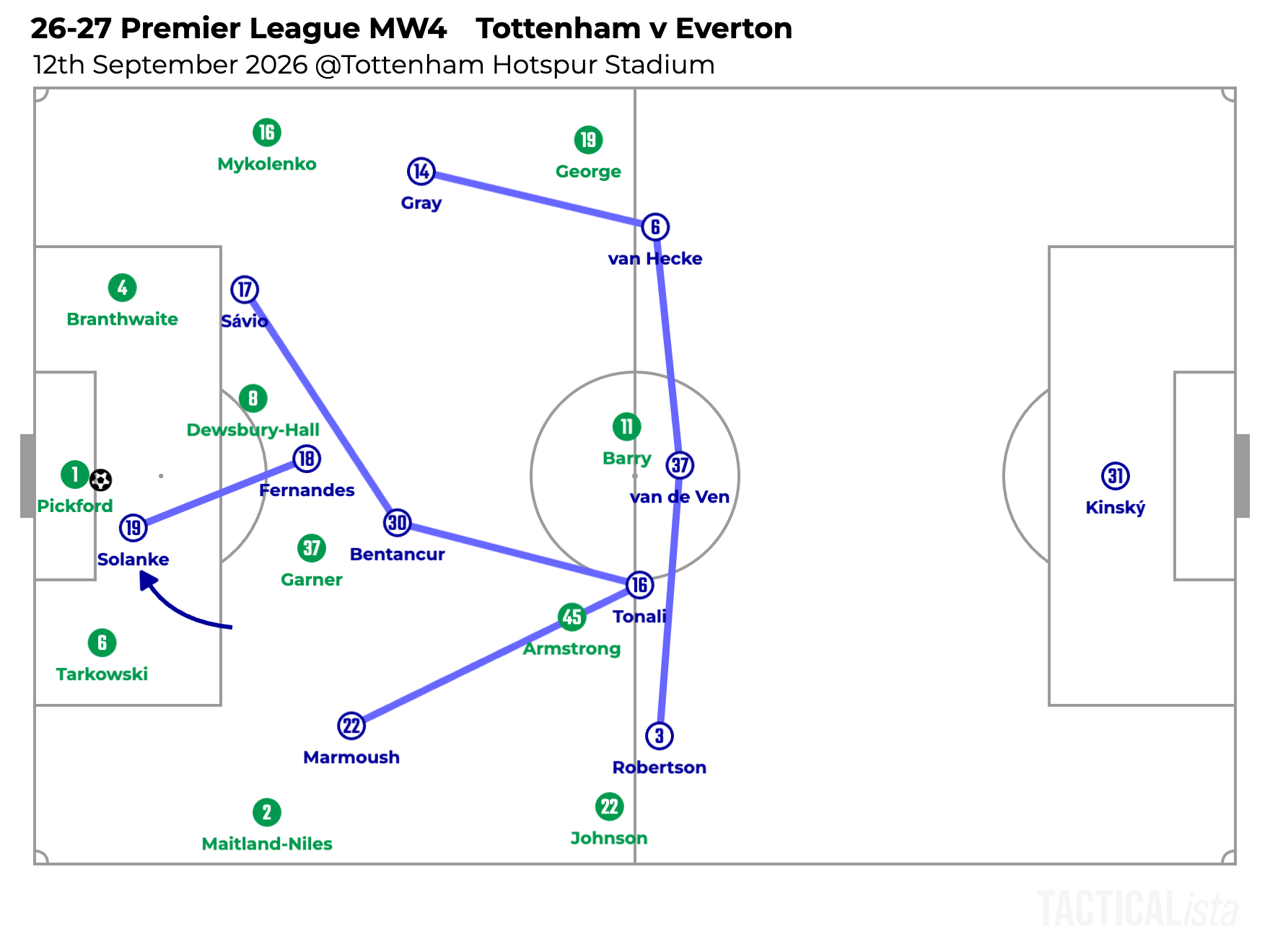
Then, the midfielders including the number 10 find the men to mark and the striker makes a curved run to apply pressure on the opposition goalkeeper.
The high pressing especially worked well against Aston Villa, who is very good at playing out from the back.
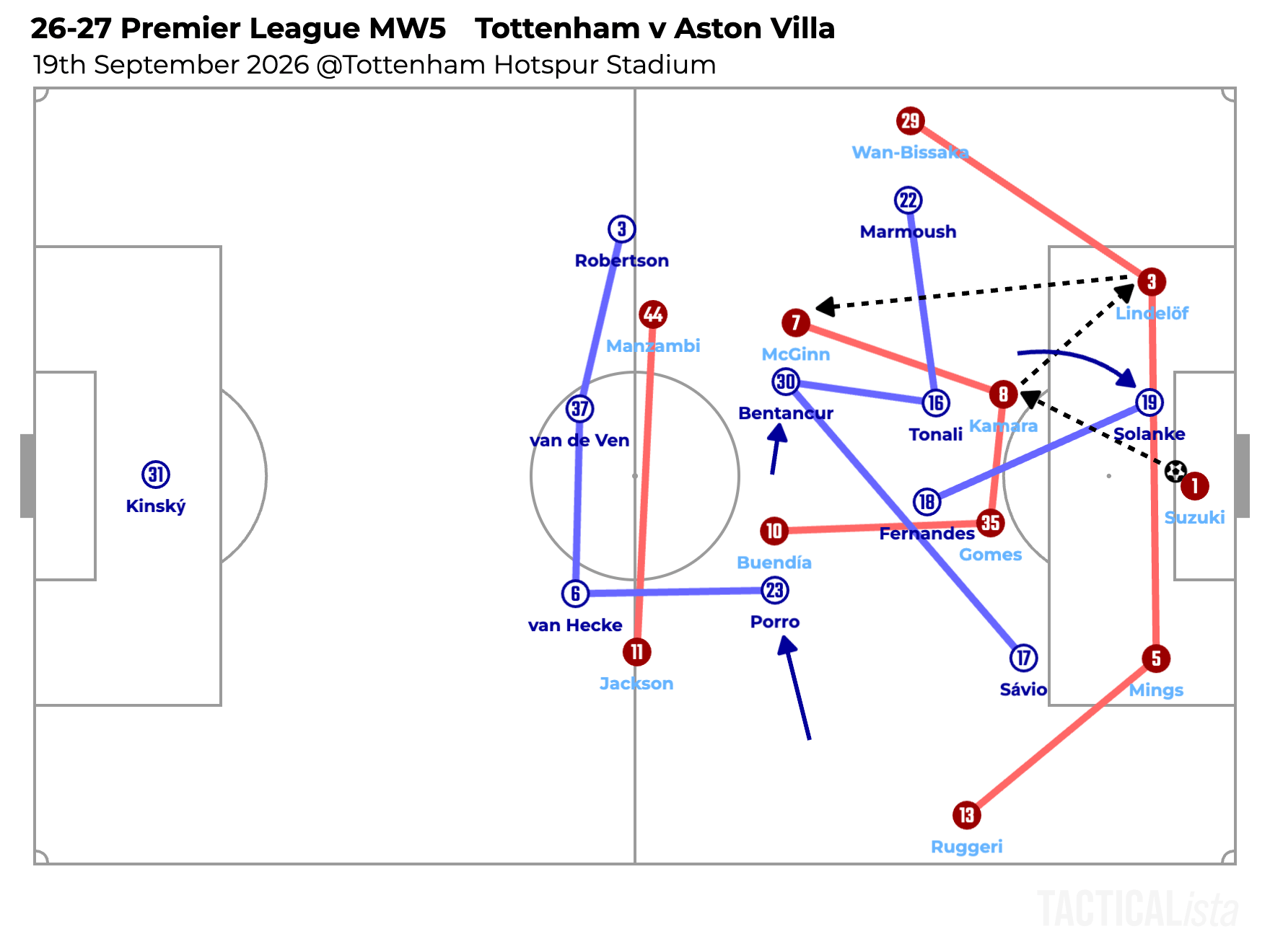
Even though the striker’s pressing was beaten by the third man combination, they successfully applied tight pressure on the opposition midfielders to try to receive the ball in between the lines. Bentancur shifted across to the ball side and even the right fullback Pedro Porro came inside to make sure the passing options through the middle were blocked.
This aggressiveness of finding the men to mark is their characteristic, but the gaps between the defenders are targeted by the opposition. Especially the right fullback is higher than the others, so the channel between the right fullback and centre back often opens up.
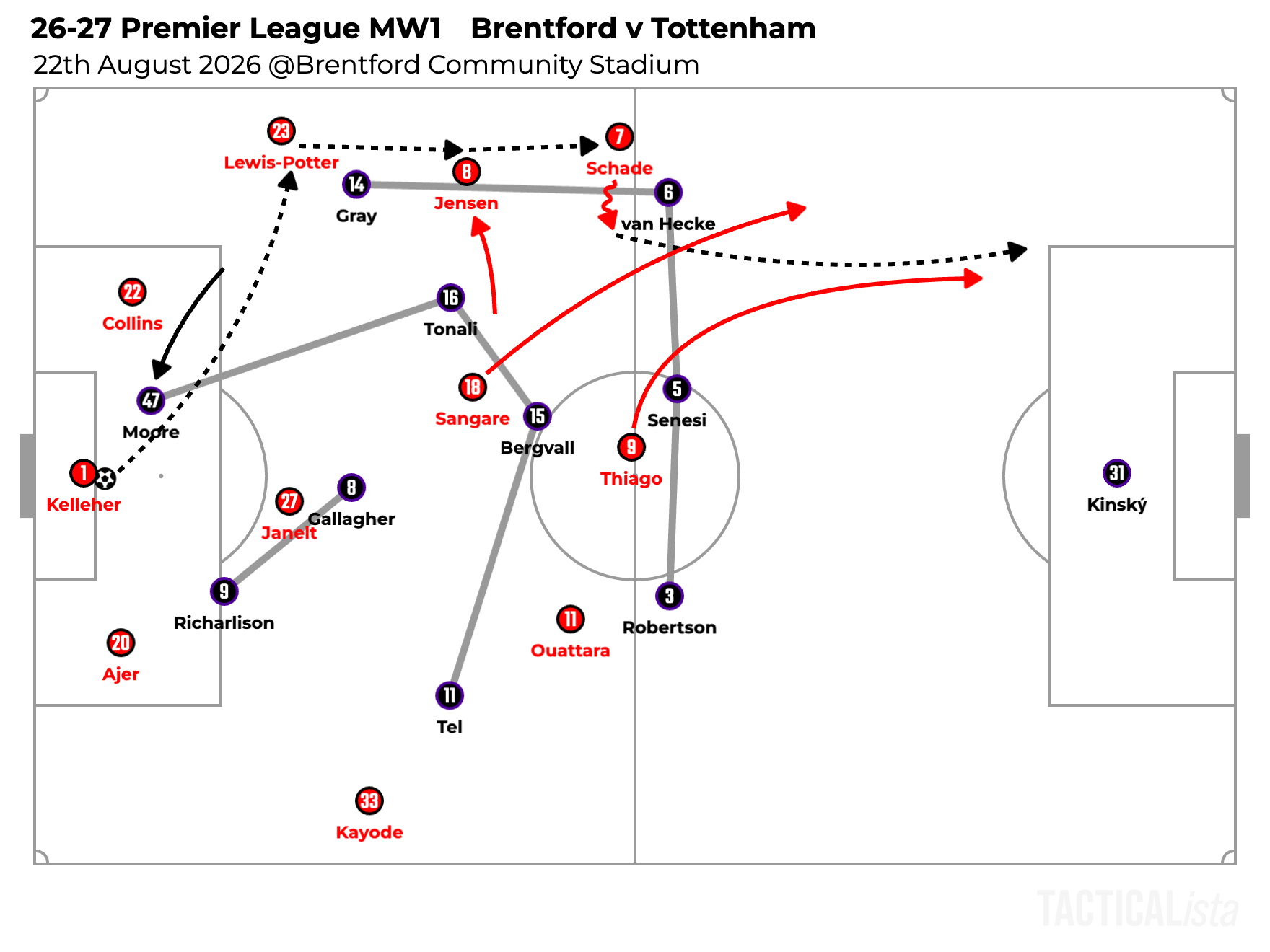
In the illustration above, the right winger Mikey Moore jumped to the opposition goalkeeper, but he managed to play to their left fullback, dragging Gray out and exploiting the space around van Hecke by making multiple runs there.
Another weakness stems from the tendency of man-oriented approach of the defensive midfielders. As it was already noted, one of the defensive midfielders, often Tonali, jumps to the opposition pivot and the other defensive midfielder, often Bentancur, stays deeper to mark the opposition number 10. And he even drops into the back line, to cover the other vulnerability, which is the space around the right centre back.
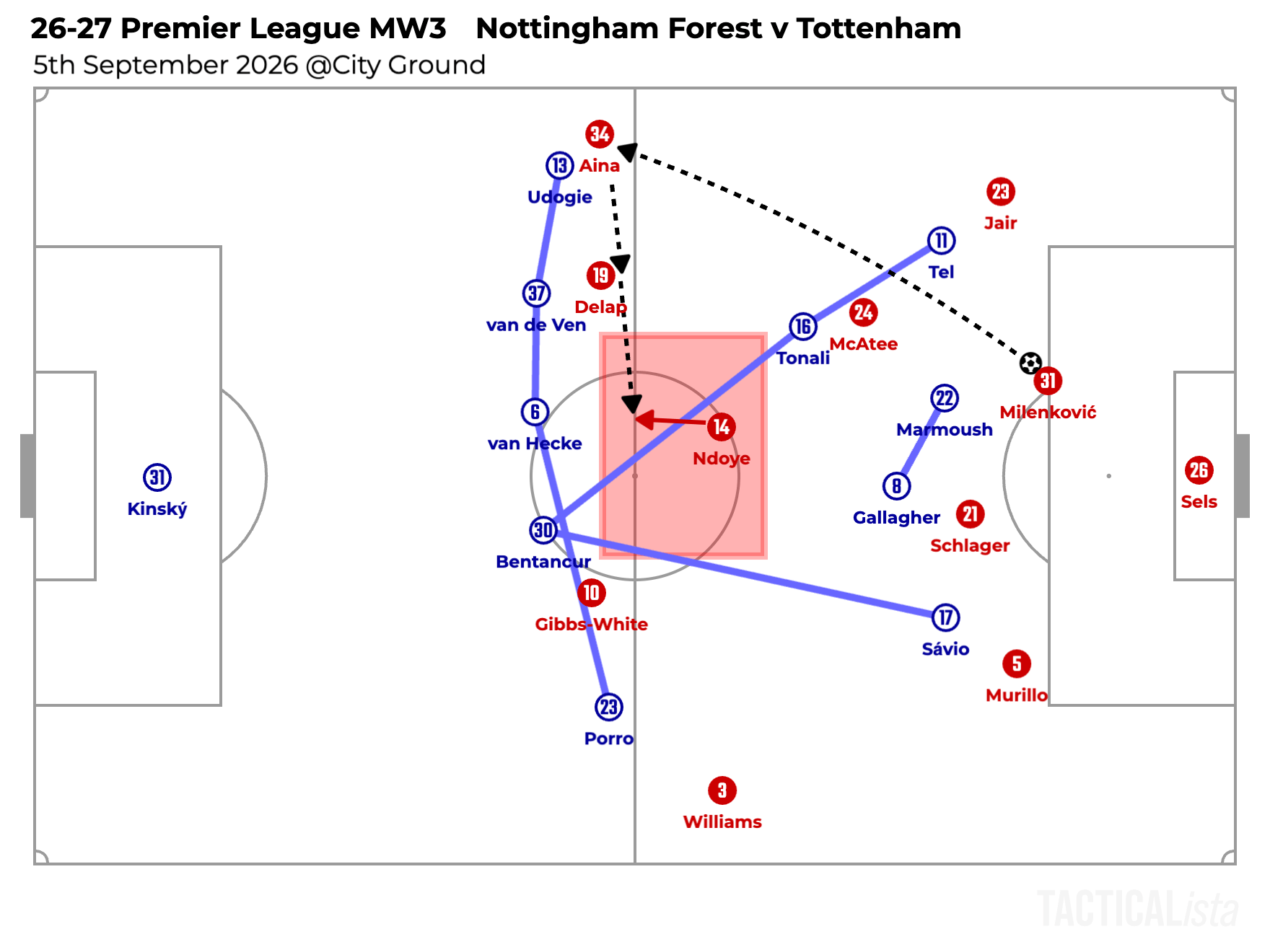
The illustration above shows the instance that they successfully forced them to play long but failed to regain the second ball. Tonali and Bentancur were far away and nobody was there to win the second ball. And this problem still appears when they need to organise a compact defensive block.
Defensive Block
This is exactly the same as we saw above. The positions of Tonali and Bentancur were opposite, but the cause of the problem is the same.
The defensive midfielder covering the channel is very common especially in the defensive third. This is because the goal is in the middle, so some coaches don’t want the centre backs to leave their position. In this case, the ball side defensive midfielder needs to cover the channel, but for them, they sometimes fail to defend there properly.
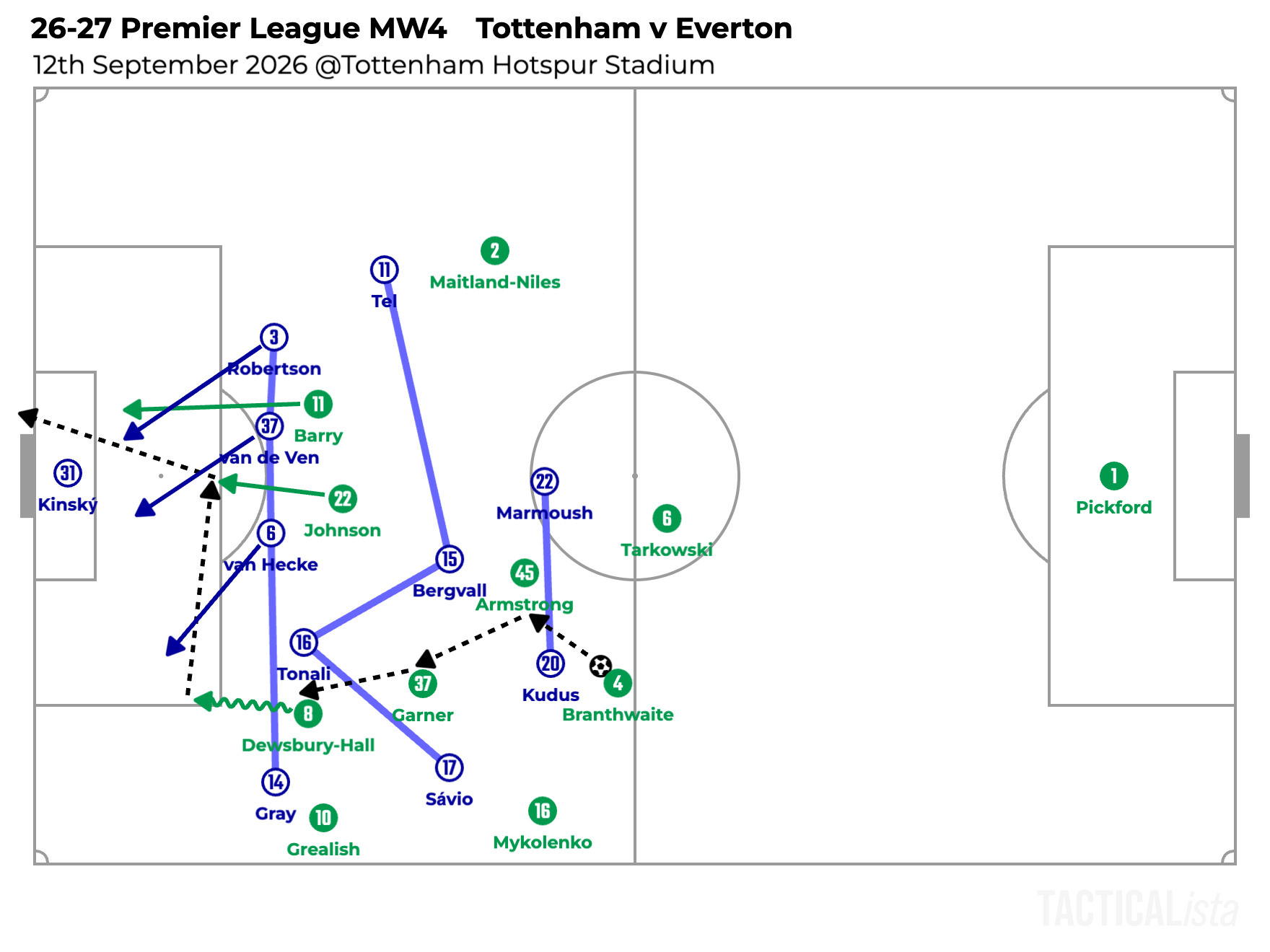
Here, Lucas Bergvall stepped higher to press on the opposition pivot and Tonali covered the right channel. However, the opposition managed to break through there and eventually van Hecke left his position but couldn’t block the cross. At the end, no defensive midfielders were there to protect the space in front of the defenders, letting Brennan Johnson take a free shot.
Overall, the right channel opened by the right fullback moving higher and the excessive amount of space the defensive midfielders have to cover has been something they need to improve. But after the international break, against United, De Zerbi decided to have the left winger and fullback position themselves higher, which is the opposite of what they did until the break. Additionally, In the next game against Coventry, he deployed three centre backs at the same time, which can also strengthen the defence.
So things are changing from the beginning and this is the reason why they won’t stay in the relegation zone so long. What prevented Tottenham from going higher in the last few years is the injury crisis, so as long as they can keep the players healthy, there’s no problem at all.