Mikel Arteta’s Arsenal Tactical Analysis 25-26
Mikel Arteta’s Arsenal Tactical Analysis 25-26
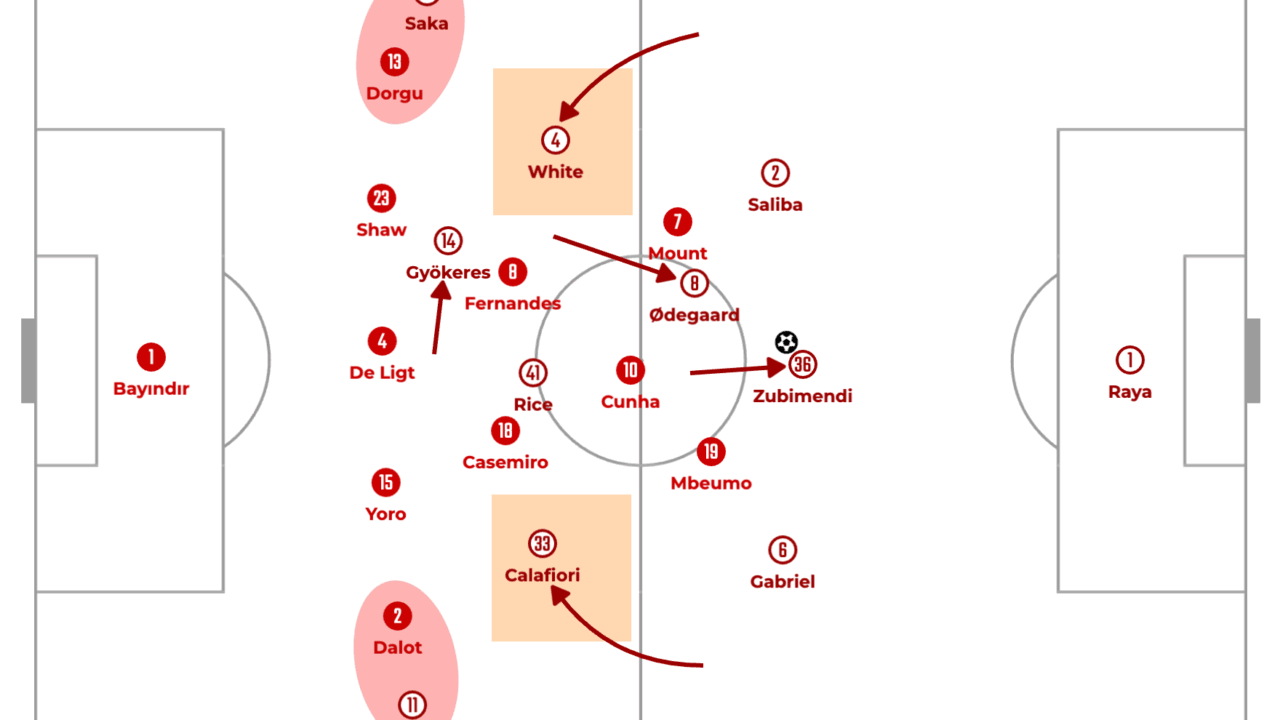
In this article, the tactics of Arsenal under Mikel Arteta in 25-26 is going to be analysed. Needless to say, their biggest strength is set pieces, but in this article, mainly open play tactics are going to be discussed.
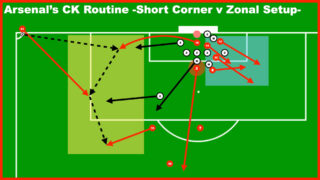
Instead, here’s the analysis of Arsenal’s strategy of attacking corner kicks, which has generated many of their goals this season.
In Possession
Mikel Arteta, who has served as assistant coach of Pep Guardiola at Man City for a few years, has developed the possession based football with the positional approach for more than five years at Arsenal.
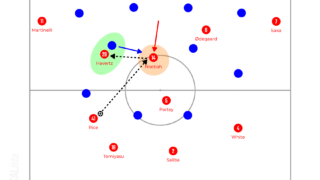
The modern games have become more and more difficult to play out as most teams came to press with man-to-man approach.
However, Arteta’s side can balance the styles as they are willing to play long and also able to beat the opposition pressing easily when they fail to apply pressure properly, thanks to the positional structure and individual qualities.
Against the deep defensive block, the players are encouraged to rotate their positions based on the positional principles especially in wide areas, triggered by the midfielders dropping off. This is one of their key tactics to retain the ball in the final third and create gaps in the opposition defence.
Let’s have a look at each phase of play, starting from the analysis of build up from the back.
Build up
As it was already mentioned, Arteta’s Arsenal has emphasised to build the game from the back, although it is not only Arsenal who has tried to do it in this decade. Additionally, as the idea of positional play has spread worldwide, the same structure can be seen everywhere. Arsenal are not the exception.
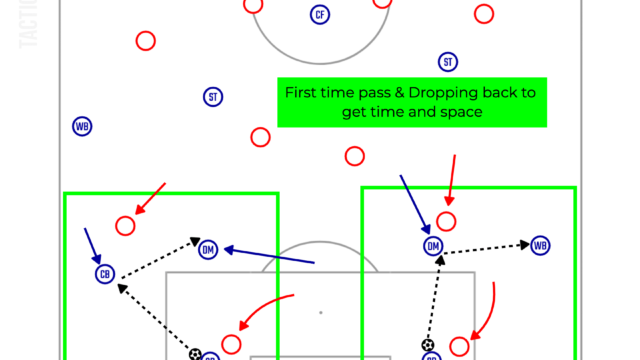
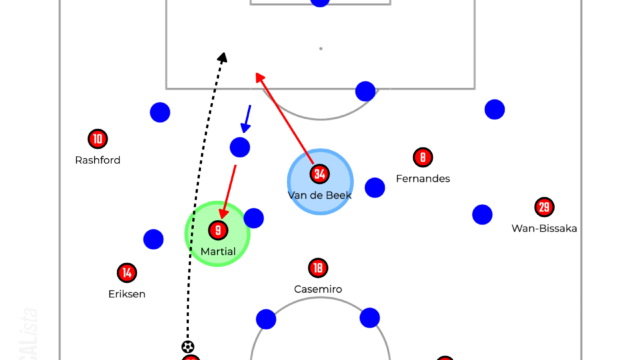
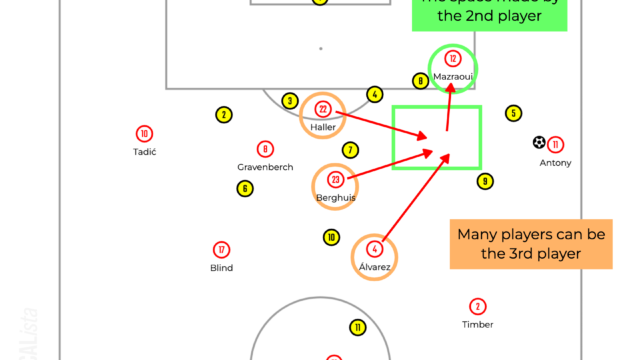
When the opposition presses high all the way to Arsenal’s goalkeeper, they try to find the defensive midfielder dropping to receive the ball as the third man. The objective here is to play the ball to the centre back who is left by the opposition striker who applies pressure on the goalkeeper.
As it is illustrated below, João Pedro was curving his run to press David Raya on the ball while screening the passing lane to Cristhian Mosquera. Thanks to Declan Rice, however, Arsenal could bypass his press and give the ball to Mosquera in space large enough to carry it forward.
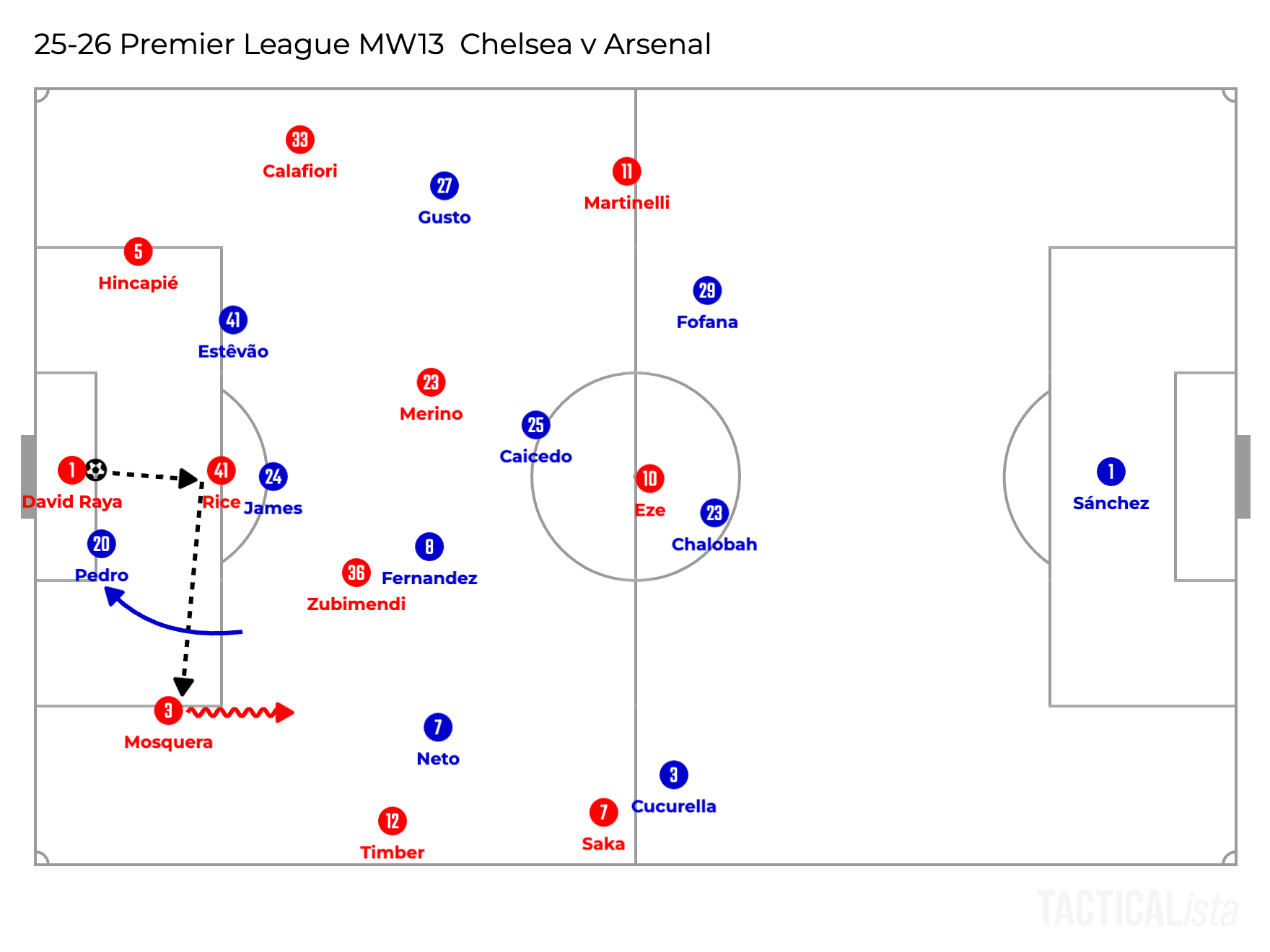
This is happening everywhere, but what makes Arsenal more secure is the rotation between Rice and Martín Zubimendi.
Zubimendi is often positioned deeper than Rice and plays like a single pivot, so when the defending team tries to press high, he will be primarily targeted and marked tightly. Therefore, in order to offer an alternative passing lane for Raya to find the spare centre back, Rice often drops to be another option in the middle.
This is also beneficial to reduce the risk of losing the ball in the dangerous area. If someone tries to receive the ball when standing still, it becomes easier for the opponent to tackle him from his back or even intercept the pass from the goalkeeper. However, like Rice, the way of receiving the pass while dropping back can keep the distance from the marker, which makes it safer to repeat this pattern.
Then, what if the opposition team can tightly mark both Rice and Zubimendi?
The answer is creating and finding options in between the lines.
Another midfielder, Martin Ødegaard often drops deep if necessary to provide another option in the build up. However, as he is often absent this season due to injuries, the left winger Leandro Trossard has become one of the most important players when playing out from the back. The illustration below shows how he helps the build up play from the back.
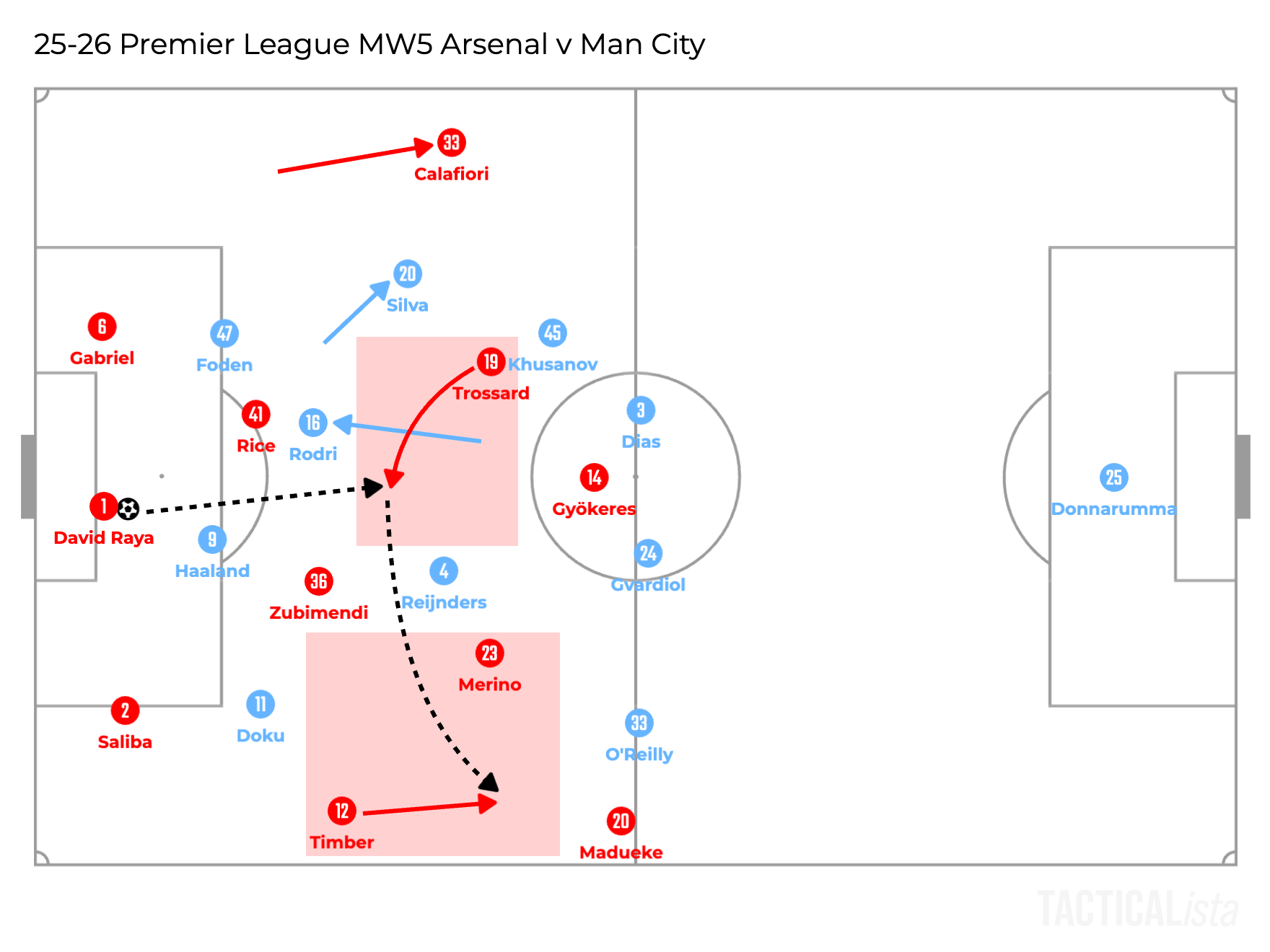
Here, Man City pressed high with Rodri jumping to Rice, leaving the space in between the lines. As soon as Trossard saw it, he drifted inside to utilise the space and received the pass from Raya, switching the play to the opposite side.
This type of winger is crucial to build the game securely under high pressure, which Jack Grealish had excelled the most in Man City’s treble winning campaign.
Even with this solid structure of the build up, when the opposition presses man-to-man, trying to play short is difficult and dangerous. Instead, playing directly in behind can be safer and even more effective.
This situation is also taken into account. The illustration below shows Bayern’s aggressive man-to-man pressing and how Arteta’s side tried to beat it.
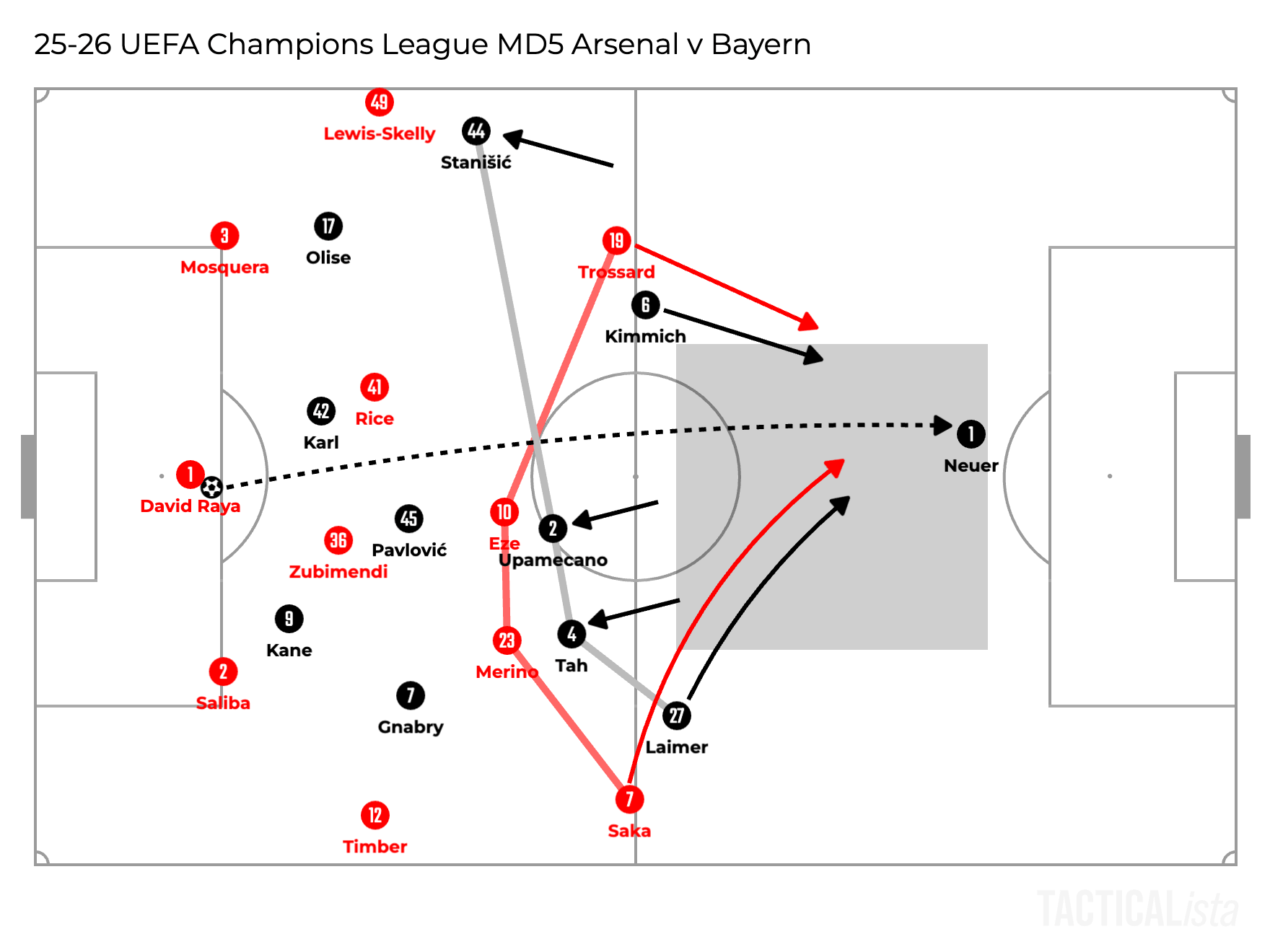
As each Bayern’s defenders followed their man to mark with accepting to leave the last line exposed, it was possible for Arteta’s side to manipulate them to create space. The front two, Eberechi Eze and Mikel Merino dropped deep to drag both centre backs out of their positions, and both wingers made their runs in behind diagonally to exploit the space in behind.
It is not always this pattern though, sometimes Rice made deep runs in behind as soon as Raya launched the ball or Kai Havertz stayed high to be the target of the long ball from Raya. But the idea of playing over the man-to-man pressing to directly exploit the space in behind is the same. Arsenal have various solutions to play out from the back, which makes it difficult for the opponents to press against them.
Possession in the Middle Third
In the midfield, first of all, they can stabilise the possession with the centre backs and the defensive midfielders. There are no fixed positions for the midfielders so that they can drop into the last line, drift outside or even step higher. They recognise the opposition pressing, find space and keep the passing lanes dynamically.
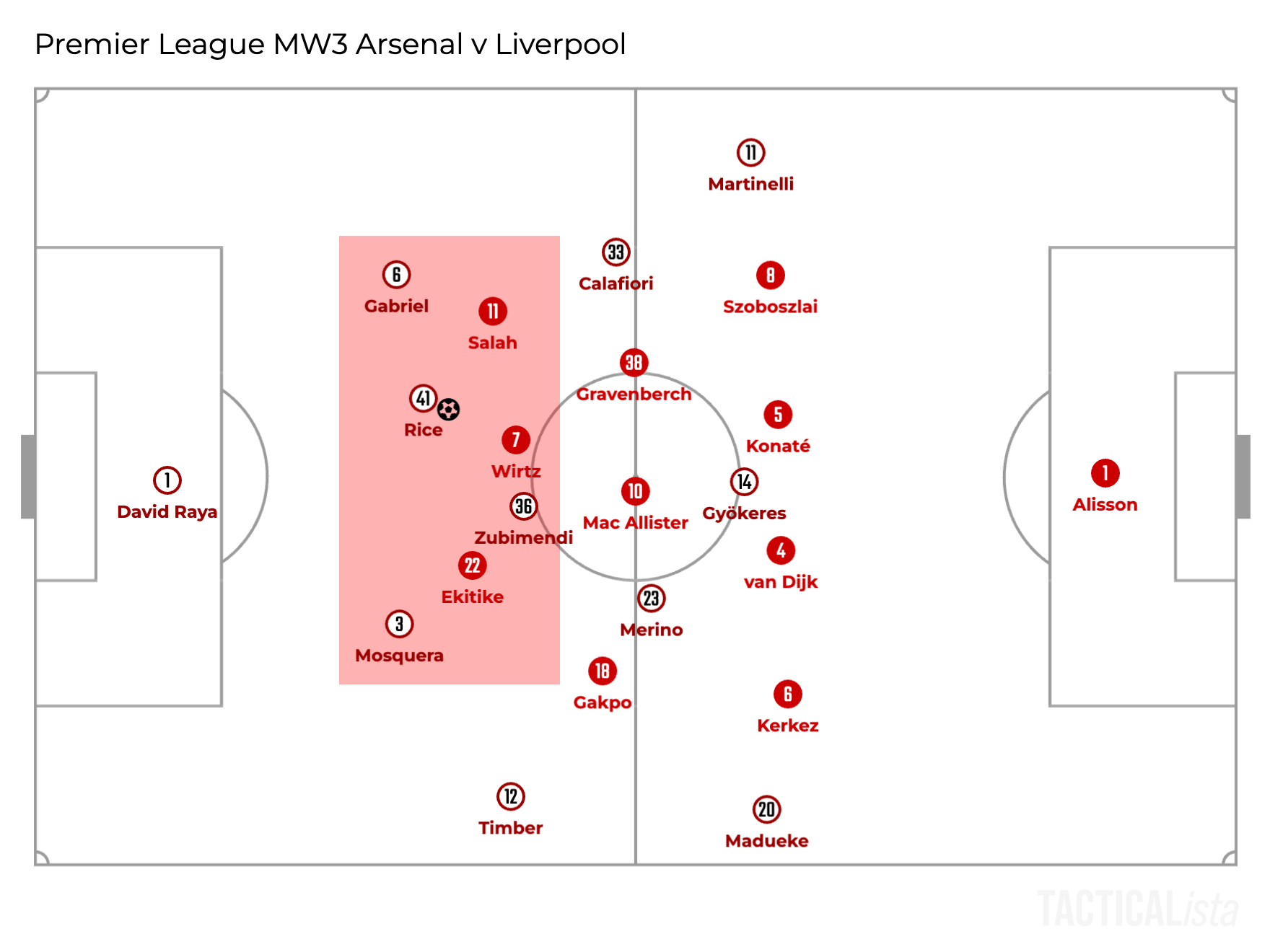
As the defensive midfielders drop into the back line to create an overload against the opposition first pressing line, the opposition midfielders need to decide if they follow or leave them. If they don’t follow, Arsenal are able to keep the ball comfortably. On the other hand, if they commit, the space between the lines will open up.
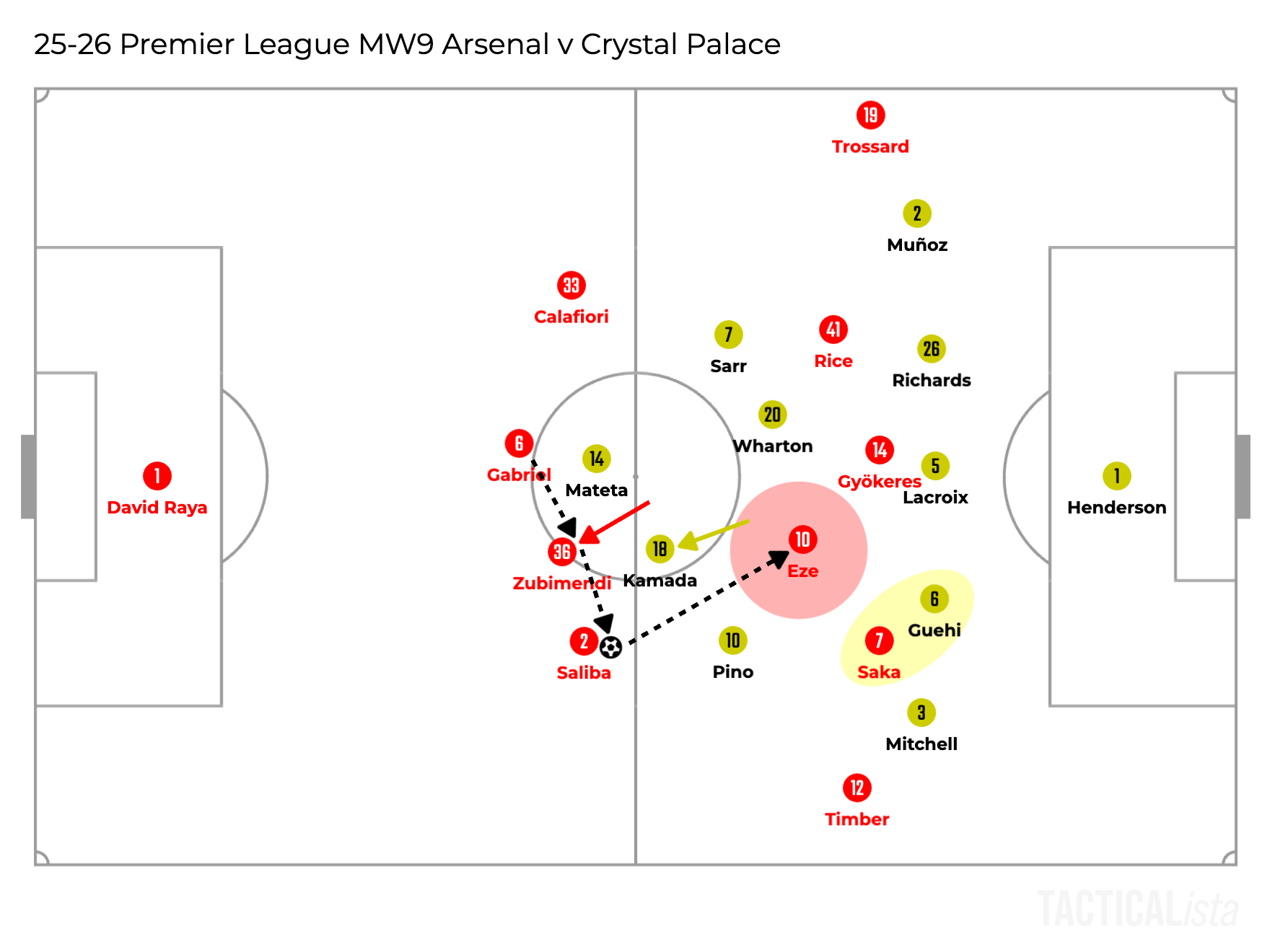
In the illustration above, Zubimendi dropped into the back line and the opposition defensive midfielder followed him, leaving space for Eze in between the lines.
It is not only the attacking midfielder who can receive this split pass in between the lines, but also Viktor Gyökeres sometimes drops there, even though this is not his best strength. Therefore, when Havertz plays as the striker, it becomes easier for Arsenal to find another option to play through, as he is comfortable with playing in the midfield.
While the centre backs and defensive midfielders keep the ball at the back, the fullbacks are allowed to move quite freely, trying to find the spaces where they can receive the passes which break the opposition midfield line. Therefore, it is not surprising to see them to position themselves in between the lines.
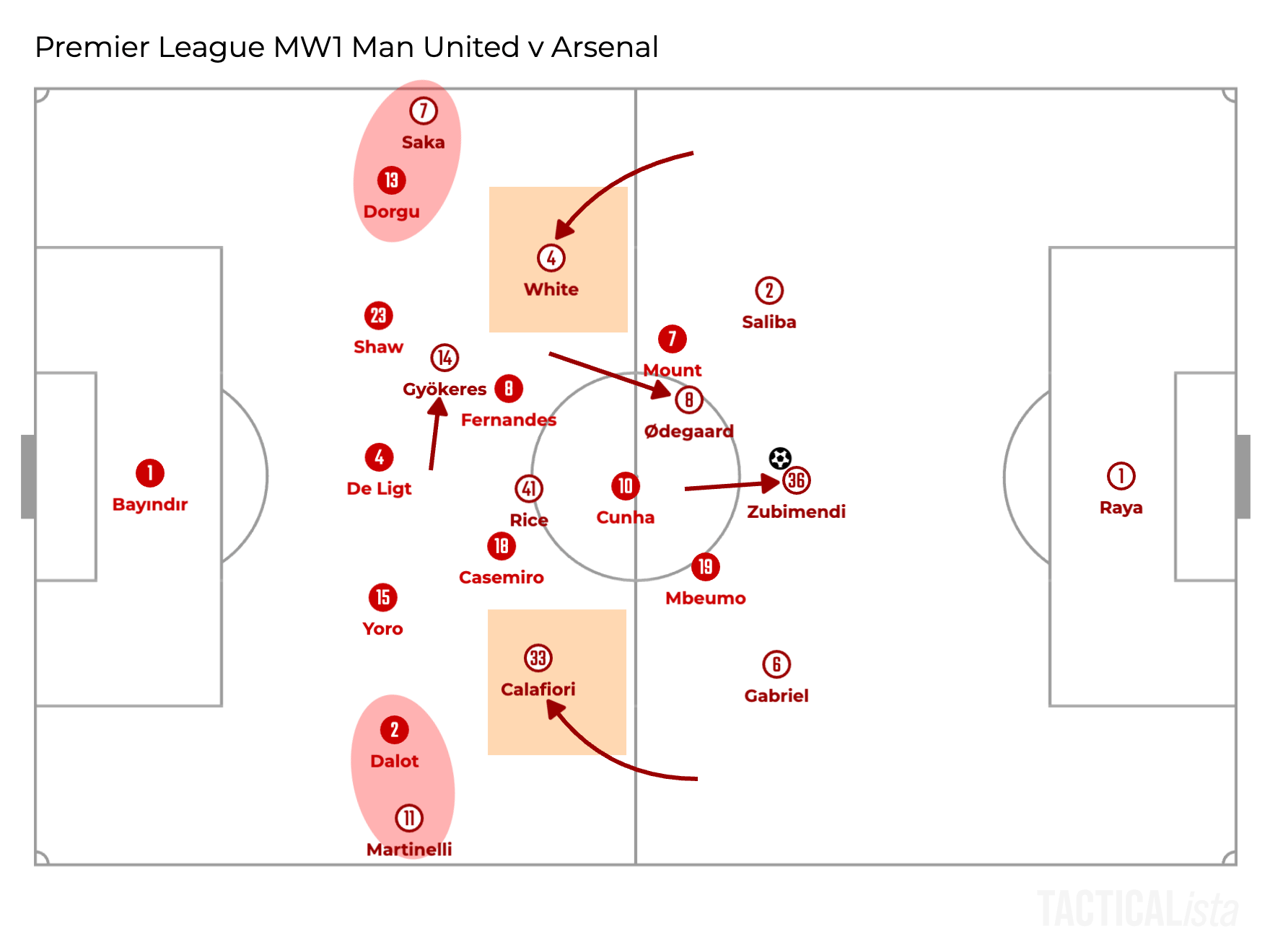
Like the example above, especially when the attacking midfielder drops off, the fullbacks often step up to fill the space between the lines.
There have been numerous combinations this season, but in recent games, the right fullback Jurrien Timber often moves diagonally into the right pocket while the left fullback Riccardo Calafiori or Piero Hincapié stays at the back line in the middle third of the pitch.
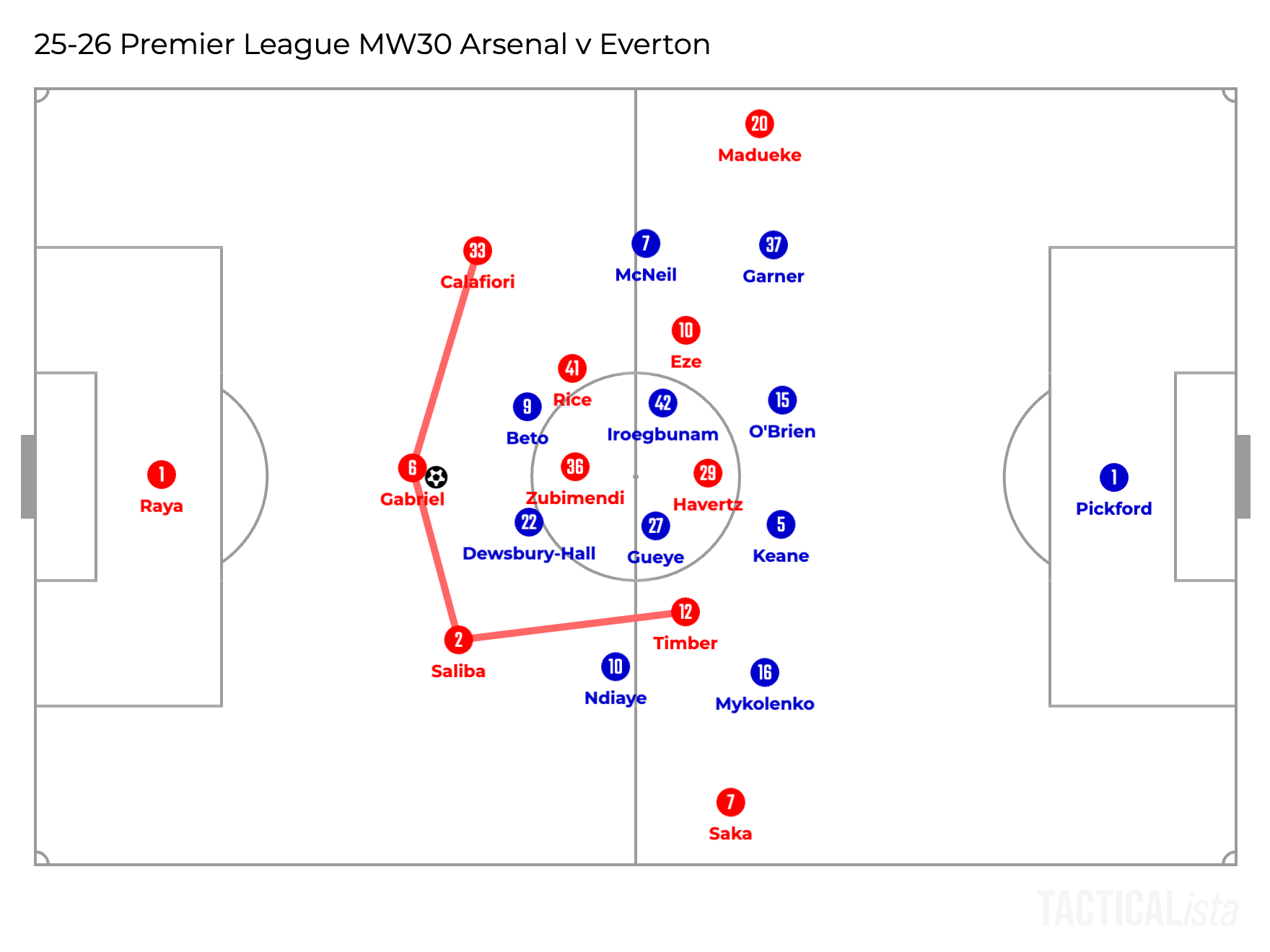
In the midfield, they build a solid, but flexible structure to maintain the ball and control the game. The reason why they can change their positions a lot but still maintain the structure as a team is the positional principles which Arteta has implemented to Arsenal for years.
Then, in the final third, he encourages more movements and rotations to break down the opposition defensive block, but yet based on the positional principles.
Final Third Attacking
For the teams with a positional approach, the biggest threat often comes from the wingers. Those teams are willing to allow the opponents to sit deep and close the middle, so they often play around it and the destination is the wingers who can take on the opposition fullback. There is one of the most famous quotes about positional play, which is “Overload one side to create and exploit a 1v1 on the opposite side”.
At Arsenal, it is often Bukayo Saka on the right or Noni Madueke on both sides. Gabriel Martinelli and Trossard are more off-the-ball players, compared with them.
Even though the ability to dribble and beat the defender in 1v1s is vital, to make the most of it, they often support the winger on the ball by overlapping him to make it a 2v1.
For example, when Saka is on the ball, the right fullback Timber or Ben White always overlaps him. This can generate two options against the opposition fullback, which are Saka cutting inside and playing through to the right fullback. Thanks to this support, the opposition fullback cannot fully commit to Saka, which allows him to more successfully dribble past the defender.
That was a very specific situation on wide areas, but as a whole, Arteta encourages the rotations to help the team to circulate the ball fluidly, which ultimately opens a gap in the defensive block.
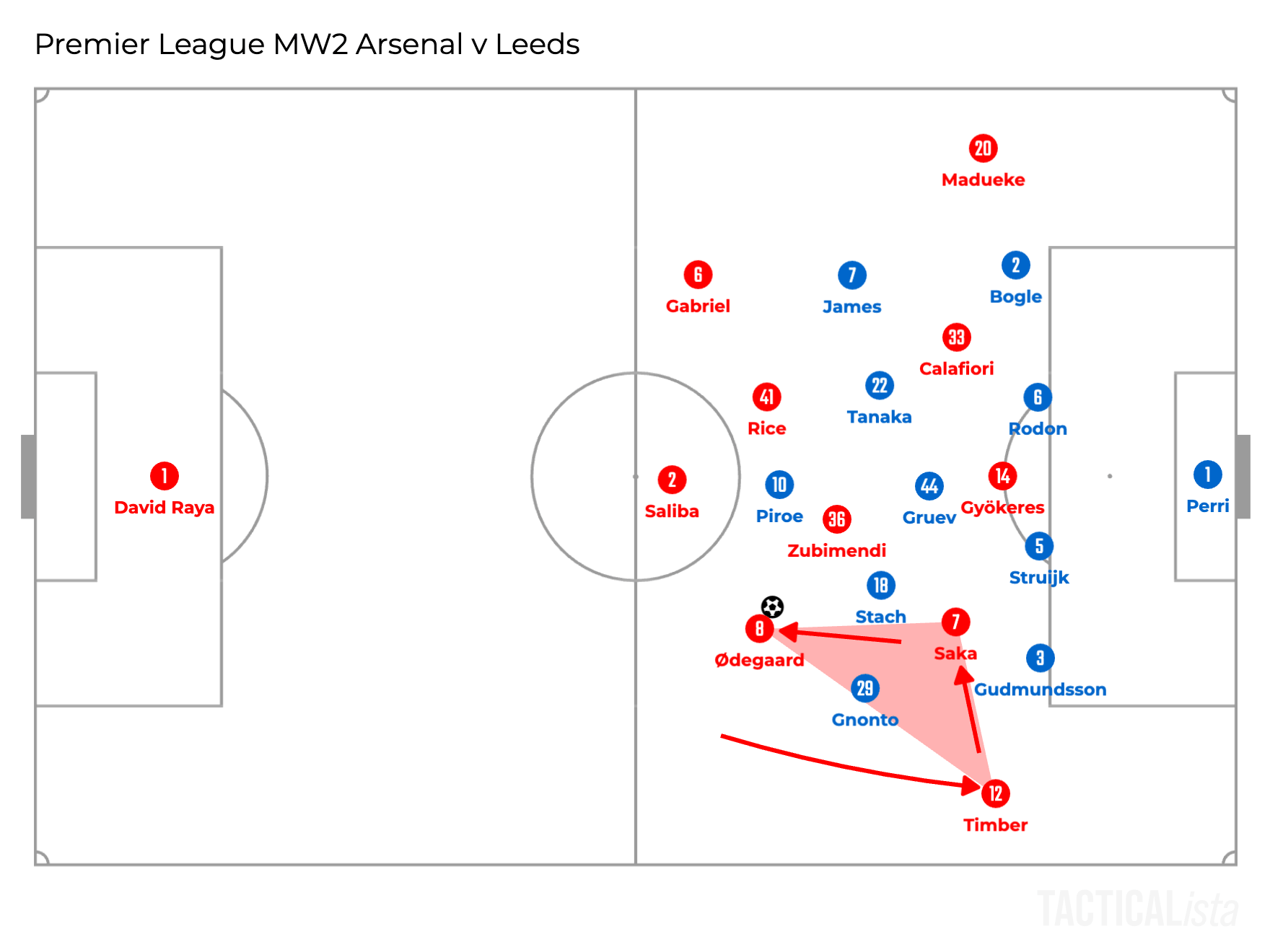
Especially on the right side, as Ødegaard prefers to drop there, the other players on the flank rotate to evenly occupy the space. The right winger Saka drifts inside while the right fullback Timber goes higher in the illustration above.
Another example is shown below, in which the right winger Saka stays outside and the right fullback Timber and the attacking midfielder Eze swaps each position.
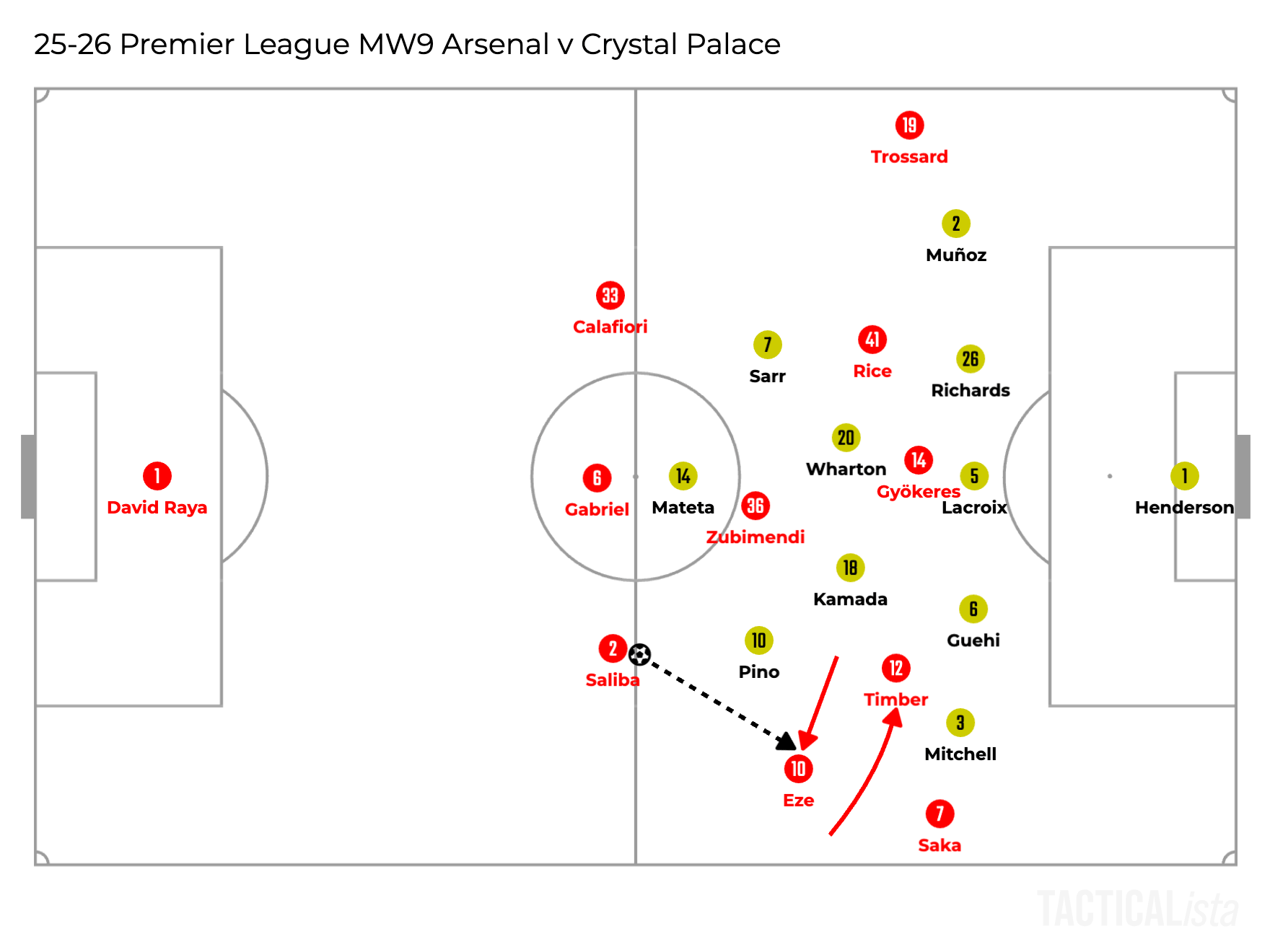
These rotations are effective to manipulate the defenders.
If the attackers just stand still, it is easy for them to manage, but these movements make it harder for them as they need to consistently make decisions to follow or leave them. This will eventually help them to receive the ball under less pressure.
However, when it comes to break the opposition defensive block and penetrate into the box, rather than circulating the ball, they need more dynamism to cause problems for the defenders, not the midfielders.
This requires the runs through the opposition back line. As it was already mentioned, the fullback overlapping the winger on the ball was one of them, which is often the relationship between Saka and Timber or White on the right. The attacking involvements by the fullbacks are vital on the left too.
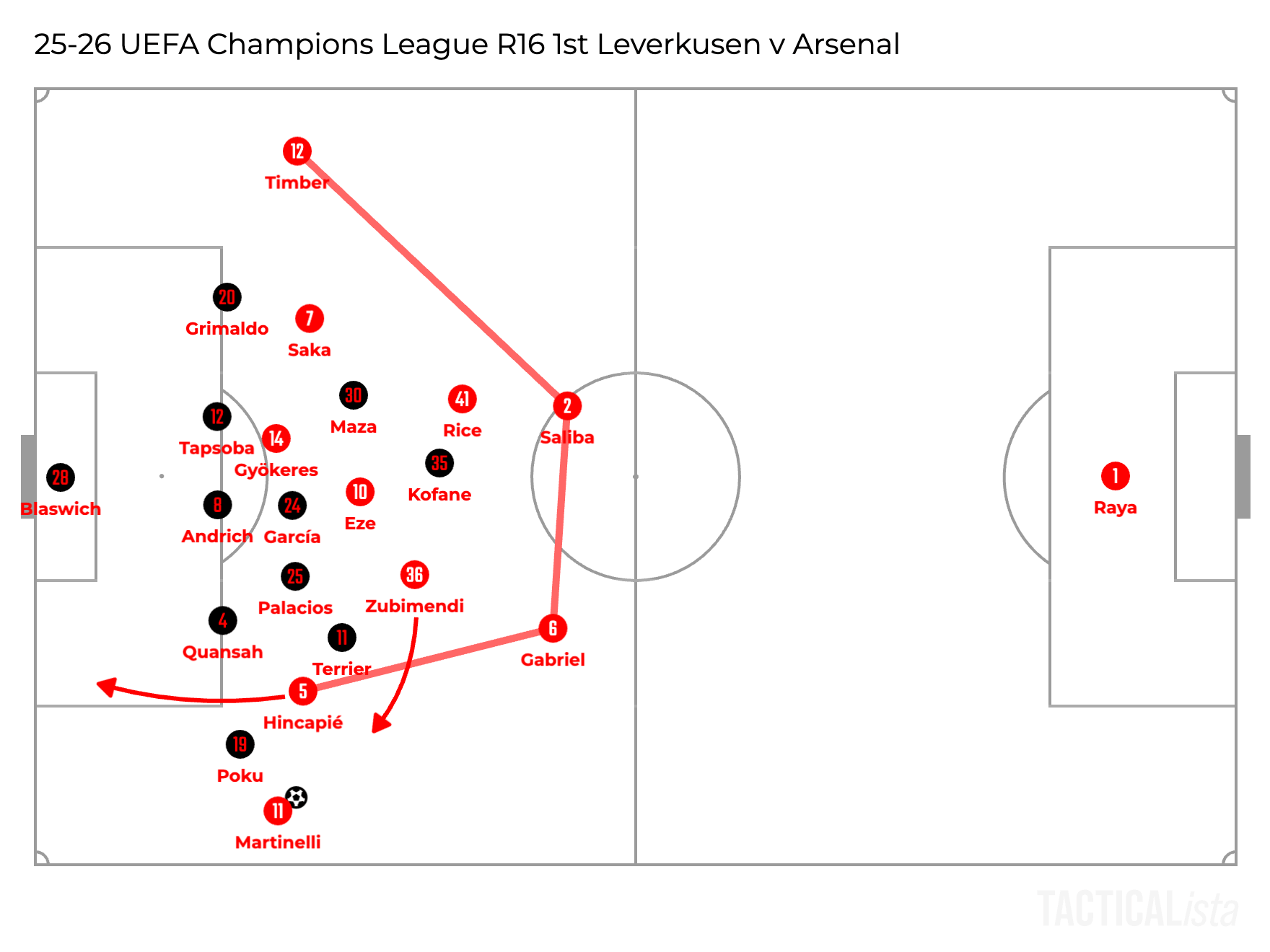
In recent games, Arteta often tilted the back line towards the right side, which the right fullback Timber played higher than the left fullback Calafiori or Hincapié. In the final third, however, the left fullback is allowed to join the attack by underlapping the winger on the ball. This deep run is difficult for the opponents to manage and a great way of taking risks in the final third.
Of course, this is a part of the rotation, so when the fullback makes a run into the box, the ball side midfielder provides another option to retain the possession and covers the space left by the fullback, as shown in the illustration above.
Overall, Arsenal are heavily influenced by positional principles in the final third, but it is a very dynamic one. They are not static, but move and rotate to break down the opposition defensive block while keeping the structure to recycle the possession at any time. At the end, the wingers are going to be the key, so very depending on their individual performance, but their organisation to lock the opposition defense in their defensive half can generate a lot of set pieces, which helps them scoring goals.
Probably, what they need more is individual consistent brilliance throughout the season.
This season, the striker Gyökeres only scored 11 so far (with 31 games), which is exactly half of Erling Haaland’s. And the second-highest scorers of Arsenal are Eze and Saka with just six goals. And last season, no Arsenal players scored more than 10 goals in the league, as the top scorer was Havertz with nine goals.
Liverpool had Mohamed Salah (29 goals), Luis Díaz (13 goals) and Cody Gakpo (10 goals) last season to win the league. Man City had Haaland (27 goals), Phil Foden (19 goals) and Julián Álvarez (11 goals) in 23-24 season and Haaland scored 36 goals in their treble-winning campaign.
Having various sources of goals (mostly thanks to set pieces) is not a bad thing, but to win something, you need to be lucky enough to have a few players who can massively overperform, especially if you are not the most dominant side yet.
Out of Possession
The great focus on the defensive side of the game is Arteta’s uniqueness and strength.
There are a few criticisms about his conservative approach, but the solidity in defense and high intensity as a team are necessary to win things in England and Europe. No team without them can win anything. The only thing that stops them from winning something is the quality in the final third attacking, which Arteta has tried to cover by focusing on set pieces.
Out of possession, the mentality is everything. Everyone can put 100% effort both in pressing and defending the goal. The striker sprints to dictate the pressing direction and everyone follows. The midfielders cover the larger space and are willing to drop into the last line when necessary and the attackers can come back all the way to the defensive third.
In addition to their high work rate, the area they can cover individually is so large and it helps them defend with a man-oriented approach and apply tight pressure.
Let’s analyse their high pressing first.
High Pressing
They are not a complete man-to-man team, so the basic idea is dictating the pressing direction to a certain side to create an overload on the ball side.
The pressing shape can be identified as a 4-D-2, in which the attacking midfielder steps up into the first line and the defensive midfielders are positioned vertically. Then, the striker presses on the goalkeeper with a curved run to force him to play to one side.
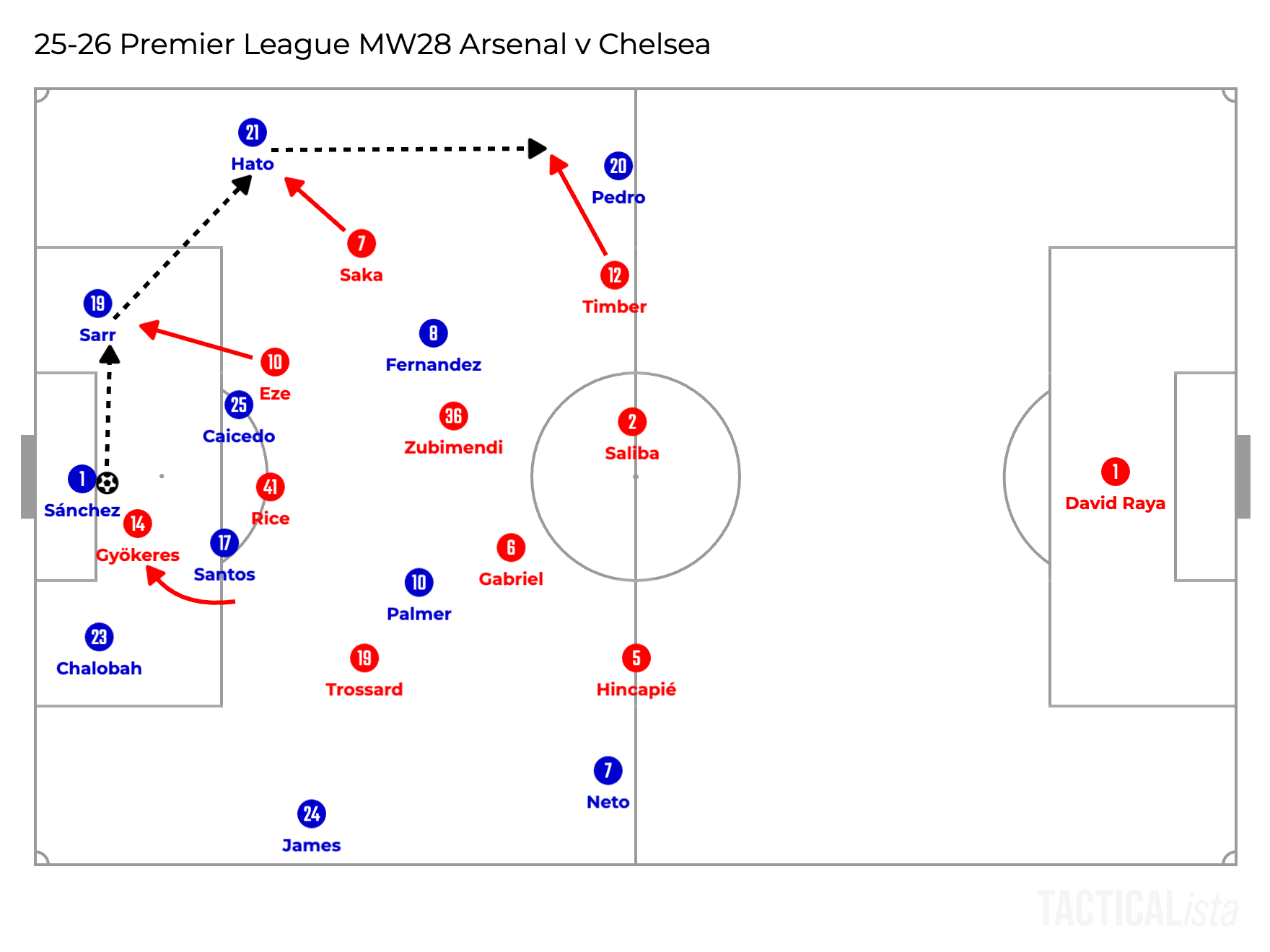
As it is illustrated above, Gyökeres applied pressure on the opposition goalkeeper by cutting the passing lane to the right centre back Trevoh Chalobah. At the same time, Eze and Rice were marking both defensive midfielders, so Robert Sánchez could only play to the left centre back Mamadou Sarr. As soon as the ball was played, Eze pressed to him while screening the passing lane to Moisés Caicedo to force him to play outside, where Arsenal intended to lock in.
By dictating the direction, Arsenal could successfully force Chelsea to play their right side while maintaining the spare defender at the back in this scenario.
The obvious advantage of this pressing is that they can reduce the risk of exposing the back line, but in return, this requires a high level of tactical understanding.
Especially the front two need to manage the numerical disadvantage, so this approach won’t work without intelligent attackers.
Although they are not a complete man-to-man team, they are heavily man-oriented. Therefore, in some games, they seemed to press fully man-to-man to disrupt the opposition build up play.
The illustration below shows how much they dedicated to man-to-man pressing against Bayern München in the Champions League.
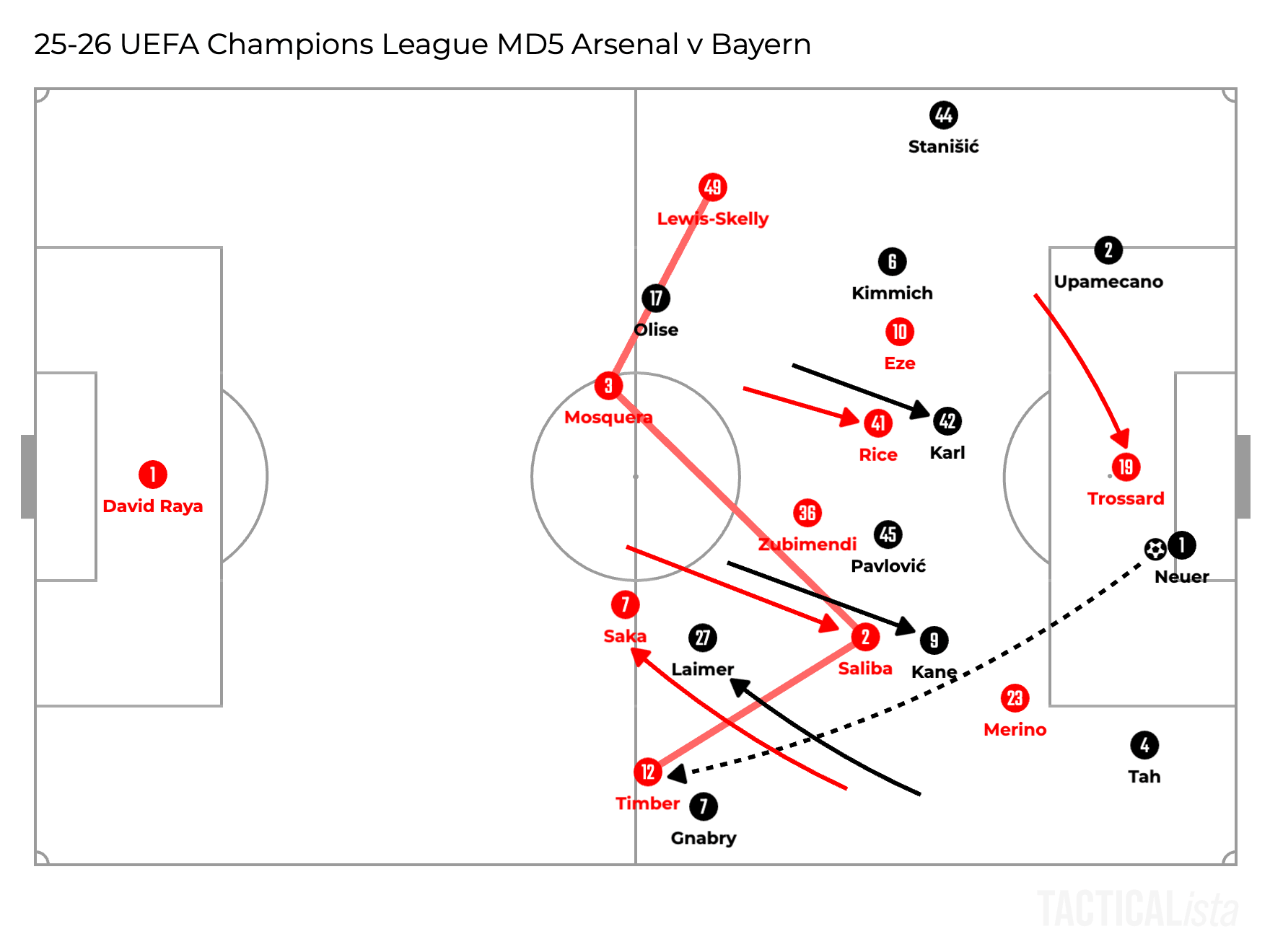
Trossard applied pressure on the opposition goalkeeper by screening the passing lane to the centre back, but on their right side, Bayern utilised a very dynamic rotation to manipulate Arsenal’s defenders. The striker Harry Kane dropped deep while the left fullback Konrad Laimer went high. Against this rotation, William Saliba followed Kane all the way and Saka kept marking Laimer even until he dropped into the back line.
This was a quite extreme example, but these two instances show how they press with a mixed, yet man-oriented approach.
Middle Pressing
In the midfield, they turn into the compact 4-4-2 defensive block.
However, this doesn’t mean they stay on each line, rather, they often leave their line to put pressure on the ball aggressively. What makes it possible is their individual mobility to cover a larger area.
The illustration below shows the scene where Lisandro Martínez played into Bruno Fernandes in between the lines and Saliba stepped out to apply pressure on him from his back.
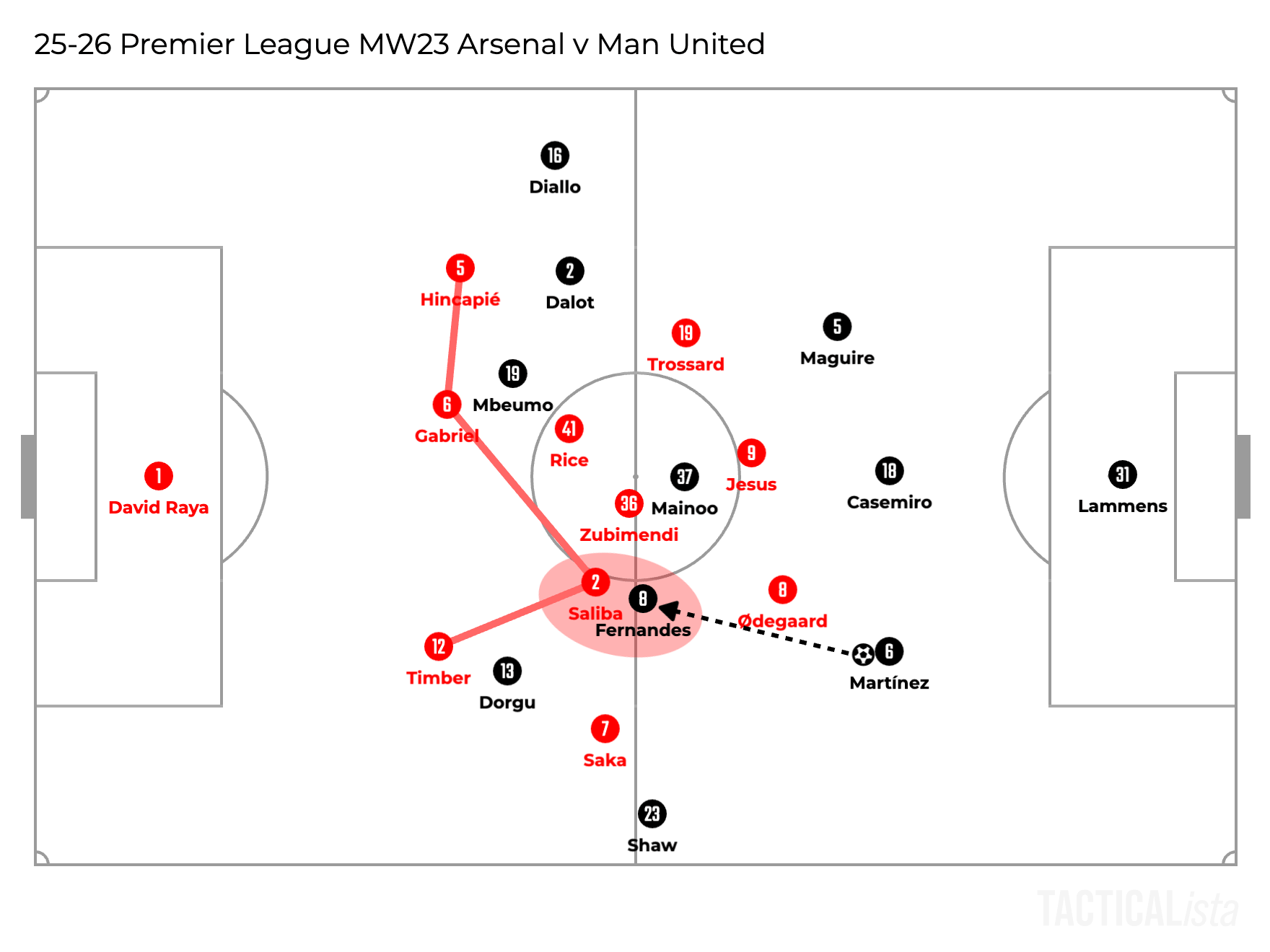
Just defending as a line can close the space well, but it is not enough to completely prevent the opposition from exploiting the space there. Some technical attackers can receive the ball there and turn to attack the last line of the defence. Therefore, like Saliba, it is important to apply pressure on the ball at the end, which ultimately reflects the intensity of pressing.
Additionally, this can help the team defend more front-footed. If the midfielders always need to care about the opponents behind their line, they cannot be as aggressive as Arsenal’s level. Thanks to this wider coverage of Saliba and Gabriel Magalhães, as a team, they can keep pushing forward from middle pressing.
And it is not only the centre backs who defend like this, but also the defensive midfielders often get closer to the opponents rather than sticking to stay on the line.
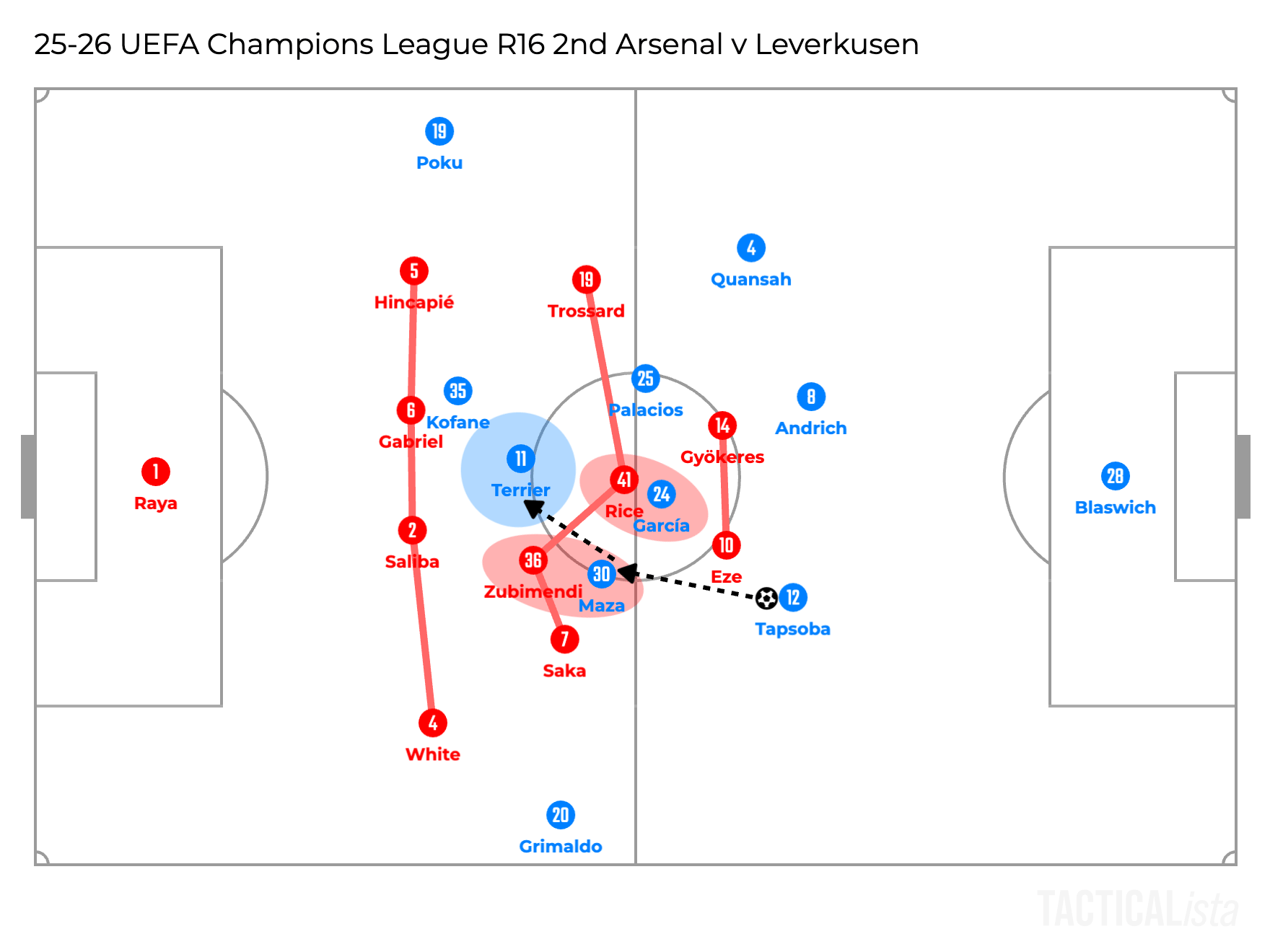
The principle is the same, they step up to catch the opposition defensive midfielders so that the front two can push up.
However, as it is shown above, it can end up opening the space between the lines. In other words, the opponents can manipulate these Arsenal midfielders.
Ideally, the opponent who received the ball there should be pressed immediately by either Gabriel or Saliba in this instance, but they had the man in front of him, preventing them from stepping up.
This is an inevitable potential risk if they want to press forward in this area of the pitch, but by maintaining their defensive block as compact as possible, they can at least reduce the space there, which most players will suffer to play.
To press front-footed, the wingers often step up to apply pressure especially on the wide centre backs of the back three. In this case, the fullbacks need to defend larger space.
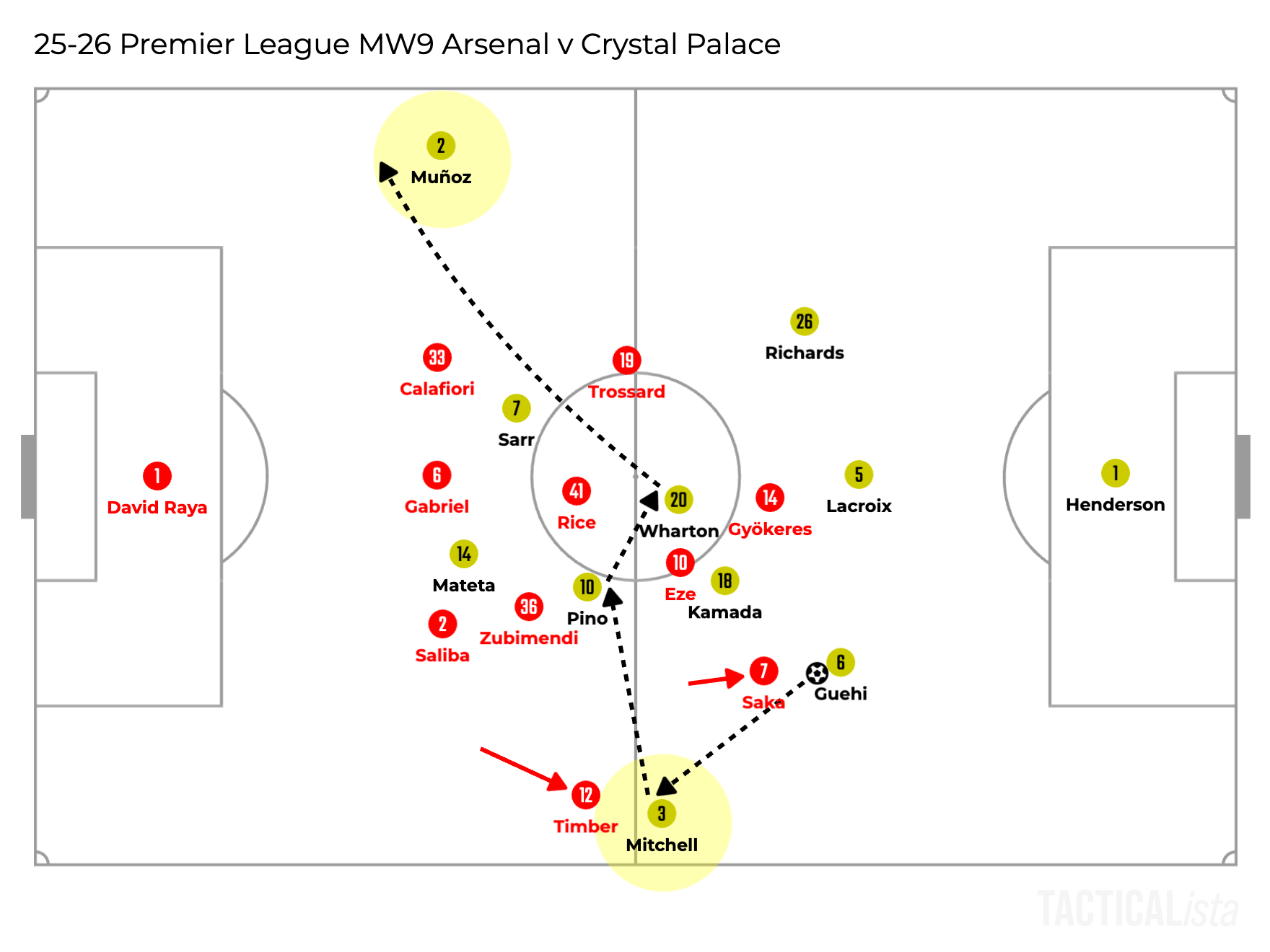
This is also a similar instance though, after the winger stepping up, whether the fullback can press on the opposition wingback on time is crucial. However, if he is late, as other defenders shuffle across the pitch, the opposition are able to switch to the opposite side.
Overall, the characteristic of Arsenal’s middle press is their front-footed behaviour with man-oriented approach, which is made possible by individual ability of covering larger space. On the other hand, however, the possible risk is being manipulated by the opposition or opening up the space by stepping up such as the defensive midfielder jumps to the opposition pivot or the winger presses on the opposition centre back.
Final Third Defending
In the final third, needless to say, their mentality or dedication to defend the goal is one of the best in the league and everyone comes back around the box to defend the goal at all costs. This time, how they defend crosses are going to be focused as they just conceded two goals from crosses against Man City in the Carabao Cup Final.
In line with their defensive approach in pressing, when defending crosses, they basically defend man-to-man in the box.
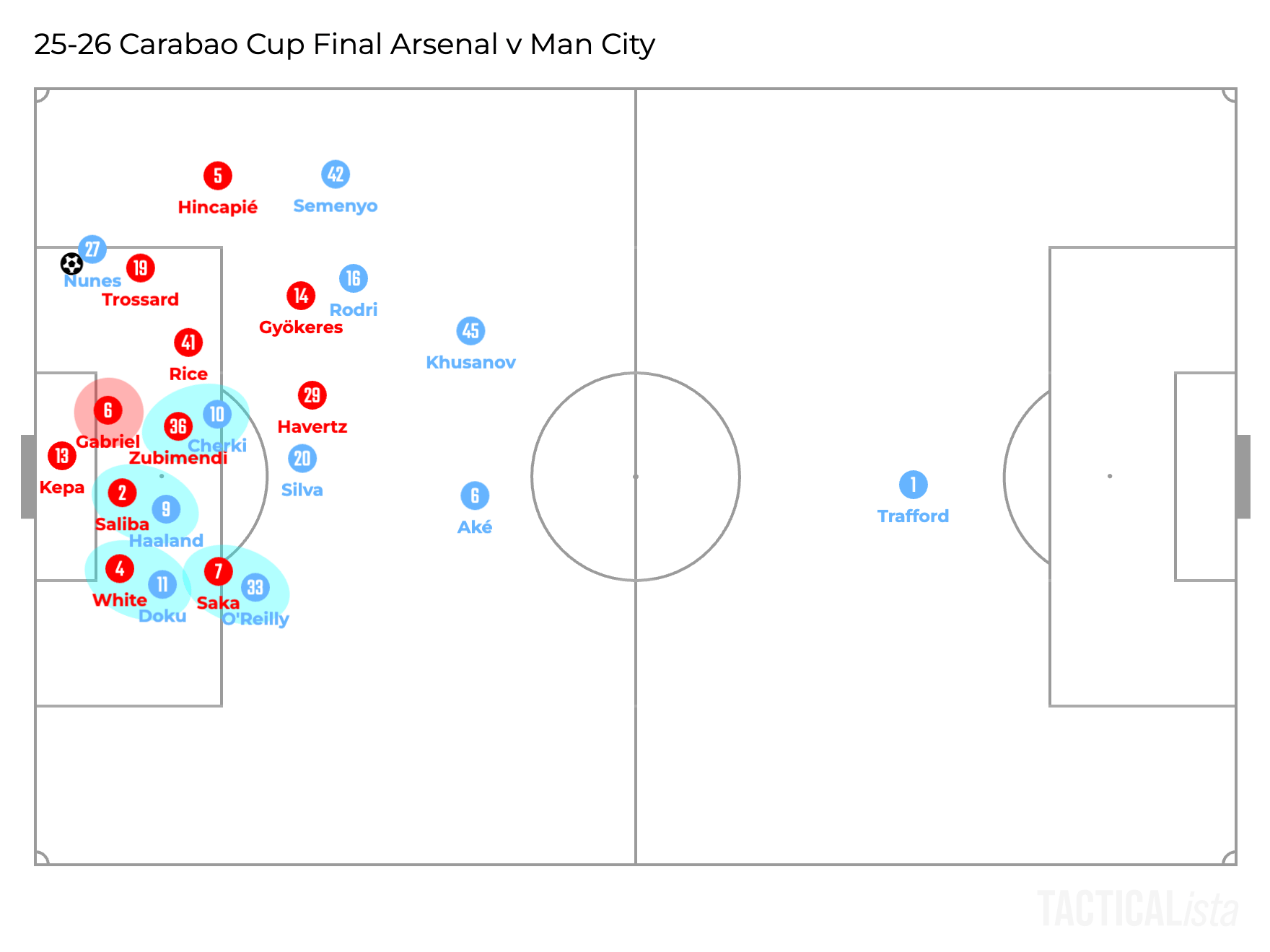
As it is categorised by colour, except for the ball side centre back who defends zonally, they man-mark the opposition attackers inside the box. Therefore, when the opponents move, they follow.
When they conceded goals against City, the problem was that the players who should’ve been there were not there.
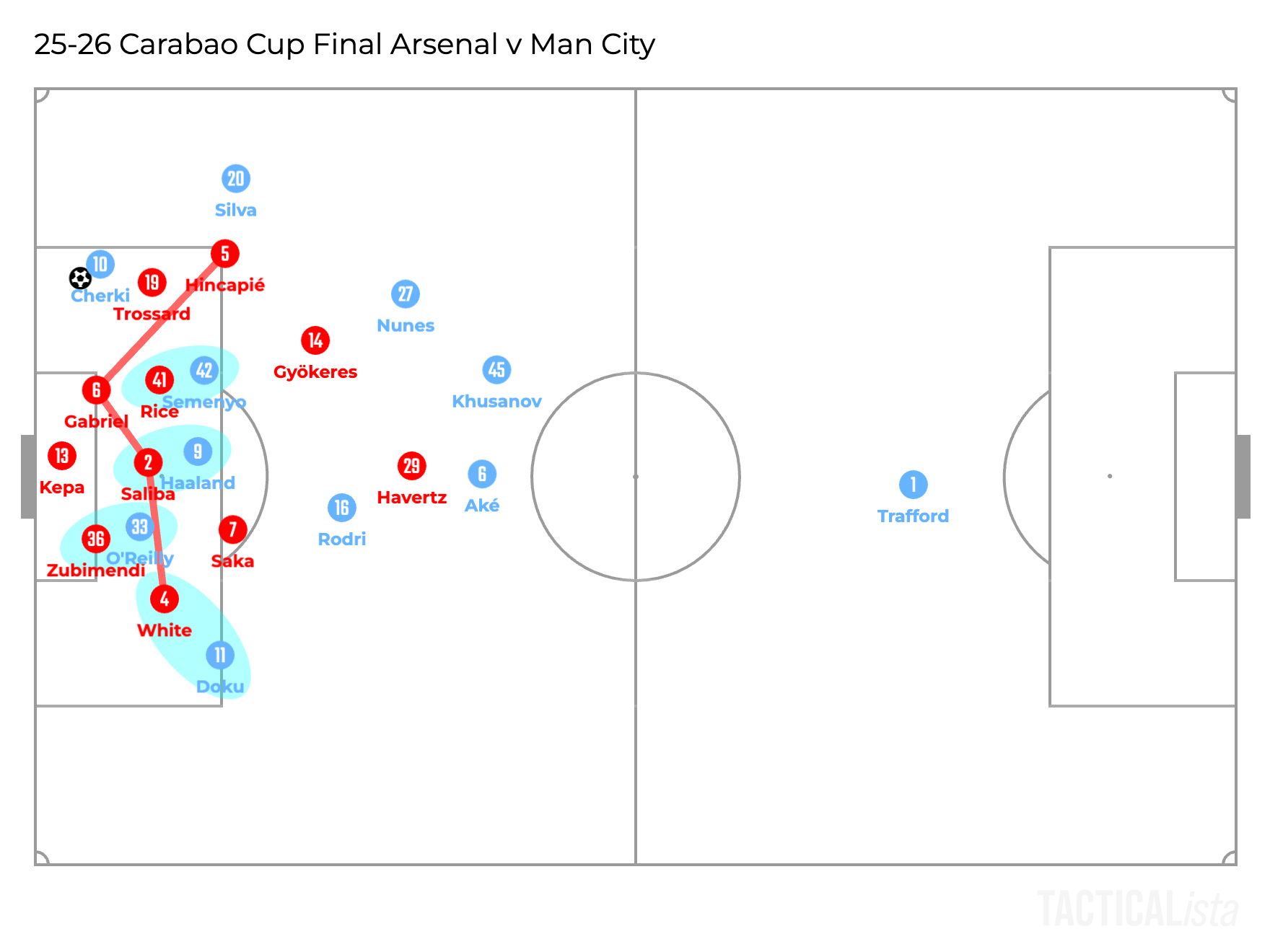
As they only focus on their markers inside the box, their positions depend on the opponents. Thus, in the illustration above, which replicates City’s first goal, Jérémy Doku stayed wide, so White didn’t tuck inside and it was Zubimendi who marked Nico O’Reilly in front of the goal, who eventually scored the goal. Additionally, Saliba was also moving away from the goal to get closer to Haaland to mark him, not to cover the space in front of the goal.
The second one was more collapsed.
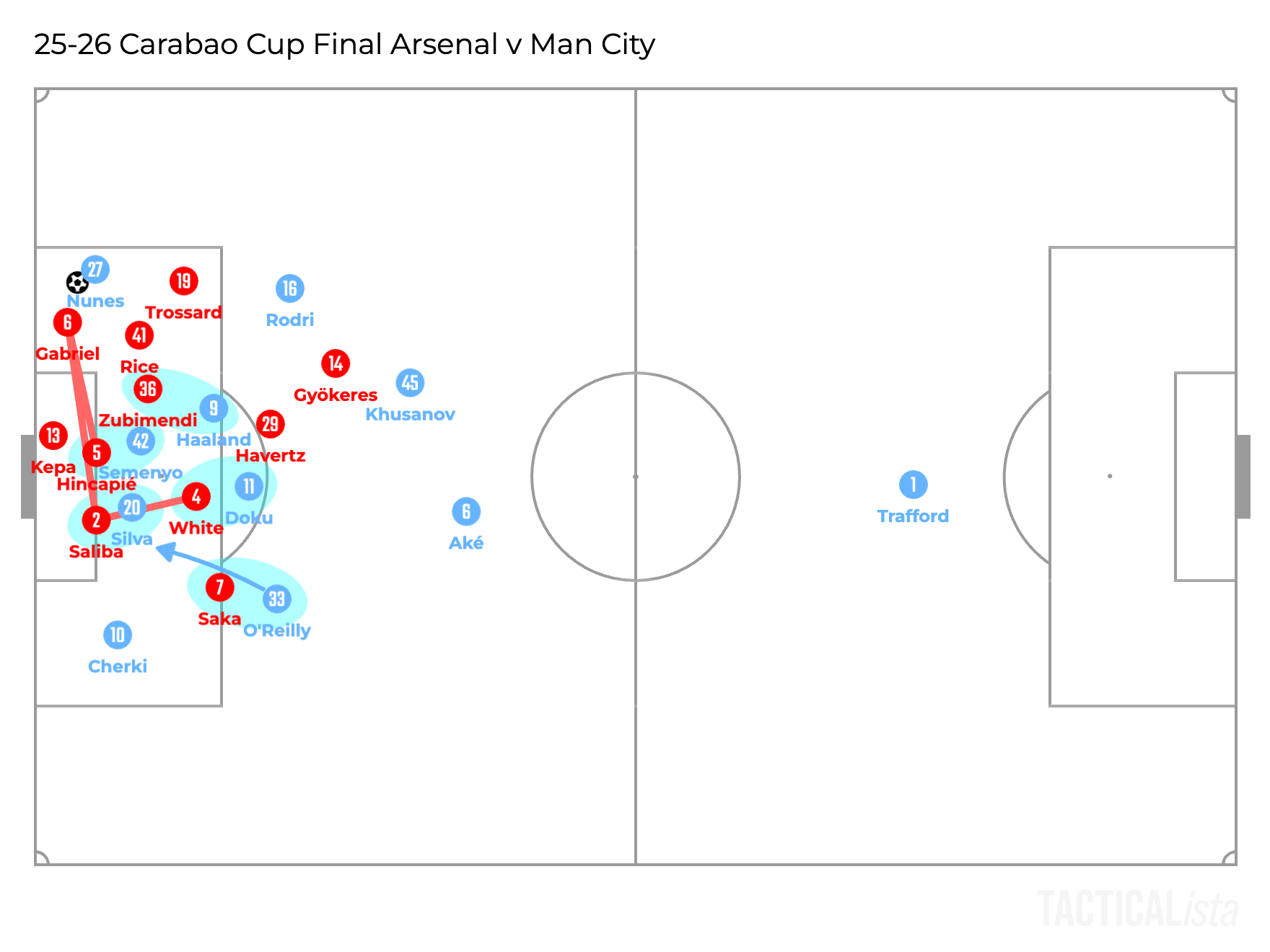
Doku cut inside and Semenyo made a diagonal run, which made the Arsenal’s back line disorganised. Gabriel was also dragged out, leaving no spare defenders in front of the goal. At the end, O’Reilly outran Saka and headed the ball freely.
In both scenarios, they couldn’t keep the solid centre backs in front of the goal and nobody could cover the individual errors from Kepa, Zubimendi and Saka.
Overall, this is not only limited to defending crosses though, Arsenal’s reliance on individual quality out of possession is the strength and also weakness. However, especially in pressing, they mix it well with tactical structure, and this is the reason why they kept challenging the titles for a couple of years unlike Liverpool under Arne Slot, who only rely on the individual with no tactical help.
Thanks for reading, I hope you enjoyed this article!